
Table of Contents
- Understanding EU Conflict Minerals & US Conflict Minerals Responsible Sourcing Regulations
- EU Conflict Minerals Regulation
- Reporting Requirements for EU Conflict Minerals Regulation
- Dodd-Frank Conflict Minerals Act Section 1502
- Reporting Requirements for the US Conflict Minerals Act
- OECD 5-Step Due Diligence Guidance
- Key Differences Between the EU Conflict Minerals Regulation and Section 1502 of the U.S. Dodd-Frank Conflict Minerals Act
- How Regilient Conflict Minerals Software can help companies comply with both the EU Conflict Minerals Regulation and Section 1502 of the U.S. Dodd-Frank Act.
- EU vs US Conflict Minerals Regulation: Frequently Asked Questions
- What is the main difference between the EU and US conflict minerals rules?
- Do both regulations require the same due diligence process?
- Is a company ever subject to both regimes at once?
- Are small-volume importers exempt from either regulation?
Last reviewed: 6 November 2026.
Understanding EU Conflict Minerals & US Conflict Minerals Responsible Sourcing Regulations
The EU Conflict Minerals Regulation and Section 1502 of the U.S. Dodd-Frank Act are both regulatory measures aimed at curbing the negative impact of conflict minerals mining. Conflict minerals, which include tin, tungsten, tantalum, and gold (3TG), are often sourced from areas riddled with human rights abuses, armed conflict, and governmental instability. The profits generated from mining these minerals usually fund the groups perpetuating these issues.
EU Conflict Minerals Regulation
The EU Conflict Minerals Regulation was enacted on January 1, 2021. The regulation applies to EU-based importers of 3TG sourced from conflict-affected and high-risk areas (CAHRAs). The regulation covers all imported 3TG, including processed metals, mineral ores, or concentrates. Upstream companies, including those involved with mines, smelters, refiners, etc., fall within the scope of the regulation. They must conduct due diligence and report on imported 3TG. Downstream companies that import or distribute end-user products containing 3TG or source finished components are currently exempt from the regulation. However, downstream companies are encouraged to report on their use of 3TG voluntarily.
Reporting Requirements for EU Conflict Minerals Regulation
Upstream companies are required to follow the Organization for Economic Cooperation and Development (OECD) Guidance, which has a 5-step framework for due diligence. Additional requirements for upstream companies include:
- Sharing supply chain data with downstream purchasers.
- Publicly reporting due diligence policies and practices.
- Publishing conflict minerals summary reports of annual third-party supply chain audits.
Reporting duties under both regimes typically flow through the same supplier-declaration process. Get the Conflict Minerals Reporting Guide for a practical walkthrough of CMRT data collection and smelter validation.
Dodd-Frank Conflict Minerals Act Section 1502
The U.S. Dodd-Frank legislation Act was enacted on July 21, 2010, with a specific Section 1502 focused on conflict minerals compliance. Section 1502 applies to publicly traded companies that manufacture products containing 3TG sourced from the Democratic Republic of the Congo (DRC) or any surrounding countries within the scope of the regulation and are required to submit a Specialized Disclosure - FORM SD along with their annual SEC filling
Reporting Requirements for the US Conflict Minerals Act
If 3TG is necessary for the functionality or production of a product, the product falls within the scope of Section 1502. This requires public companies to conduct due diligence by tracing the 3TG back to the utilized smelter to determine where the minerals originated.
Public companies are required to file a Conflict Minerals Report and must follow the due diligence process of a nationally or internationally recognized framework, such as the OECD Due Diligence Guidance. The due diligence process results in one of three determinations, each with its own set of requirements.
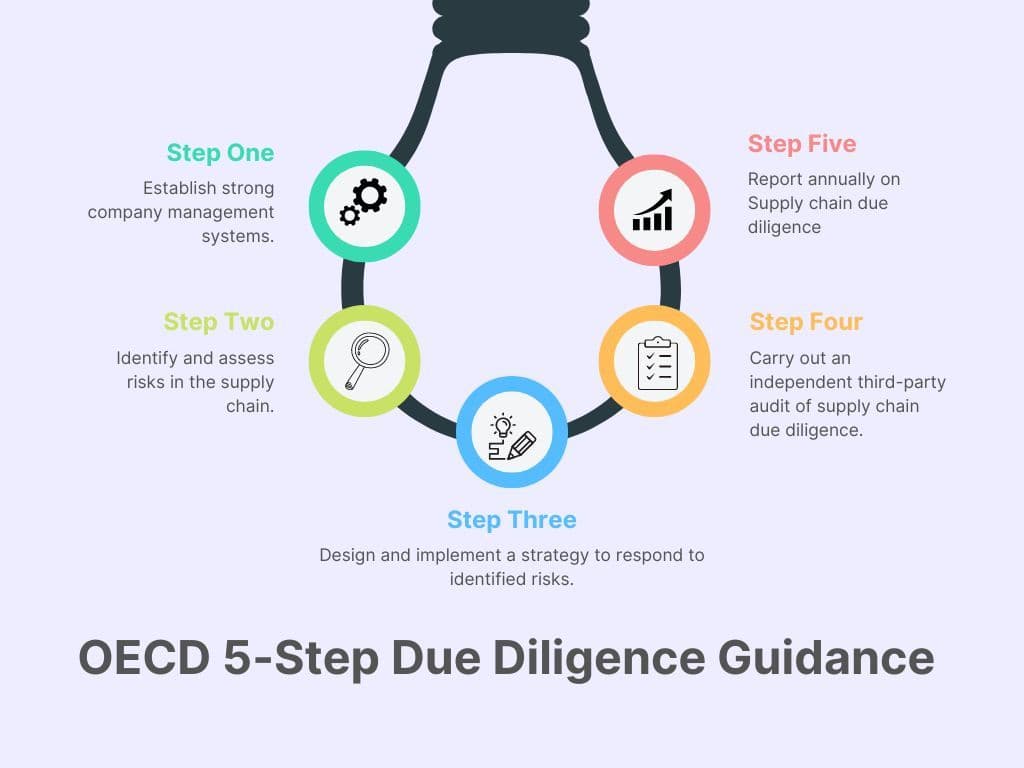
OECD 5-Step Due Diligence Guidance
- Step 1: Establish strong company management systems.
- Step 2: Identify and assess risks in the supply chain.
- Step 3: Design and implement a strategy to respond to identified risks.
- Step 4: Carry out an independent third-party audit of supply chain due diligence.
- Step 5: Report annually on Supply chain due diligence
Key Differences Between the EU Conflict Minerals Regulation and Section 1502 of the U.S. Dodd-Frank Conflict Minerals Act
Both regimes share the same underlying goal: reducing the financing of armed conflict through 3TG mineral trade. The practical compliance burden, however, differs in scope, covered entities and enforcement mechanics, summarised below.
Dimension | EU Conflict Minerals Regulation (2017/821) | US Dodd-Frank Act Section 1502 |
|---|---|---|
Geographic scope | 3TG sourced from any conflict-affected or high-risk area (CAHRA), not a fixed country list | 3TG linked to the Democratic Republic of Congo and adjoining countries |
Who is covered | EU-based importers of 3TG, plus smelters and refiners | US publicly traded companies that manufacture or contract to manufacture products where 3TG is necessary to function or production |
Due diligence standard | Must conform to the OECD Due Diligence Guidance for responsible supply chains | Does not itself prescribe a due diligence methodology, though companies commonly apply the same OECD guidance |
Small-volume exemption | Importers below annual volume thresholds set by Delegated Regulation (EU) 2020/1588 are exempt | No equivalent small-importer exemption |
Enforcement | Each EU member state designates its own competent authority, under European Commission oversight | SEC enforcement through the annual Form SD filing |
Primary sources: Regulation (EU) 2017/821 (EUR-Lex) and the SEC conflict minerals disclosure guidance. Volume thresholds and CAHRA designations are revised periodically, so confirm current figures before relying on them for a filing decision.
How Regilient Conflict Minerals Software can help companies comply with both the EU Conflict Minerals Regulation and Section 1502 of the U.S. Dodd-Frank Act.
Regilient Conflict Minerals Compliance Solution can help companies comply with conflict minerals regulations with a comprehensive set of software and services including:
- Monitor Compliance Status: Keep track of your suppliers' compliance status easily. Use tools to stay updated and address any risks quickly.
- Global Supplier Engagement: Communicate with suppliers worldwide through user-friendly multilingual support. Clear communication helps ensure everyone meets compliance requirements.
- Plan Your Compliance Roadmap: Create a clear plan for conflict minerals compliance. Set steps and milestones to ensure your supply chain adheres to regulations.
- Execute RCOI Due Diligence: Conduct Reasonable Country of Origin Inquiry (RCOI) due diligence through supplier CMRT declarations and smelter validation. This helps ensure accurate data and compliance.
- Budget-Friendly Compliance Reporting: Use budget-friendly solutions for easy compliance reporting. Automated tools can simplify data collection, analysis, and reporting, saving you time and money.
By leveraging expertise and technology, Regilient can help companies streamline & automate conflict minerals compliance processes and ensure meeting obligations under conflict minerals regulations.
EU vs US Conflict Minerals Regulation: Frequently Asked Questions
What is the main difference between the EU and US conflict minerals rules?
The EU Conflict Minerals Regulation covers 3TG from any conflict-affected or high-risk area and applies to EU importers and smelters/refiners, while US Dodd-Frank Section 1502 is scoped to the Democratic Republic of Congo region and applies to US publicly traded manufacturers.
Do both regulations require the same due diligence process?
The EU Regulation requires due diligence that conforms to the OECD Due Diligence Guidance. Section 1502 does not itself mandate a specific methodology, though most US filers apply the same OECD framework in practice.
Is a company ever subject to both regimes at once?
Yes. A US-listed manufacturer with EU-based importing or refining operations can have reporting obligations under both Section 1502 and the EU Regulation simultaneously, which is why many companies align their CMRT collection process to satisfy both.
Are small-volume importers exempt from either regulation?
The EU Regulation exempts importers below annual volume thresholds set by Delegated Regulation (EU) 2020/1588. Section 1502 does not have an equivalent small-importer exemption.
Explore Regilient's Conflict Minerals Compliance Software to manage CMRT collection, smelter validation and dual EU/US reporting in one workflow.
Reach out to our Conflict Minerals Compliance experts to streamline your compliance process