
Key Capabilities

- 1SVHC screening and threshold checks at material/part/BOM level
- 2Supplier declaration & test evidence intake with version control
- 3SCIP field mapping (identifiers, SVHC info, EU article category, safe-use)
- 4Complex object (assembly) tree builder with reuse across products
- 5Submission exports/API payloads and audit-ready document packs
How It Works

Ingest engineering Bills of Materials (BOMs) to establish the structural relationship of complex objects, and instantly screen all articles against the ECHA Candidate List to identify SVHCs exceeding 0.1% w/w.

Deploy agentic workflows to collect declarations from suppliers and validate them for completeness to close data gaps.

Assemble structured IUCLID-compatible dossiers by mapping mandatory fields, including TARIC codes, material categories, and article-level safe-use instructions.

Utilize System-to-System (S2S) integration to perform automated ECHA validation checks before seamlessly pushing finalized dossiers directly to the SCIP database.

Store SCIP Reference IDs for multi-entity Simplified SCIP Notifications (SSN), and continuously monitor ECHA updates to flag affected dossiers for revision when new SVHCs are added.
Free Resource: SCIP Compliance Guide
Learn how to prepare and submit SCIP notifications under the EU Waste Framework Directive (WFD). This guide explains SVHC identification, IUCLID dossier preparation, supply-chain data collection, and the steps required to submit and maintain SCIP database notifications.
Download E-Book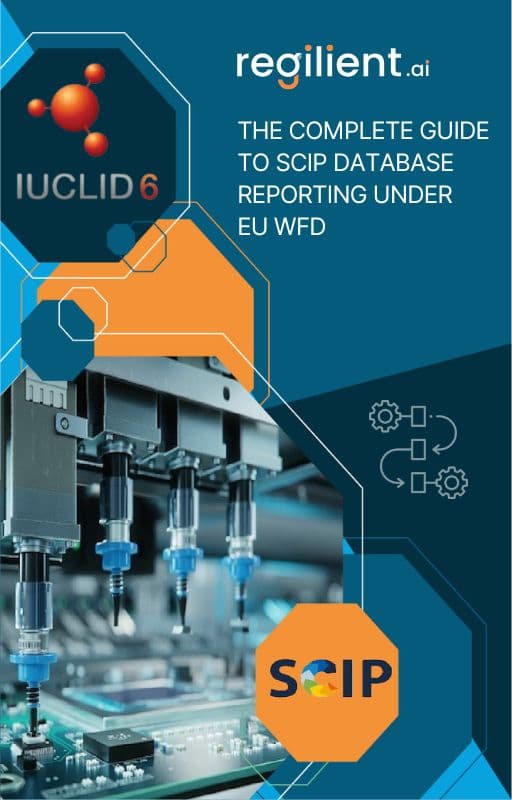
Operational Benefits

Cut manual effort with automated validations and reusable datasets

Reduce submission errors with field checks and required metadata

Maintain an auditable evidence trail across suppliers and parts

Scale submissions across product portfolios without rework
SCIP Implementation & Advisory Services
Pair the platform with experts who operationalize SCIP: faster onboarding, cleaner data, and smoother submissions.

Implementation (3-6 weeks)
- Data model & field configuration
- Supplier request templates & workflows
- BOM tree modeling and reuse patterns
- Team training (ops, quality, sourcing)
Outcome:
Live environment; first submission dataset generated.

Advisory (Quarterly)
- Applicability & prioritization rules
- Evidence QA & gap closure plans
- Submission readiness reviews
- Executive risk/readiness updates
Outcome:
Fewer surprises; faster responses to requests.

Managed Service (MSP)
- Ongoing supplier outreach & validation
- Dataset maintenance and change monitoring
- Submission support and archive management
- SLA: initial triage in 2 business days
Outcome:
Stable compliance ops without adding headcount.
SCIP: Manual vs Software
| Process Area | Manual (Spreadsheets) | Software (Regilient) |
|---|---|---|
| SVHC Screening | Ad-hoc checks, inconsistent thresholds | Automated SVHC Cross-Matching — Hierarchical mapping of complex objects and automated cross-reference of articles against the ECHA Candidate List. |
| Complex Objects | Rebuilt per product, error-prone | Agentic Evidence Collection — Automated collection, validation, and gap-closure of multi-tier supplier data. |
| Field Validation | Copy/paste, missing metadata | Automated Metadata Mapping — Automated population of mandatory SCIP metrics, TARIC codes, and material categories for IUCLID dossiers. |
| Submissions | One-off files, no lineage | S2S Validation & Submission — System-to-System integration for automated ECHA validation and direct-to-database submission. |
SCIP Scope & Roles (High-Level)
| Role | Typical Actions (examples) |
|---|---|
| Producer / Assembler | Screen parts for SVHCs, submit SCIP for articles and complex objects, maintain updates. |
| Importer | Ensure imported articles are assessed and submissions made as required. |
| Distributor | Pass information and maintain records where applicable. |
Always verify current applicability, data elements, and any portal/process changes in official guidance.
SCIP Compliance Checklist
- Confirm articles with SVHCs above threshold
- Collect and validate supplier evidence
- Build/maintain complex object trees
- Populate required SCIP fields
- Export & submit; archive documentation
FAQs for SCIP (WFD) Compliance Software
Who is required to submit SCIP notifications - and what if my company is outside the EU?
What’s the difference between an "article as such" and a "complex object" - and why does it matter for SCIP?
How is SCIP different from what I’m already doing under REACH Article 33?
The EU has proposed repealing the SCIP database. Should we stop investing in compliance?
Are there penalties for not submitting to the SCIP database?
When a new substance is added to the SVHC Candidate List, how quickly do I need to update my SCIP submissions?
Useful Waste Framework Directive Compliance Resources
Related Compliance Solutions
Achieve SCIP Compliance Efficiently
Automate screening, standardize datasets, and keep documentation audit-ready with Regilient.