
Table of Contents
- What is the EU RoHS Directive?
- RoHS Timeline: 20+ Years of Evolution
- 10+2 Restricted Substances (and Counting)
- Exemptions: Time-Limited, Strategically Crucial
- Key facts:
- Country Specific RoHS-Regulations
- EN IEC 63000: Technical File Best Practices
- RoHS vs. REACH vs. SCIP vs. WEEE: What’s the Difference?
- The world’s leading manufacturers don’t guess—they track.
- Sources (checked 18 November 2026)
Last updated: 18 November 2026
The Restriction of Hazardous Substances (RoHS) Directive has evolved from a narrow electronics safety law to a foundational pillar of environmental compliance strategy. If you're building or selling electrical and electronic equipment (EEE) in the EU—or selling globally, you’re on the hook for RoHS compliance.
Let’s get you RoHS-ready for today and tomorrow.
What is the EU RoHS Directive?
The RoHS Directive restricts hazardous substances in EEE to protect human health and the environment. Compliance isn’t just a checkbox—it’s a market access requirement in the EU and increasingly worldwide.
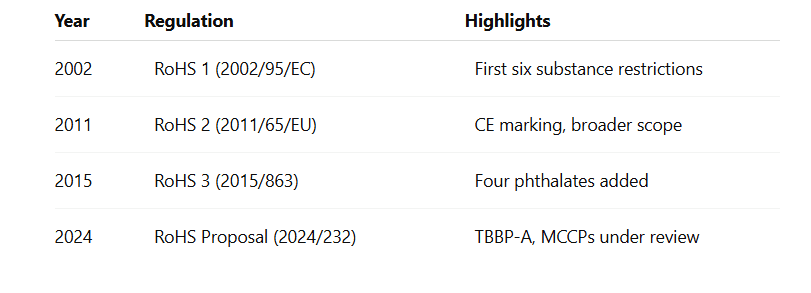
Initially introduced in 2003 as Directive 2002/95/EC (RoHS 1), it has since been replaced and expanded by:
- 2011/65/EU (RoHS 2) – CE marking requirement added
- 2015/863 (RoHS 3) – Added four phthalates
- (EU) 2024/232 – Added an exemption for cadmium and lead in recovered rigid PVC, valid until 28 May 2028
RoHS applies to products at the homogeneous material level—you must ensure each material in each component stays within substance thresholds.
As regulations evolve, RoHS compliance software helps companies stay current and maintain defensible compliance records.
RoHS Timeline: 20+ Years of Evolution
Download eBook The Complete Guide to ROHS Compliance
10+2 Restricted Substances (and Counting)
RoHS currently restricts 10 substances with strict thresholds:
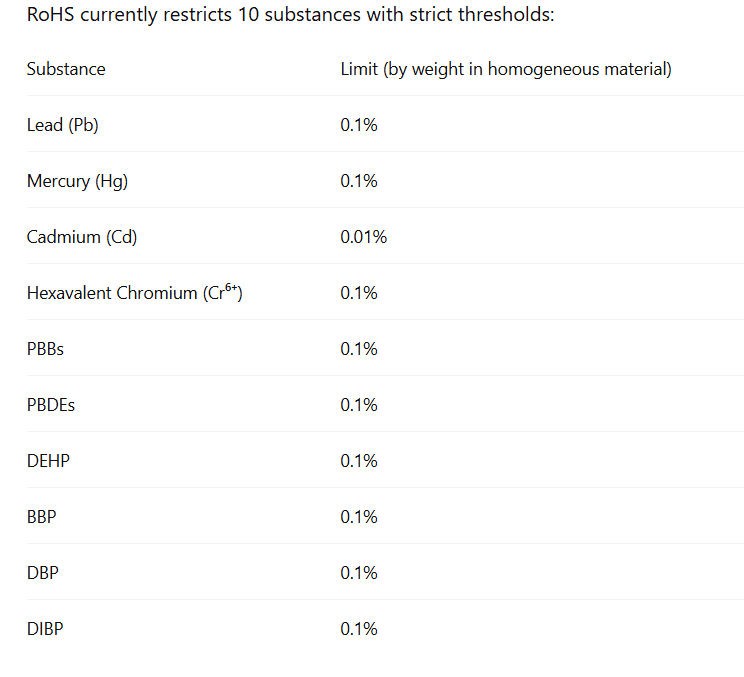
Coming Soon? TBBP-A & MCCPs are currently under evaluation for restriction under the Green Deal and Chemicals Strategy.
Exemptions: Time-Limited, Strategically Crucial
Exemptions under Annex III and IV allow limited use of restricted substances in specific applications—like lead in high-reliability solder or mercury in backlighting.
Key facts:
- Exemptions expire after 5–7 years
- Stakeholder renewal applications must be submitted 18 months before expiry
- ECHA is taking over technical assessments under Directive (EU) 2025/2456, published 12 December 2025, with a transition of about 20 months
Update, 18 November 2026: delegated directives published in November 2025 restructured several lead exemptions (entries 6, 7(a) and 7(c)), and Directive (EU) 2025/2456, published on 12 December 2025, transfers scientific and technical tasks under RoHS from the Commission to ECHA, with a transition of about 20 months. For the standard that governs the technical file, see our guide to EN IEC 63000:2018, and for how RoHS differs from REACH, read RoHS vs REACH compliance.
How to Manage RoHS Exemptions and Extensions
Country Specific RoHS-Regulations
RoHS-style regulations now exist globally. Here’s your country-by-country breakdown with links to Regilient’s blogs:
- 🇨🇳 China RoHS 2: What You Need to Know About the Latest Compliance Requirements
- 🇮🇳 India RoHS
- 🇬🇧 UK RoHS
- 🇺🇸 California RoHS
- 🇷🇺 EAEU RoHS
- 🇹🇼 Taiwan RoHS
- 🇯🇵 Japan RoHS (J-MOSS)
- 🇺🇦 Ukraine RoHS
- 🇦🇪 UAE RoHS
- 🇦🇪 SASO RoHS
Explore All Regional RoHS Blogs →
EN IEC 63000: Technical File Best Practices
Since November 2021, EN IEC 63000 is the harmonized standard for RoHS technical documentation.
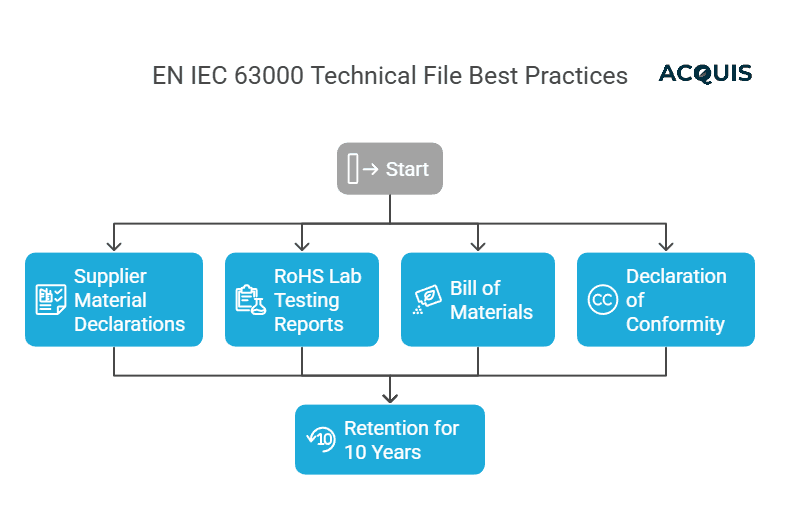
Your file should include:
- Supplier material declarations (IPC-1752A, IEC 62474)
- RoHS lab testing reports or risk-based evaluations
- Bill of Materials (BoM) with substance tracking
- Declaration of Conformity (DoC)
- Retention for 10 years post-market entry
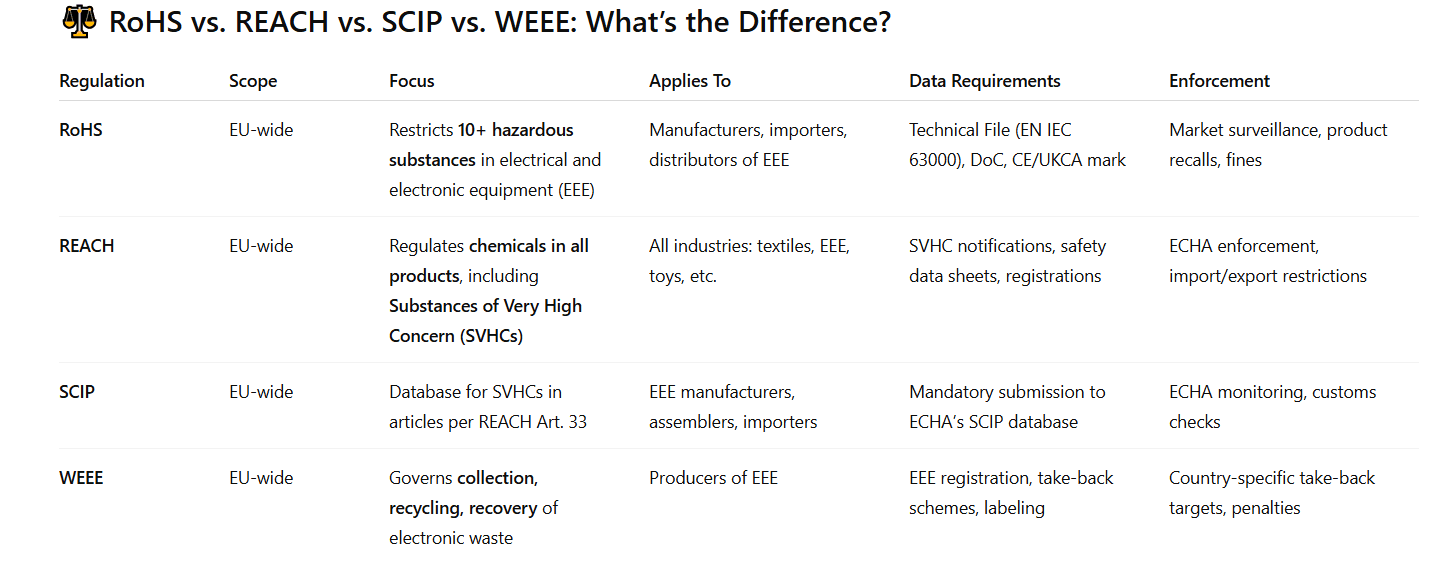
RoHS vs. REACH vs. SCIP vs. WEEE: What’s the Difference?
If you're managing compliance for RoHS, REACH, SCIP, or WEEE, you're not alone. These frameworks often intersect—but they’re not interchangeable. Here's a clear side-by-side breakdown to help you stay audit-ready and focused.
Stay updated by subscribing to regulatory alerts from Regilient.
The world’s leading manufacturers don’t guess—they track.
Let Regilient automate your RoHS, REACH, SCIP, and exemption workflows—globally.
- Track global RoHS updates
- Manage complex exemption renewals
- Automate technical documentation workflows
- Engage with supply chains to ensure 100% data coverage
Book a Free Demo to scale your RoHS compliance globally.
Sources (checked 18 November 2026)
- European Commission, RoHS Directive pages, environment.ec.europa.eu (Directive 2011/65/EU in force 21 July 2011; ten restricted substances)
- Directive (EU) 2024/232 (recovered rigid PVC exemption, expiry 28 May 2028), EUR-Lex, via search results
- Freyr, CIRS Group and ChemRadar reports on Directive (EU) 2025/2456 (secondary; see SME review)