
Table of Contents
- What is EN IEC 63000:2018?
- Evolution of RoHS Documentation Standards
- Key Objectives of EN IEC 63000:2018
- What Are RoHS Exemptions — And Why Do They Matter?
- Supplier Declarations: What Manufacturers Should Actually Collect
- 4. Risk Assessment
- 5. Testing and Verification
- 6. RoHS Exemptions Must Be Documented
- 7. Declaration of Conformity
- How to Build an IEC 63000 RoHS Technical File
- Step 1: Identify the Product
- Step 2: Build the BOM
- Step 3: Collect Supplier Evidence
- Step 4: Validate the Evidence
- Step 5: Perform Risk Assessment
- Step 6: Evaluate Exemptions
- Step 7: Perform Additional Testing Where Needed
- Step 8: Compile the Technical Documentation
- Step 9: Complete the Conformity Assessment
- Step 10: Maintain the File
- Why Static RoHS Documentation Becomes a Problem
- IEC 63000 and Changing RoHS Exemptions
- How to Implement EN IEC 63000:2018 in Your Compliance Process
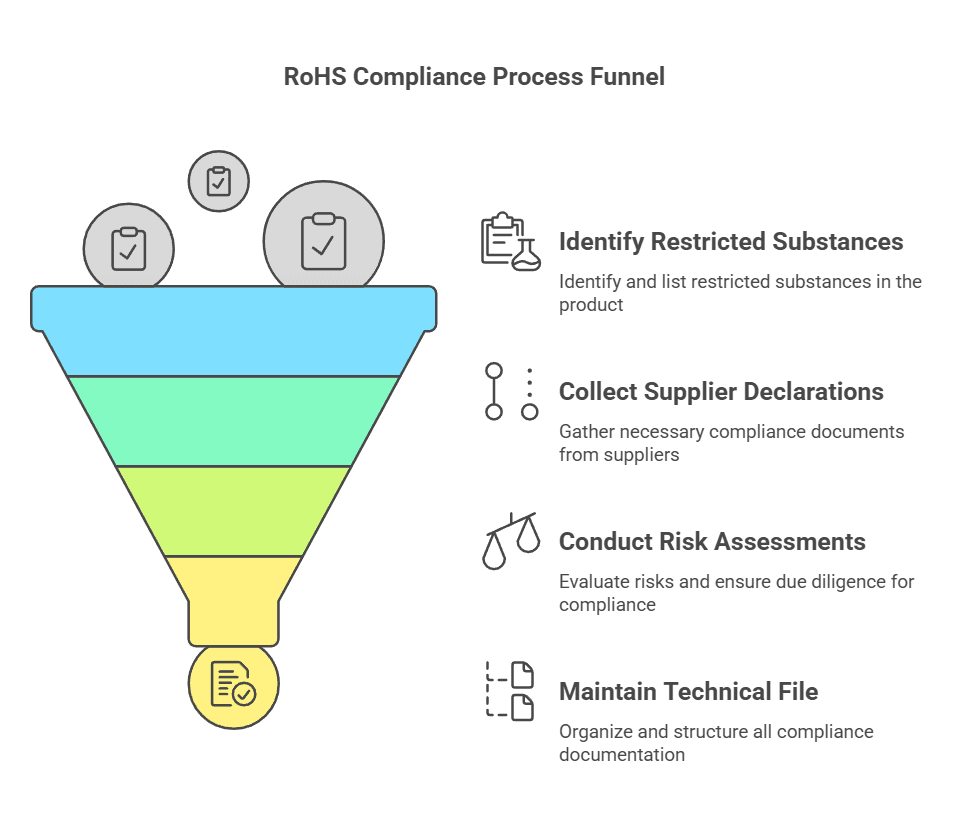
- 1. Identify Restricted Substances in Your Product
- 2. Collect Supplier Declarations and Testing Reports
- 3. Conduct Internal Risk Assessments
- 4. Maintain a Well-Structured RoHS Technical File
- 5. Update Your RoHS Declaration of Conformity (DoC)
- How Manufacturers Should Maintain IEC 63000 Documentation
- A supplier changes material
- A component is replaced
- A product revision changes
- A supplier declaration expires or becomes outdated
- A RoHS exemption changes
- A new regulatory requirement applies
- Testing identifies a potential issue
- IEC 63000 Documentation Checklist for Electronics Manufacturers
- Why Compliance with EN IEC 63000:2018 Matters
- How Regilient Helps Manufacturers Manage RoHS Technical Documentation
In today’s regulatory landscape, compliance with hazardous substance restrictions is crucial for manufacturers of electrical and electronic equipment (EEE). The European Union’s Restriction of Hazardous Substances (RoHS) Directive (2011/65/EU) mandates that all EEE products meet strict environmental standards. To support this, the EN IEC 63000:2018 standard provides a framework for creating technical documentation that demonstrates RoHS compliance.
What is EN IEC 63000:2018?
EN IEC 63000:2018 is a harmonized standard that defines the technical documentation manufacturers must compile to ensure their products comply with substance restriction regulations like RoHS 2. It eliminates the need for costly chemical testing by offering a structured, documentary approach to compliance verification.
Evolution of RoHS Documentation Standards
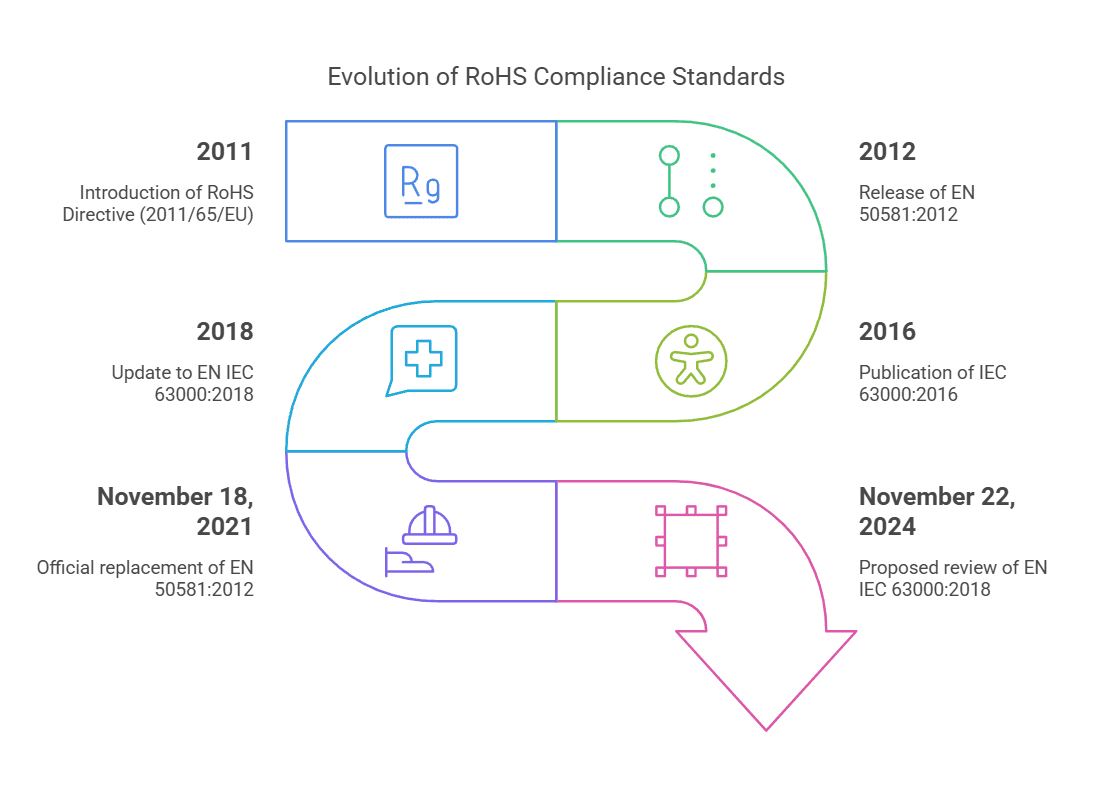
- EN 50581:2012 – The first EU standard for RoHS technical documentation, developed by CENELEC.
- IEC 63000:2016 – A global version of EN 50581 with a broader international scope.
- EN IEC 63000:2018 – The latest update, officially replacing EN 50581:2012 on November 18, 2021, under Decision (EU) 2020/659.
- November 22, 2024 – The European Commission proposed a future review of EN IEC 63000:2018 to better align with Decision No. 768/2008/EC regarding internal production control.
Strong technical documentation processes become easier to manage with RoHS compliance software that supports evidence collection, declaration review, and audit readiness.
Key Objectives of EN IEC 63000:2018
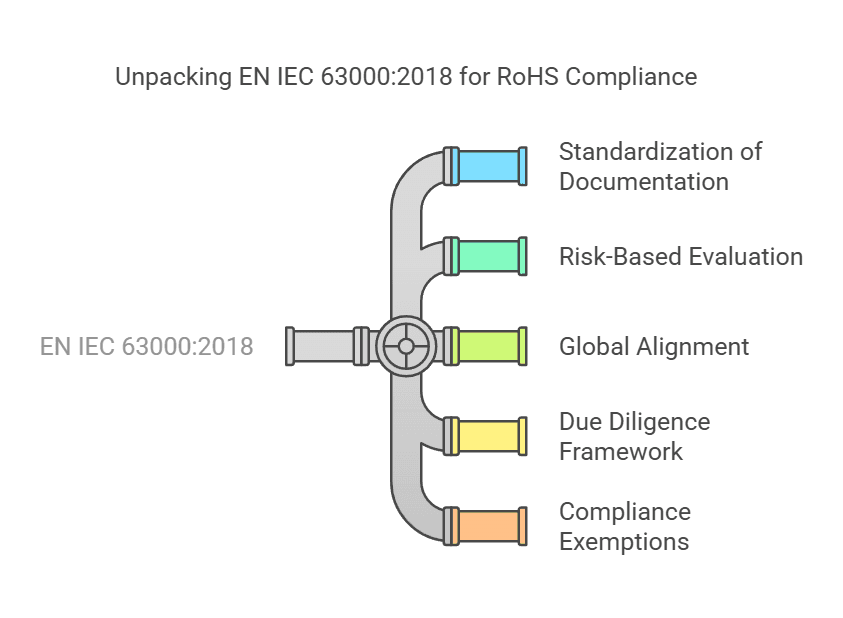
- Standardizes the technical documentation process for RoHS compliance.
- Establishes a risk-based approach to evaluating hazardous substances.
- Aligns with global environmental regulations beyond just EU RoHS.
- Provides a due diligence framework to assess suppliers and materials.
- Incorporates the latest application-specific RoHS exemptions, including the limited exemption for cadmium and lead in recovered rigid PVC from closed-loop recycling systems, introduced under Directive (EU) 2024/232 and valid until May 28, 2028, subject to strict material traceability and documentation requirements.
While EN IEC 63000:2018 provides a framework for technical documentation, it's essential to understand the role of RoHS exemptions. These exemptions allow for the temporary use of certain hazardous substances in specific applications where alternatives are not yet feasible.
What Are RoHS Exemptions — And Why Do They Matter?
While the RoHS Directive restricts the use of specific hazardous substances in electrical and electronic equipment, certain uses are temporarily allowed under what are known as RoHS exemptions. These exemptions are granted when eliminating a substance is technically or scientifically infeasible — for example, when no viable alternatives exist for a critical function.
Commonly exempted substances include lead in high-reliability solders, hexavalent chromium in surface treatments, or cadmium in optical components. Each exemption applies to specific use cases and carries a defined validity period, after which it may expire or be reviewed for renewal.
> Manufacturers relying on exemptions must document them clearly in the Technical File and monitor expiration timelines to remain compliant.
In 2025, the European Commission adopted new delegated directives restructuring several long-standing lead exemptions under RoHS, including Series 6 (lead in alloys), 7a (high-melting-point solders), and 7c (lead in glass and ceramics).
While these changes do not modify the requirements of EN IEC 63000:2018 itself, they significantly affect what must be documented in the RoHS Technical File — particularly exemption scope, validity periods, and product-specific applicability.
Manufacturers relying on lead exemptions must ensure their technical documentation reflects the new exemption structure and sunset dates.
Need a RoHS documentation checklist? Get the eBook.
Supplier Declarations: What Manufacturers Should Actually Collect
Supplier declarations are an important part of the evidence chain, but not all declarations have the same evidentiary value.
A generic statement such as:
“Product complies with RoHS.”
may not provide enough information for a manufacturer to understand:
- Which revision of the product was assessed
- Which substances were evaluated
- Whether an exemption is being claimed
- Which exemption applies
- Whether the declaration covers the current product revision
- When the evidence was generated
- What happens if the supplier changes materials or processes
This is particularly important for large electronics BOMs.
A manufacturer may have thousands of components and hundreds of suppliers. A technical documentation process therefore needs a way to connect supplier evidence to the exact component and product where that evidence is being used.
4. Risk Assessment
IEC 63000 supports a risk-based approach to technical documentation rather than requiring identical verification for every component.
This matters because not every component presents the same compliance risk.
For example, manufacturers may prioritise additional review for materials or components where:
- Restricted substances are historically associated with the material
- Supplier information is incomplete
- The component is safety-critical
- The supplier has changed material or manufacturing processes
- An exemption is being claimed
- The component comes from a higher-risk supply chain
- Existing evidence is old or inconsistent
- A supplier declaration conflicts with other available information
The result should be a documented rationale for why the evidence collected is sufficient for the manufacturer's conformity assessment.
5. Testing and Verification
IEC 63000 does not mean that every component must automatically undergo laboratory testing.
Instead, manufacturers can use available technical and supplier evidence as part of their assessment and determine where additional verification is appropriate based on risk.
Testing can therefore form one part of a broader compliance evidence strategy.
For example:
Supplier declaration → material information → risk assessment → additional verification/testing where warranted
This approach is particularly important for electronics manufacturers because testing every component in a complex BOM would be costly, destructive in many cases and operationally impractical.
Where testing is performed, manufacturers should maintain the relevant reports and trace them to the component, material or product being assessed.
6. RoHS Exemptions Must Be Documented
An exemption should never simply appear as a checkbox saying:
“RoHS exemption applies.”
The manufacturer needs to establish why the exemption applies to the specific use.
This becomes especially important as RoHS exemptions are amended, renewed, narrowed or allowed to expire.
The technical documentation should therefore allow the manufacturer to identify:
- Exemption number
- Relevant substance
- Material/application
- Component
- Product
- Reason the exemption applies
- Applicable validity period
- Supporting supplier/technical evidence
This is increasingly important for lead exemptions, where several long-standing exemptions have been restructured.
Regilient's current IEC 63000 article already identifies the 2025 restructuring of several lead exemptions as an important documentation issue.
Related: EU RoHS Regulations & Exemptions
7. Declaration of Conformity
The technical documentation supports the manufacturer's conformity assessment and Declaration of Conformity.
The DoC should be consistent with the product, applicable legislation and standards being declared.
For EU products, RoHS is part of a wider conformity-assessment framework. The European Commission explains that manufacturers must demonstrate that products meet all applicable legislative requirements before placing them on the EU market.
This is why RoHS documentation should not exist as an isolated spreadsheet owned by the compliance team.
It needs to connect with the manufacturer's broader product compliance process.
How to Build an IEC 63000 RoHS Technical File
For an electronics manufacturer, a practical workflow looks like this:
Step 1: Identify the Product
Define the product, SKU, revision and applicable RoHS scope.
↓
Step 2: Build the BOM
Map the product to its components, materials and assemblies.
↓
Step 3: Collect Supplier Evidence
Request declarations, material data, certificates and other relevant evidence.
↓
Step 4: Validate the Evidence
Check whether the evidence actually covers the component, revision and applicable RoHS requirements.
↓
Step 5: Perform Risk Assessment
Identify components and materials requiring deeper review or verification.
↓
Step 6: Evaluate Exemptions
Map any claimed exemption to the correct substance, application and product.
↓
Step 7: Perform Additional Testing Where Needed
Use appropriate verification where supplier evidence or risk assessment indicates that additional evidence is necessary.
↓
Step 8: Compile the Technical Documentation
Connect the BOM, supplier evidence, risk assessment, testing and exemption information.
↓
Step 9: Complete the Conformity Assessment
Use the evidence to support the manufacturer's RoHS conformity assessment and Declaration of Conformity.
↓
Step 10: Maintain the File
Update the evidence when products, suppliers, materials, components or regulatory requirements change.
Why Static RoHS Documentation Becomes a Problem
The biggest challenge isn't creating a technical file once.
It's keeping it accurate.
Consider an electronics product with 800 components.
A supplier changes:
- a resin,
- alloy,
- plating,
- manufacturing location,
- subcontractor,
- material formulation,
or issues a new declaration.
That change may affect the evidence associated with the component.
If the technical file exists as a collection of disconnected PDFs and spreadsheets, the manufacturer may not know which finished products are affected.
This is where component-level traceability becomes critical.
The manufacturer should be able to move from:
Product → BOM → Component → Supplier → Material → Substance → Evidence → RoHS assessment
and, in the opposite direction:
Supplier change → Component → BOM → Finished products → Compliance impact
That is the operational difference between a static compliance archive and a living compliance system.
IEC 63000 and Changing RoHS Exemptions
RoHS exemptions are not permanent permissions.
They can have defined validity periods and can be amended, renewed, narrowed or allowed to expire.
That means manufacturers relying on exemptions should track more than the exemption number.
They need to know:
Which products depend on it?
For example:
Compliance data | What the manufacturer should know |
|---|---|
Exemption | Which exemption is being used? |
Substance | Which restricted substance is involved? |
Component | Where is it used? |
Material | What material/application contains it? |
Supplier | Who supplied the evidence? |
Product | Which finished products depend on it? |
Expiry | When does the current exemption position change? |
Evidence | What supports the claim? |
Action | What happens if the exemption changes? |
This is particularly important following recent changes to several lead exemptions.
Do not treat an exemption as a permanent compliance status. Treat it as a controlled dependency.
How to Implement EN IEC 63000:2018 in Your Compliance Process
To meet RoHS compliance requirements efficiently, manufacturers must structure their RoHS technical files using the EN IEC 63000:2018 framework. Here’s a step-by-step approach:
1. Identify Restricted Substances in Your Product
List all materials and components used in your product and ensure they do not contain RoHS-restricted substances like Lead, Mercury, and Cadmium.
2. Collect Supplier Declarations and Testing Reports
Obtain Material Declarations (MDs) and Certificates of Compliance (CoC) from suppliers.
3. Conduct Internal Risk Assessments
Define a risk-based approach to verify compliance and maintain a due diligence process
4. Maintain a Well-Structured RoHS Technical File
Ensure the documentation includes:
- Product Information (name, model, category, manufacturer details)
- Material and Substance Declarations
- Supplier Certificates and Compliance Declarations
- Compliance Verification Process Details
- Declaration of Conformity (DoC)
5. Update Your RoHS Declaration of Conformity (DoC)
Since EN IEC 63000:2018 is the recognised harmonised standard, manufacturers should update their Declarations of Conformity to reference:
- Directive 2011/65/EU (RoHS 2)
- Commission Delegated Directive (EU) 2015/863 (phthalates)
- EN IEC 63000:2018 as the technical documentation standard
References to EN 50581:2012 should be fully removed from active DoCs.
How Manufacturers Should Maintain IEC 63000 Documentation
A technical file should evolve with the product.
Manufacturers should establish triggers for reviewing documentation when:
A supplier changes material
Reassess the affected component and evidence.
A component is replaced
Update the BOM and compliance evidence.
A product revision changes
Determine whether the existing assessment remains valid.
A supplier declaration expires or becomes outdated
Request updated evidence.
A RoHS exemption changes
Identify all affected components and products.
A new regulatory requirement applies
Reassess the relevant technical documentation.
Testing identifies a potential issue
Update the risk assessment and conformity evidence.
This turns RoHS documentation from a once-a-year compliance exercise into a controlled product lifecycle process.
IEC 63000 Documentation Checklist for Electronics Manufacturers
Before considering your RoHS technical documentation complete, ask:
Question | Status |
|---|---|
Is the product clearly identified? | ☐ |
Is the current BOM available? | ☐ |
Are components traceable to suppliers? | ☐ |
Do we have relevant material/substance information? | ☐ |
Are supplier declarations current? | ☐ |
Have supplier declarations been reviewed rather than simply stored? | ☐ |
Is a risk assessment documented? | ☐ |
Is additional testing performed where warranted? | ☐ |
Are RoHS exemptions mapped to specific applications? | ☐ |
Are exemption changes and expiry dates monitored? | ☐ |
Can every compliance claim be traced back to supporting evidence? | ☐ |
Is the Declaration of Conformity consistent with the assessment? | ☐ |
Can the technical documentation be retrieved efficiently? | ☐ |
Is there a process for updating the file when the product or supply chain changes? | ☐ |
Why Compliance with EN IEC 63000:2018 Matters
Failure to comply with EN IEC 63000:2018 can result in:
- Market access restrictions in the EU and other RoHS-enforcing regions.
- Costly recalls and penalties due to non-compliance.
- Reputational damage and loss of consumer trust.
- Potential future amendments—The European Commission has proposed reviewing the standard to ensure alignment with broader internal production control requirements.
By adopting this standard, manufacturers can streamline compliance, reduce testing costs, and enhance trust with regulators and customers.
With the European Commission signalling further alignment of harmonised standards with internal production control requirements, maintaining up-to-date, risk-based technical documentation under EN IEC 63000 is expected to become even more critical in future market surveillance actions.
Download The Complete Guide to ROHS Compliance for a clear roadmap on technical documentation, compliance strategies, and best practices to stay ahead of evolving regulations.
How Regilient Helps Manufacturers Manage RoHS Technical Documentation
Building an IEC 63000-aligned evidence trail manually becomes difficult as product portfolios and supply chains grow.
Regilient helps manufacturers connect the compliance workflow across:
BOMs → components → suppliers → declarations → material data → exemptions → risk → technical documentation
With Regilient, compliance teams can:
- Collect supplier declarations through structured workflows
- Track component and product-level compliance data
- Review supplier evidence
- Map RoHS exemptions to affected components and products
- Monitor exemption changes and expiry dates
- Maintain compliance evidence against BOMs
- Identify missing or outdated supplier information
- Centralise technical documentation
- Support audit-ready compliance records
Instead of asking:
“Where is the RoHS certificate?”
your team can answer:
“Show me the evidence supporting RoHS conformity for this product, including the components, suppliers, exemptions and supporting documentation.”
Explore Regilient's RoHS Compliance Software to see how component-level exemption tracking and supplier evidence collection work in practice.
Static technical files fall out of date the moment a supplier changes a material.
Book a Regilient demo to see how Regilient keeps your RoHS documentation continuously audit-ready.