
Table of Contents
- What Is the UK RoHS Regulation?
- Scope: Who and What Falls Under UK RoHS?
- UK RoHS Restricted Substances and Limits (by weight in homogeneous material)
- UKCA and CE Marking, What's the Deal?
- UK RoHS Technical Documentation: Your First Line of Defense
- Roles and Responsibilities Under UK RoHS
- UK RoHS Enforcement and Penalties
- Conclusion: UK RoHS Isn’t Optional, It’s Strategic
- Let Regilient Simplify Your UK RoHS Compliance
Let’s be honest: post-Brexit compliance isn’t just messy — it’s risky. If you’re placing electronic products in the UK market and think CE marking alone keeps you safe, think again.
UK RoHS - officially the Restriction of the Use of Certain Hazardous Substances in Electrical and Electronic Equipment Regulations 2012 — is its own regime now. It mirrors the EU RoHS Directive in substance, but the rules of the game have changed.
Here’s what you need to know to stay compliant, avoid fines, and keep your supply chain flowing smoothly.
What Is the UK RoHS Regulation?
The UK RoHS Regulation governs the restriction of ten hazardous substances in electrical and electronic equipment (EEE). While derived from the EU’s framework, it’s now enforced separately by the Office for Product Safety and Standards (OPSS) in Great Britain (England, Scotland, and Wales).
Products sold in Northern Ireland follow EU RoHS under the Windsor Framework and require CE marking. Great Britain (England, Scotland, and Wales) is governed by UK RoHS, where manufacturers can demonstrate conformity with either the UKCA mark or the CE mark. Both are indefinitely accepted for RoHS-scope EEE following the Product Safety and Metrology etc. (Amendment) Regulations 2024.
Scope: Who and What Falls Under UK RoHS?
Applicable to:
- All finished EEE placed on the GB market
Not applicable to:
- Components not sold individually to the market
- Military and space equipment
- Large-scale fixed installations and stationary industrial tools
You must:
- Maintain a technical file (including risk assessment and supplier docs)
- Issue a Declaration of Conformity (DoC)
- Apply appropriate marking (UKCA or CE)
Managing UK RoHS obligations across a multi-supplier BOM, especially with dual-mark (UKCA/CE) documentation requirements for manufacturers selling into both GB and the EU typically requires structured RoHS compliance software rather than manual tracking.
UK RoHS Restricted Substances and Limits (by weight in homogeneous material)
Under the UK RoHS Regulations (Restriction of the Use of Certain Hazardous Substances in Electrical and Electronic Equipment), the following 10 substances are restricted by weight in homogeneous materials. These limits are consistent with EU RoHS requirements.
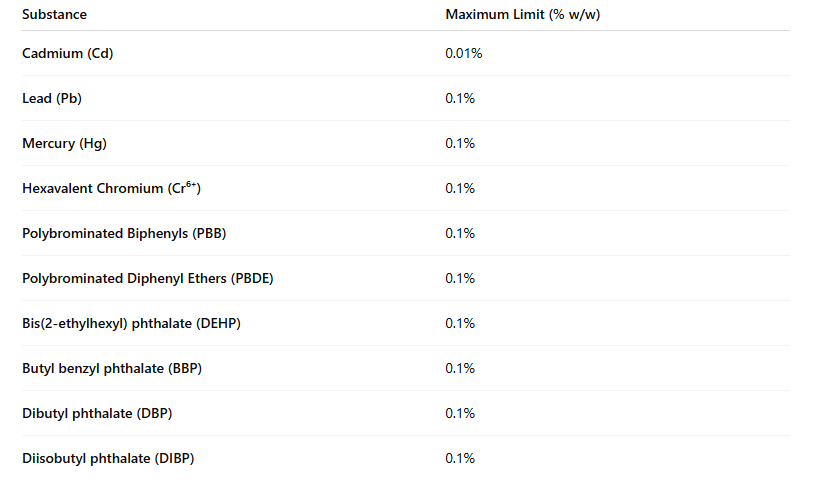
> If you’re over these thresholds in any homogeneous material, your product is non-compliant. No exceptions.
UKCA and CE Marking, What's the Deal?
GB Market: Use the UKCA mark NI Market: Use the CE mark (EU RoHS still applies)
The Product Safety and Metrology etc. (Amendment) Regulations 2024, made on 23 May 2024 and in force from 1 October 2024, removed the previous 31 December 2024 expiry date for CE marking recognition and extended it indefinitely for 21 product regulations, including RoHS. As of 2026, the UK government has not announced any date at which the CE marking will lose its current legal status. Manufacturers placing electrical and electronic equipment on the GB market can choose either the UKCA mark or the CE mark to demonstrate RoHS conformity. UKCA is not mandatory and CE is not a transitional concession — both are accepted on an ongoing basis.
Note: while indefinite, this is a policy decision, not a legal guarantee of permanent status. The government has committed to a minimum two-year transition period if the policy is ever reversed, so CE-only manufacturers have some warning but should still consider commercial exposure to a future reversal.
UK RoHS Technical Documentation: Your First Line of Defense
To prove compliance, your technical file must include:
- Product design and manufacturing details
- Material declarations and test reports
- Risk assessments
- Supplier certifications
- DoC with product and issuer details
Pro tip: Maintain this documentation for 10 years post-placement.
Roles and Responsibilities Under UK RoHS
Manufacturers must:
- Ensure compliance and affix proper markings
- Create and retain technical docs and DoC
Importers must:
- Verify manufacturer compliance before import
- Maintain access to DoC and documentation
Distributors must:
- Check for proper labeling and documentation
- Refrain from placing non-compliant products on the market
- Assume full manufacturer responsibilities if modifying products
UK RoHS Enforcement and Penalties
If you're found non-compliant, OPSS can issue product recalls, corrective action notices, and prosecute manufacturers, importers, or distributors. On summary conviction, historical maximum fines were £5,000, later £20,000; following the Legal Aid, Sentencing and Punishment of Offenders Act 2012 (Section 85, in force 12 March 2015), maximum fines on summary conviction in magistrates' courts in England and Wales for most environmental and product safety offences became unlimited. On conviction on indictment, fines are also unlimited, and offences may carry imprisonment. The "£20,000 maximum" figure is now outdated for most enforcement pathways.
Conclusion: UK RoHS Isn’t Optional, It’s Strategic
If you want to keep selling in the UK, compliance isn’t just a box to check. It’s a core part of your go-to-market strategy.
UK RoHS = market access + brand trust + futureproofing.
Let Regilient Simplify Your UK RoHS Compliance
Tired of chasing certificates or emailing suppliers endlessly? Regilient helps you:
- Centralize RoHS data across suppliers
- Auto-generate UKCA-ready DoCs
- Track risk by BOM or component
- Prepare for OPSS audits with confidence
Chasing supplier certificates across two separate marking regimes is not a sustainable compliance strategy.
Learn more about Regilient's RoHS compliance software, or book a demo today to turn compliance from chaos into competitive edge.