
Table of Contents
- What Is RMI’s RMAP Participating Smelters and Refiners List?
- Why the Smelter & Refiner List Matters for Conflict Minerals Compliance
- What Are Smelter Audits and Risk Assessments for CMRT?
- How to Prepare for Smelter Audits & Risk Assessments
- Technology’s Role in Simplifying Audits
- How Regilient Simplifies the Process
- Strengthen Your Conflict Minerals Compliance
- Sources (checked 18 November 2026)
Last updated: 18 November 2026
Responsible sourcing isn’t optional anymore. With rising regulatory scrutiny and growing stakeholder pressure, manufacturers must prove their supply chains are conflict-free—and that starts with knowing exactly who’s refining your minerals.
The Responsible Minerals Assurance Process (RMAP), maintained by the Responsible Minerals Initiative (RMI), offers a verified list of smelters and refiners that have undergone rigorous third-party audits. Whether you're reporting under the Dodd-Frank Act Section 1502, preparing your Form SD and Conflict Minerals Report (CMR), or simply trying to meet ESG expectations, the RMI Conformant Smelter & Refiner List is your first step toward transparency and traceability.
What Is RMI’s RMAP Participating Smelters and Refiners List?
The RMAP Smelter & Refiner List identifies facilities that have been audited and validated for responsible sourcing practices. It includes:
- Facility name and location
- Metal(s) processed (3TG: tin, tantalum, tungsten, gold)
- Conformance status (RMI lists facilities as Conformant, Active or Eligible by metal)
- Audit dates and reassessment schedule
This list allows downstream companies to make informed sourcing decisions and demonstrate due diligence to stakeholders, regulators, and customers.
RMAP assessments are independent third-party reviews of a facility's management systems and sourcing practices, using a risk-based approach, and are valid for one or three years. RMI states that an assessment is not a material validation assessment. A conformant listing therefore supports your due diligence, but it does not by itself prove where the material you bought came from. Source: RMI.
Why the Smelter & Refiner List Matters for Conflict Minerals Compliance
- Ensures your minerals are not funding armed conflict
- Helps meet SEC disclosure and CMR expectations
- Supports ESG and sustainability reporting frameworks
- Reduces reputational, operational, and legal risks
Being proactive with smelter review shows your commitment to responsible sourcing and ethical business practices.
What Are Smelter Audits and Risk Assessments for CMRT?
A smelter audit evaluates whether a facility is sourcing minerals responsibly and complying with frameworks like the OECD Due Diligence Guidance. It typically includes:
- Documentation review
- Traceability checks
- Chain-of-custody analysis
- Site inspections (in some cases)
A risk assessment identifies and evaluates any red flags in your supply chain, such as:
- High-risk sourcing countries (CAHRAs)
- Suspicious ownership or management
- Gaps in supplier disclosures
How to Prepare for Smelter Audits & Risk Assessments
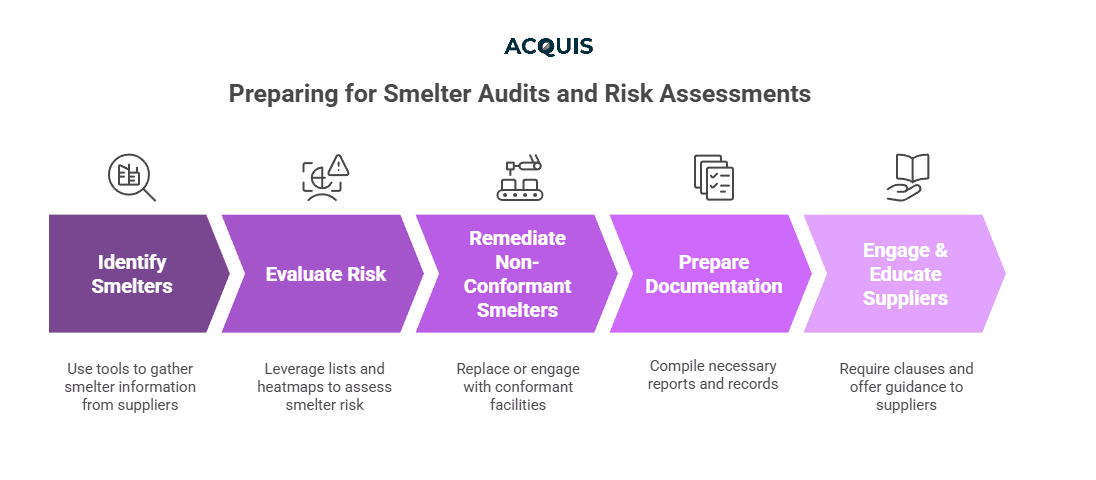
- Step 1: Identify Smelters in Your Supply Chain
Use tools like the Conflict Minerals Reporting Template (CMRT) or supply chain tracing software to gather smelter info from your Tier 1 and Tier 2 suppliers.
- Step 2: Evaluate Risk Using Public & Proprietary Lists
Leverage:
- RMI Conformant & Active Lists
- EU CAHRAs List
- Regilient’s Smelter Risk Heatmap (if using Regilient software)
- Step 3: Remediate Non-Conformant Smelters
- Replace high-risk smelters where possible
- Work with suppliers to engage conformant facilities
- Track and document all remediation efforts
- Step 4: Prepare Documentation
- Smelter audit reports
- Supplier declarations
- RCOI process records
- Due diligence policies and training logs
- Step 5: Engage & Educate Your Suppliers
- Require conflict minerals clauses in contracts
- Offer guidance on CMRT/EMRT completion
- Share risk findings and expectations
A note on the EU CAHRA list: the European Commission published an award notice in December 2025 for an indicative, non-exhaustive list of conflict-affected and high-risk areas under Regulation (EU) 2017/821. Check whether the list has been published before you rely on it as a screening tool. The Commission has also recognised the RMAP as equivalent under the Regulation, in an Implementing Decision adopted on 16 October 2025. Source: European Commission.
Technology’s Role in Simplifying Audits
Modern compliance platforms like Regilient automate risk flagging, smelter validation, supplier outreach, and document management.
Look for Tools That Offer:
- Pre-integrated RMI Smelter Lists
- CMRT/EMRT survey automation
- Custom dashboards and real-time analytics
- AI-assisted smelter validation
How Regilient Simplifies the Process
- Centralized CMRT & smelter data tracking
- Auto-flagging of high-risk smelters
- Built-in conformity status from RMI
- Dynamic reports for SEC filing and stakeholder updates
Bonus: Our expert team guides you on engagement strategy, risk prioritization, and supplier compliance.
Strengthen Your Conflict Minerals Compliance
Whether you're starting your first RCOI or optimizing a mature program, Regilient helps you:
- Ensure smelter transparency
- Reduce supplier risk
- Automate Form SD compliance
For the wider programme, see our guide to the six steps to eliminate conflict minerals and how to build 3TG traceability. For minerals beyond 3TG, see the Extended Minerals Reporting Template, and for collecting smelter data see our CMRT compliance software.
Schedule a Demo to streamline your conflict minerals due diligence.
Sources (checked 18 November 2026)
- Responsible Minerals Initiative, Responsible Minerals Assurance Process page, responsiblemineralsinitiative.org
- European Commission, Conflict Minerals Regulation page, policy.trade.ec.europa.eu