
Table of Contents
Introduction to Halogens and the Drive Towards Halogen-Free Standards: IEC 61249-2-21
Halogens, encompassing fluorine, chlorine, bromine, iodine, and astatine, stand as elemental pillars integral to diverse industrial applications, particularly in the realm of electrical and electronic products. This discourse delves into the multifaceted roles played by halogens, examining their applications across industries and shedding light on the burgeoning concerns propelling the evolution of halogen-free standards. As we navigate through the significance of halogens, their pivotal functions, and the pressing need for sustainable alternatives, we embark on a journey that underscores the intricate interplay between technological advancement and environmental responsibility.
The International Electrotechnical Commission (IEC) set a standard for halogen-free materials. The standard is called IEC 61249-2-21. It defines halogen-free as having:
- Less than 900 parts per million (ppm) of chlorine
- Less than 900 ppm of bromine
- Less than 1,500 ppm of total halogens
The Ubiquity of Halogens in Everyday Life:
Halogens, omnipresent in our daily existence, are sourced from natural reservoirs like the sea, volcanoes, and fumaroles. Their indispensable functions extend to various products, including swimming pool disinfectants, drinking water treatment solutions, toothpaste formulations, and common table salt. While trace amounts of halogens are vital for health, the widespread application of these elements prompts heightened scrutiny due to emerging environmental and safety apprehensions. This examination delves into the pervasive presence of halogens in our daily lives, acknowledging their importance while addressing the critical considerations surrounding their extensive utilization.
Halogens in Electronics:
- Integral Components: Halogens play an indispensable role in diverse components within the electronics industry, ranging from printed circuit boards to electrical cables.
- Flame Retardant Properties: Notably, halogen-based flame retardants are employed to bolster resistance to heat. This characteristic is pivotal in preventing combustion during fire incidents, enhancing overall safety measures.
- Exemplary Application in Plastics: Polyvinyl chloride (PVC), a ubiquitous plastic in electronics, serves as a prime example of the flame-resistant properties attributed to halogens. Its wide usage underscores the effectiveness of halogen-based compounds in ensuring the safety and reliability of electronic devices.
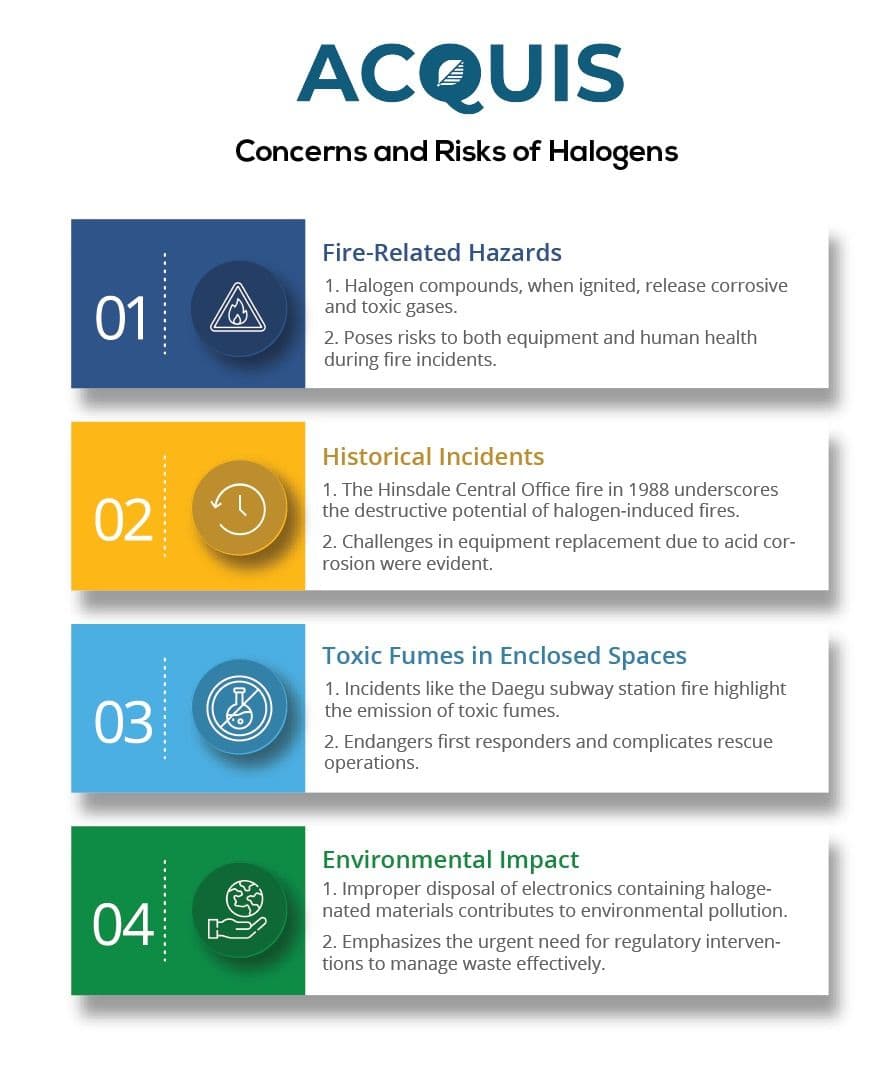
Concerns and Risks:
Regulations and Standards:
IEC 61249-2-21 is a voluntary industry standard, not a legal requirement. No jurisdiction currently mandates "halogen-free" status as defined by this standard. The actual legal restrictions on halogenated substances in electronics come from separate regulations:
- RoHS (Directive 2011/65/EU) restricts two specific brominated flame retardants, PBB and PBDE, to below 0.1% by weight at the homogeneous material level. This is a legal requirement for CE marking, but it restricts two named substances, not "halogens" broadly.
- The EU POPs Regulation ((EU) 2019/1021) separately restricts persistent organic pollutants including decaBDE and HBCD, both brominated flame retardants used historically in plastics and textiles.
A product can be fully RoHS-compliant while still containing halogenated materials that fall outside PBB/PBDE. "Halogen-free" per IEC 61249-2-21 is a stricter, voluntary specification some OEMs require contractually, distinct from the legal RoHS/POPs floor.
- IEC's Crucial Role:
- The International Electrotechnical Commission (IEC) is pivotal in setting industry benchmarks.
- Standards like IEC 62474 address hazardous materials reporting, promoting transparency.
- European Legislation on Flame Retardants:
- Europe has enacted legislation limiting halogenated flame retardants in designated plastics.
- Reflects a proactive approach to address environmental concerns and resource scarcity.
- Industry Response:
- Manufacturers are adapting to regulations by developing products with reduced halogen content.
- However, challenges persist, notably in the standardization of terminology and testing methods.
- Emphasis on Resource Scarcity and Recycling:
- Growing attention to resource scarcity and recycling drives legislative actions.
- Urges industries to adopt sustainable practices and develop alternatives to halogenated materials.
Role of Standards in Achieving Clarity:
- Terminology Challenges:
- Inconsistencies in terminology and testing methodologies create industry-wide challenges.
- Terms like "halogen-free," "non-halogenated," "zero halogen," and "low halogen" are used interchangeably.
- Industry Confusion:
- The interchangeable use of terms leads to confusion within the industry and its supply chain.
- Hinders effective communication and understanding of halogen-related provisions.
- IEC Advisory Committee Initiative:
- The IEC Advisory Committee on Environmental Affairs (ACEA) recognizes the need for clarity.
- Undertakes the development of a comprehensive guide for standards developers.
- Objective: Uniform and Clear Terminology:
- The guide aims to establish uniform and clear terminology related to halogen content.
- Provides a standardized framework for consistent communication and understanding.
- Addressing Discrepancies:
- The initiative seeks to address existing discrepancies in the usage of halogen-related terms.
- Promotes a standardized approach to enhance transparency and coherence in the industry.
- Facilitating Effective Communication:
- By establishing standardized terminology, the initiative facilitates effective communication.
- Enables stakeholders to navigate halogen-related provisions with clarity and precision.
Conclusion:
In conclusion, the versatile applications of halogens, despite their undeniable benefits, demand a judicious approach to address inherent risks. The standardization initiatives spearheaded by organizations like the IEC play a pivotal role in elucidating terminology, ensuring environmental stewardship, and catalysing innovative strides in halogen-free material development.
By fostering clarity through standardized practices, these efforts not only enhance industry transparency but also contribute to a sustainable future. The ongoing pursuit of a scientifically sound classification of halogens based on risk factors serves as a compass, guiding the trajectory of materials and manufacturing practices toward safer, more responsible, and environmentally conscious solutions. In this collaborative journey, standardized approaches become the cornerstone for navigating the complexities of halogen-related challenges and shaping a resilient and forward-looking industry landscape.
A "halogen-free" label without IEC 61249-2-21 evidence behind it is a claim a customer or auditor can challenge. Book a Regilient demo to see how Regilient turns halogen-free claims into documented, audit-ready compliance data.