
Table of Contents
In brief
The Montreal Protocol on Substances that Deplete the Ozone Layer is the 1987 international treaty that phases out ozone-depleting substances, and it is the only treaty in history ratified by all 198 UN member states. Its 2016 Kigali Amendment now drives global cuts to hydrofluorocarbons (HFCs) of more than 80% within 30 years, and that phase-down is what has turned an old ozone treaty into a live 2026 compliance and disclosure obligation. Regilient's ESG reporting automation tracks ozone-depleting and F-gas obligations alongside GRI, CSRD, and EPA disclosure requirements.
Key facts
Field | Detail |
|---|---|
Applies to | Manufacturers producing, importing, or using CFCs, HCFCs, halons, or HFCs in refrigeration, air conditioning, foams, aerosols, or fire suppression |
Core obligations | Phase-out production and consumption of controlled substances; report emissions; hold quota or allowance where required |
Key thresholds | Kigali Amendment: over 80% cut in global HFC production and consumption within 30 years; EU quota cut to roughly 12% of 2015 baseline by 2030 |
Key dates | 1987 (Protocol adopted); 2016 (Kigali Amendment); 2024 to 2028 (US 60% HFC cap); 2029 to 2033 (US 30% HFC cap); 2036 (US 85% cut complete); 2050 (EU HFC phase-out complete) |
Enforced by | UNEP Ozone Secretariat and national authorities; in the EU, the F-Gas Portal and Member State authorities; in the US, EPA under the AIM Act |
Why an ozone treaty is a 2026 compliance issue
The Montreal Protocol looks, at first glance, like finished business. The chemicals it originally targeted, CFCs and halons, have been phased out of production for years, and the ozone layer is recovering: the 2025 Antarctic ozone hole was the fifth-smallest since 1992, and it closed on 1 December, the earliest closure since 2019.
What is not finished is the Protocol's most recent chapter. The 2016 Kigali Amendment shifted the treaty's attention to hydrofluorocarbons (HFCs), the refrigerants that replaced the original ozone-depleting substances. HFCs do not deplete ozone, but they are potent greenhouse gases, and the global phase-down schedule now attached to the Protocol is actively tightening supply and reporting duties in both the EU and the US through 2026 and beyond.
For a compliance or ESG manager at a manufacturer that uses refrigeration, air conditioning, foam blowing, or fire suppression equipment, that means the Montreal Protocol is no longer a historical footnote. It is the legal ancestor of two active regulatory regimes and one mandatory ESG disclosure line, and all three are moving right now.
What is the Montreal Protocol?
The Montreal Protocol on Substances that Deplete the Ozone Layer is an international treaty, adopted on 16 September 1987 and in force since 1 January 1989, that phases out the production and consumption of ozone-depleting substances (ODS). Together with its 1985 precursor agreement, the Vienna Convention for the Protection of the Ozone Layer, it has achieved universal ratification: all 198 UN member states, plus the Cook Islands, Niue, the Holy See, Palestine, and the European Union, are parties.
The Protocol has been strengthened six times since 1987 through a series of formal amendments, and it also carries a unique adjustment mechanism that lets parties tighten existing phase-out schedules quickly, with the tightened schedule applying automatically to every ratifying country.
The substances, the amendments, and where recovery stands
Regilient's compliance definition: ozone-depleting substance (ODS) is any of the nearly 100 controlled chemicals, including CFCs, HCFCs, halons, and related compounds, whose atmospheric release damages the stratospheric ozone layer.
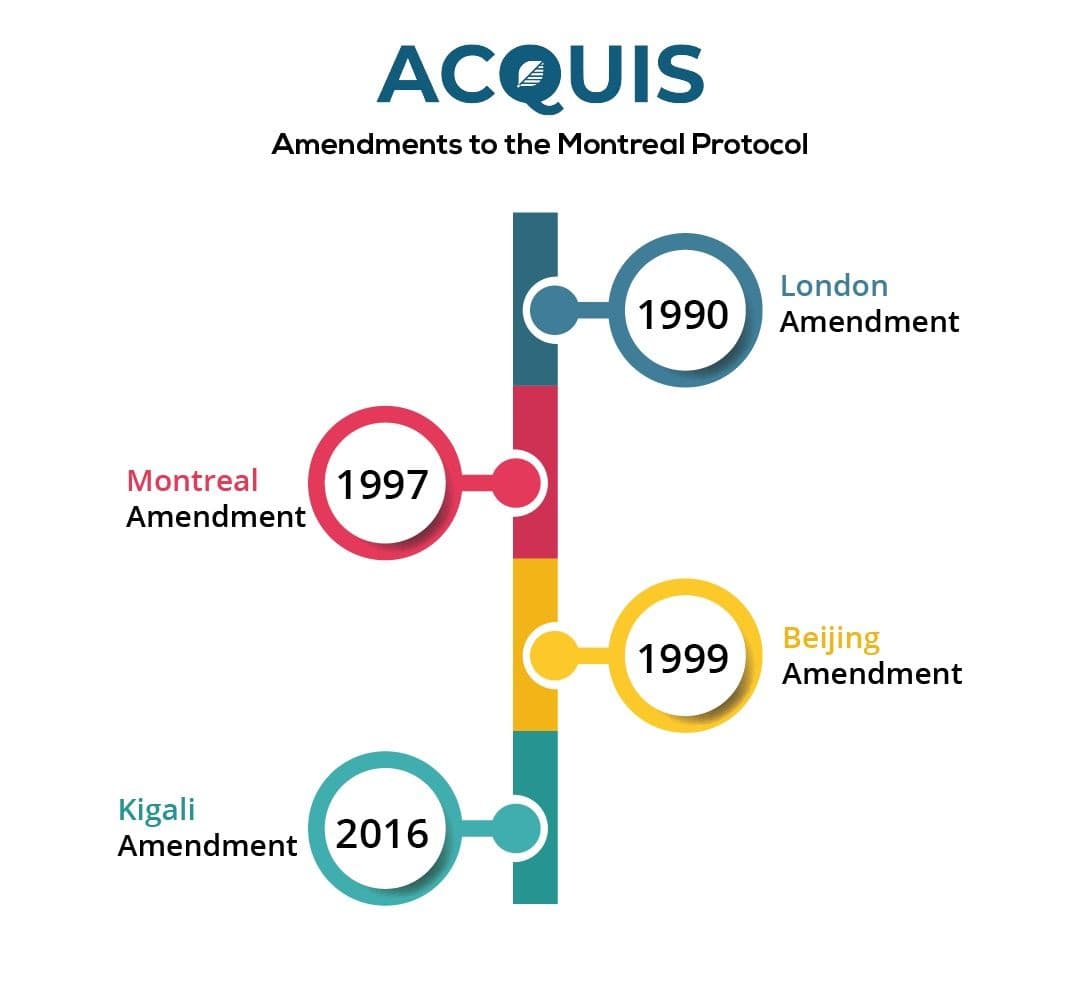
Six amendments have progressively widened the Protocol's scope:
- London (1990): required developed countries to fully eliminate CFCs, halons, and carbon tetrachloride by 2000, and added methyl chloroform to the controlled list.
- Copenhagen (1992): introduced an HCFC phase-out for developed countries, starting in 2004.
- Montreal (1997): extended HCFC controls to developing countries and added methyl bromide for all parties.
- Beijing (1999): tightened HCFC production and trade controls and added bromochloromethane.
- Kigali (2016): added HFCs, chemicals that do not deplete ozone but carry high global warming potential, and set the phase-down schedule now driving 2026 compliance activity.
The 2022 WMO/UNEP Scientific Assessment of Ozone Depletion, the most recent quadrennial report (the next is due in 2026), projects the ozone layer will recover to 1980 levels by around the middle of the century. That recovery is the direct, measured result of the original phase-out; it is also the reason the Protocol's remaining work, the HFC phase-down, gets less attention than it deserves.
The two live phase-down regimes: EU and US
The Kigali Amendment sets a global target. Two separate domestic regimes translate that target into obligations a manufacturer actually has to meet, and they run on different clocks.
In the EU, Regulation (EU) 2024/573 (the F-Gas Regulation) implements Kigali through a quota system. Producers and importers need registration on the EU's F-Gas Portal to place HFCs on the market, the 2025 to 2026 quota already sits roughly 48% below the 2023 level, and from 2026 onwards a quota holder pays a mandatory fee of €3 per tonne of CO2 equivalent for its allocation. The quota continues stepping down toward a full phase-out of new HFC placement by 2050.
In the US, the AIM Act runs its own schedule, aligned with but not identical to Kigali. The allowance cap sits at 60% of baseline from 2024 through 2028, and it drops sharply to 30% of baseline for 2029 through 2033, the steepest single step in the entire US schedule, before reaching an 85% cumulative cut by 2036.
Here is a question worth asking of your own programme: if your bill of materials tracks refrigerant type and charge size by product and by region today, you already have the raw data both regimes require. If it does not, the 2029 US step-down and the EU's rising quota fee will surface that gap at the worst possible moment, mid-supply-chain, not during a planning cycle.
What compliance and ESG teams should do now
- Inventory refrigerant and F-gas content at the product and equipment level. Charge size, refrigerant type, and global warming potential need to sit in the same system as your bill of materials, not in a separate facilities spreadsheet.
- Confirm your GRI 305-6 disclosure obligation. If your organisation reports under GRI 305: Emissions, Disclosure 305-6 requires reporting ODS emissions in metric tons of CFC-11 equivalent. This sits alongside, but separately from, your Scope 1 to 3 GHG figures.
- Map the ODS line to ESRS E2 if you report under CSRD. ESRS E2 covers pollution, and several GRI 305 disclosures map directly into ESRS datapoints, so ODS and F-gas data collected once can serve both frameworks.
- Track your F-Gas Portal quota position if you place HFCs on the EU market, and track your AIM Act allowance position if you do so in the US. The two schedules move on different years and different percentages; treating them as one obligation is a common and costly assumption.
- Build a monitoring process for the next quadrennial assessments and amendment cycles. The Protocol's adjustment mechanism means schedules can tighten quickly, and the next WMO/UNEP Scientific Assessment is due in 2026.
A programme that does all five of these consistently looks very different from one relying on an annual facilities audit and a shared spreadsheet: it can answer a supplier's or an auditor's question about ODS and HFC exposure in minutes, not weeks.
How this connects to your ESG programme
Ozone-depleting substance and F-gas tracking is not a separate compliance silo. It draws on the same product-level and supplier-level data that already feeds your REACH, RoHS, and PFAS substance tracking, and it needs to land in the same disclosure pipeline as your GRI, CSRD, and CBAM reporting.
Regilient's ESG reporting frameworks software maps GRI, SASB, CDP, and TCFD data points against a single crosswalk, so an ODS emissions figure collected once for GRI 305-6 can be validated, versioned, and exported into ESRS E2 without a second data collection cycle. Regulatory alerts flag amendment cycles, quota changes, and AIM Act allowance updates as they happen, so a phase-down step does not surface as a surprise during an audit.