
Table of Contents
- Why REACH Mistakes Still Happen in 2026
- Mistake #1: Ignoring Article 33 Communication Obligations
- Mistake #2: Confusing "Substance" vs "Mixture" vs "Article"
- Mistake #3: Failing to Keep Up with SVHC Candidate List Updates
- Mistake #4: Incomplete Supply Chain Declarations
- Mistake #5: No System for Tracking Authorisation or Restriction Status
- Mistake #6: Misapplying the 0.1% w/w Threshold
- Mistake #7: Treating SCIP Notification as Optional or Low Priority
- Mistake #8: Treating "RoHS Compliant" as Proof of REACH Compliance
- The Cost of Non-Compliance: Fines, Market Access, and Reputation
- How Regilient Helps You Stay REACH-Ready
Why REACH Mistakes Still Happen in 2026
Despite the maturity of the EU REACH regulation, many companies, especially those outside the EU, continue to face major compliance challenges. With regulatory updates, supply chain complexity, and evolving obligations, even well-intentioned manufacturers and OEMs can stumble. Let's break down the most common REACH compliance mistakes and learn actionable strategies to avoid them.
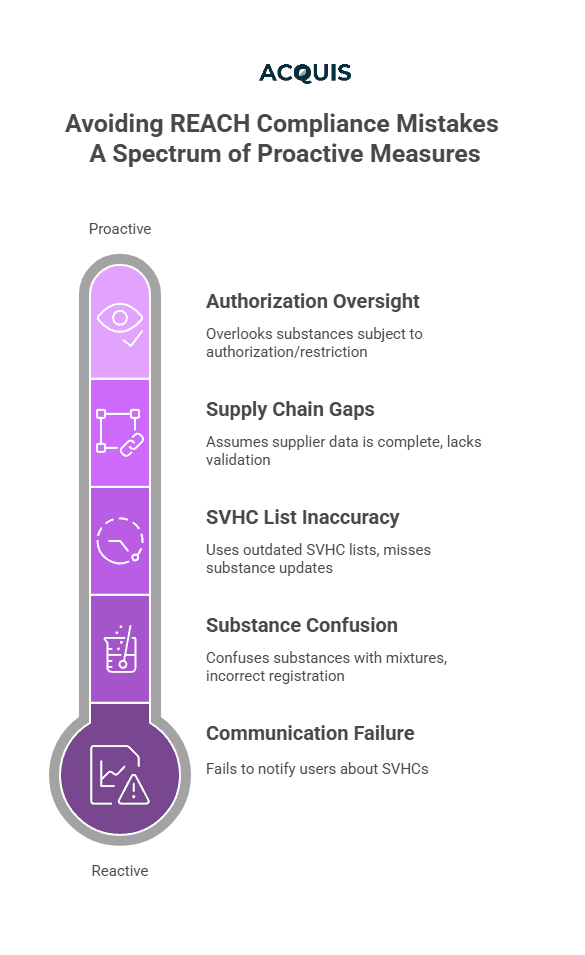
Mistake #1: Ignoring Article 33 Communication Obligations
What goes wrong: When an article contains a Substance of Very High Concern (SVHC) from the REACH Candidate List above the 0.1% weight-by-weight (w/w) threshold, the supplier has a legal obligation to communicate this to every recipient in the supply chain. Many manufacturers either do not know this obligation exists, treat it as optional, or assume that their existing safety data sheets (SDS) satisfy it.
Article 33 of REACH is not optional, and an SDS does not fulfil it. The requirements are specific:
- To professional recipients: You must provide sufficient information to allow safe use of the article, at a minimum the name of the SVHC. This obligation is automatic and proactive; you do not wait for someone to ask.
- To consumers: If a consumer requests information, you must respond within 45 days, free of charge, with the SVHC name and safe-use information.
The obligation triggers the moment a substance is added to the Candidate List. As of February 2026, that list contains 253 entries, and it grows with every ECHA update cycle.
Why it happens: Article 33 is a supply-chain communication duty, not a registration or notification duty. It does not generate a filing number or a submission receipt. Because there is no formal "submit and confirm" step, it is easy to overlook. Many compliance teams focus their energy on ECHA notifications (Article 7(2)) and SCIP submissions because those have clear submission interfaces and deadlines, while Article 33 sits in the background as a continuous obligation.
The fix: Implement automated alerts within your compliance management system that flag every product and component containing a Candidate List SVHC above 0.1% w/w. When a flag triggers, the system should generate an Article 33 notification with the SVHC name, concentration, and safe-use instructions, ready for distribution to your downstream recipients. This is not a one-time exercise; it must be re-triggered every time the Candidate List is updated or your BoM changes.
Mistake #2: Confusing "Substance" vs "Mixture" vs "Article"
What goes wrong: REACH assigns different obligations depending on whether something is classified as a substance, a mixture, or an article. Misclassification leads to either doing too much (wasting resources on obligations that do not apply) or too little (missing obligations that do).
Here is the distinction, simplified:
- A substance is a chemical element or compound (e.g., lead, di(2-ethylhexyl) phthalate).
- A mixture is a blend of two or more substances (e.g., paint, adhesive, cleaning solvent).
- An article is an object whose function is determined by its shape, surface, or design rather than its chemical composition (e.g., a circuit board, a cable, a gasket).
The obligations differ substantially. Substance and mixture suppliers must provide safety data sheets (SDS). Article suppliers do not provide SDS but instead have Article 33 communication and Article 7(2) notification obligations when SVHCs are present above the threshold.
Why it happens: The boundary between "mixture" and "article" is not always intuitive. A printer cartridge filled with ink: is that an article (it has a defined shape and function) or a mixture (the ink is a chemical blend)? Under REACH, it is treated as an article that contains a mixture. The SVHC obligations apply to the article as a whole, and the 0.1% w/w threshold is assessed against the article, not the mixture inside it.
The fix: Conduct REACH classification training for your regulatory, product engineering, and procurement teams. Use material classification tools to tag each component in your BoM as substance, mixture, or article. When in doubt, refer to ECHA's "Guidance on requirements for substances in articles" (Version 4.0 or later) for boundary cases.
Mistake #3: Failing to Keep Up with SVHC Candidate List Updates
What goes wrong: The Candidate List is not static. ECHA adds new SVHCs in update cycles that typically occur twice per year (January/February and June/July). Each update can add anywhere from one to a dozen or more substances. Manufacturers who screened their products against the list two years ago and have not re-screened since are working with stale data and are potentially non-compliant for any newly added SVHCs present in their articles.
The February 2026 update, for example, added n-hexane (widely used in coatings, polymer processing, and cleaning agents) and bisphenol AF and its salts (used in process regulation and cross-linking). If your products use any of these chemistries and you have not re-screened, your Article 33 and SCIP obligations for those substances are already overdue.
Why it happens: Without automated monitoring, SVHC updates are easy to miss. ECHA publishes press releases and updates its website, but if nobody on the compliance team is actively watching (or if the update falls during a holiday period), weeks or months can pass before the new additions are actioned.
The fix: Subscribe to ECHA's notification service for Candidate List updates. Better yet, integrate a real-time regulatory feed into your REACH compliance management software so that new SVHC additions automatically trigger a re-screening of your entire product portfolio. The system should flag any products that contain the newly added substance and generate the corresponding Article 33, Article 7(2), and SCIP actions without manual intervention.
Mistake #4: Incomplete Supply Chain Declarations
What goes wrong: Manufacturers assume their tier-1 suppliers have complete, accurate material data. In practice, supplier declarations are frequently incomplete, outdated, or non-specific. A supplier may declare "contains no restricted substances" without specifying which regulation or substance list they are referencing. Or they may provide a full material declaration (FMD) for the finished component but have no data on sub-components sourced from their own tier-2 suppliers.
The result: your BoM looks clean on paper, but the underlying data has gaps that are invisible until someone probes them.
Why it happens: Supplier data collection is a relationship exercise as much as a technical one. Smaller suppliers may lack the regulatory expertise to provide declarations in standardised formats. Global supply chains introduce language barriers, timezone complications, and varying levels of regulatory awareness. And many procurement teams treat compliance data collection as a one-time onboarding task rather than an ongoing requirement.
The fix: Use a digital supplier engagement tool to collect, validate, and audit material declarations in standardised formats such as IPC-1752A (commonly used in electronics), IEC 62474 (electrotechnical products), or full material disclosure (FMD) templates. Implement automated data gap detection that identifies missing substances, incomplete coverage percentages, and expired declarations. Set re-validation cycles (annually at minimum, or triggered by BoM changes and regulatory updates).
The goal is not to trust your suppliers less; it is to give them the structure and tools to provide better data. A supplier portal with pre-built templates and validation rules makes it easier for suppliers to comply and easier for you to verify.
Mistake #5: No System for Tracking Authorisation or Restriction Status
What goes wrong: The Candidate List is only the first stage of REACH's substance control pipeline. Substances on the Candidate List can be escalated to the Authorisation List (Annex XIV), which effectively bans their use after a defined sunset date unless the manufacturer obtains a specific, time-limited authorisation from the European Commission. Separately, substances can be placed on the Restriction List (Annex XVII), which imposes conditions or outright bans on manufacture, marketing, or use.
Many manufacturers track the Candidate List but lose sight of substances as they move through the Authorisation and Restriction pipelines. The Authorisation List currently contains 59 entries as of the last published amendment, with the 12th and 13th recommendation rounds potentially adding further substances. The 12th recommendation round was submitted to the European Commission; check whether any additional entries have been formally added since then]. Annex XVII contains 77 entries as of mid-2025, with 22 new CMR substance restrictions expected in 2026.
Why it happens: The Candidate List, Authorisation List, and Restriction List are governed by different processes, different timelines, and different legal consequences. Tracking them requires monitoring three separate regulatory pipelines simultaneously, each with its own consultation periods, recommendation rounds, and Official Journal publications. Without a centralised system, substances slip through the cracks between lists.
The fix: Map every substance in your product inventory against all three REACH lists (Candidate List, Annex XIV, Annex XVII) and automate alerts for status changes. When ECHA publishes a recommendation for Annex XIV inclusion, your system should immediately flag affected products and estimate the timeline to sunset date. When an Annex XVII restriction is published in the Official Journal, the system should trigger a compliance assessment for every product containing the restricted substance.
This is not a spreadsheet-scale problem. If you are tracking hundreds of substances across thousands of products, you need a platform that maintains a live regulatory database and maps it against your BoM continuously.
Mistake #6: Misapplying the 0.1% w/w Threshold
What goes wrong: The 0.1% w/w threshold for SVHC obligations under REACH is applied per article, not per finished product. This distinction matters enormously for complex products. A laptop contains dozens of individual articles (circuit boards, cables, housing components, display panels, screws). The 0.1% threshold is assessed against each of those articles individually, not against the total weight of the laptop.
This means a small component (say, a 5g gasket) that contains 0.015g of a Candidate List SVHC (0.3% w/w of that gasket) triggers Article 33 obligations, even though that same 0.015g represents a negligible percentage of the total 2kg laptop.
Why it happens: The "per product" interpretation is intuitively simpler and, frankly, more convenient for manufacturers. Some companies adopted this interpretation before ECHA clarified its position, and have not updated their screening methodology since. Others simply do not have the data granularity to assess SVHC content at the individual article level within a complex product.
The fix: Ensure your SVHC screening methodology assesses the 0.1% w/w threshold at the individual article (component) level, not the finished product level. This requires BoM data that is granular enough to identify materials and substances at the component level, and supplier declarations that report SVHC content per component rather than per shipment or per finished assembly.
Here is a concrete example to illustrate:
Imagine a power supply unit weighing 200g. It contains a PVC cable with a plasticiser that is a Candidate List SVHC. The cable weighs 10g, and the plasticiser makes up 2g of that cable (20% w/w of the cable). Even though 2g is only 1% of the total power supply weight, the cable is a separate article. At 20% w/w of the cable, the SVHC content is well above the 0.1% threshold, and Article 33 and SCIP obligations apply.
Mistake #7: Treating SCIP Notification as Optional or Low Priority
What goes wrong: The SCIP database (Substances of Concern In articles as such or in complex objects, i.e., Products) was established under the EU Waste Framework Directive. Since January 2021, EU/EEA producers, importers, assemblers, and distributors of articles containing a Candidate List SVHC above 0.1% w/w must submit a SCIP notification to ECHA. The data is publicly accessible and supports circular economy objectives by ensuring waste handlers know which substances of concern are present in products entering the waste stream.
Many manufacturers still treat SCIP as a secondary obligation, something to get to after the "real" REACH compliance work is done. Some are not aware it exists at all.
Why it happens: SCIP was a relatively late addition to the REACH compliance landscape, coming into force in January 2021 under the Waste Framework Directive rather than REACH itself. Enforcement has been uneven across Member States, and the submission interface (via ECHA's IUCLID system) is not the most intuitive. The combination of a newer obligation, inconsistent enforcement, and a cumbersome submission process has led many companies to deprioritise it.
The fix: Integrate SCIP dossier generation into your existing SVHC screening workflow. When your system flags a product as containing a Candidate List SVHC above 0.1% w/w, the SCIP notification should be generated as part of the same process, not as a separate, later step. Purpose-built compliance platforms can export data directly in the SCIP-compatible format, eliminating the manual translation from spreadsheets to IUCLID.
Mistake #8: Treating "RoHS Compliant" as Proof of REACH Compliance
What goes wrong: This is one of the most common conflations in the industry, particularly among non-EU manufacturers supplying into the European market. A supplier declares their product "RoHS compliant" and the manufacturer's compliance team records it as evidence of REACH compliance. These are fundamentally different regulations with different scopes.
RoHS (Restriction of Hazardous Substances, Directive 2011/65/EU) restricts the use of specific substances (lead, mercury, cadmium, hexavalent chromium, PBBs, PBDEs, and four phthalates) in electrical and electronic equipment, with defined maximum concentration thresholds.
REACH is far broader. It covers all chemical substances manufactured in or imported into the EU above 1 tonne per year, applies across all industries (not just electronics), and imposes a range of obligations from registration and evaluation through to authorisation and restriction. The SVHC Candidate List alone contains 253 entries, the vast majority of which are not covered by RoHS at all.
A product can be fully RoHS compliant and simultaneously contain multiple Candidate List SVHCs above the 0.1% threshold.
Why it happens: Both regulations deal with hazardous substances in products, and in the electronics sector they often come up in the same conversation. Procurement and supplier management teams that lack specific REACH training may default to the simpler "yes/no RoHS compliant" framework and assume it covers the broader regulatory landscape.
The fix: Treat RoHS and REACH as separate compliance tracks, each with its own data requirements, substance lists, and reporting obligations. When requesting supplier declarations, always specify which regulation you are requesting data for. A generic "is this product compliant?" question will get you a generic answer. Instead, ask: "Does this article contain any substance from the REACH Candidate List above 0.1% w/w?" and require the supplier to reference the specific Candidate List version they screened against.
The Cost of Non-Compliance: Fines, Market Access, and Reputation
From six-figure penalties to blocked shipments and public non-compliance listings, the cost of getting REACH wrong is steep. And with enforcement tightening across the EU, the margin for error is shrinking.
How Regilient Helps You Stay REACH-Ready
Regili automates the tedious, error-prone parts of REACH compliance:
- Real-time SVHC list monitoring
- Automated Article 33 and SCIP dossier generation
- Supplier engagement workflows
- Annex XIV/XVII tracking
Let us help you simplify REACH compliance and reduce regulatory risk.
Book a Compliance Audit Review
Is your REACH program bulletproof? Book a free strategy session with our compliance experts to find out.