
Table of Contents
- CBAM at the border
- The four questions the customs rules answer
- Part one: Who has to declare
- Direct or indirect: the difference that costs money
- A worked example: same goods, different person on the hook
- Three rules that catch people out
- Part two: What starts the obligation
- Inward processing: the rule worth reading twice
- Returned goods
- There is no accidental back door
- Part three: Where the goods came from
- Origins that put you outside CBAM
- Switzerland and preferential proofs
- Northern Ireland
- Part four: What you write on the form
- The two habits that matter most
- Before you file: a short working checklist
- Outlook: what is coming for customs teams
- How Regilient supports CBAM customs work
In brief: CBAM customs rules decide who owes CBAM and when. Under Regulation (EU) 2023/956, the obligation falls on whoever enters their CBAM account number on the customs declaration, at the moment the goods are released for free circulation. Representation, origin and Y codes all follow from that rule. Regilient tracks CBAM goods, origins and declarant status across your supplier base.
CBAM at the border
You can get your emissions number exactly right and still get CBAM wrong. The obligation is not created by the calculation. It is created by the customs declaration. Here is who has to declare, what starts the obligation, why origin matters twice over, and which codes belong on the form, in plain English.
Drawn from Regulation (EU) 2023/956, the Union Customs Code (Regulation (EU) No 952/2013) and the European Commission's published CBAM guidance, current to 27 May 2026.
Most CBAM effort goes into the number. Companies chase supplier data, argue about default values and wait on verification. That work matters, but it is not what creates the obligation.
The obligation is created at the border. A customs declaration is filed, the goods are released, and from that moment a named legal person owes CBAM. If the customs side is wrong, a perfect emissions figure will not rescue it.
The customs rules answer four questions, in this order. Who has to declare? What starts the obligation? Where did the goods come from? And what do you write on the form? Twenty-four separate clarifications sit behind those four questions. They are set out below, one question at a time.
One rule to remember CBAM is owed by whoever puts their CBAM account number on the customs declaration, at the moment the goods are released for free circulation.
Almost every rule in this guide is a version of that one sentence. If you know who entered the number, and when the goods were released, you can usually work out the answer yourself.
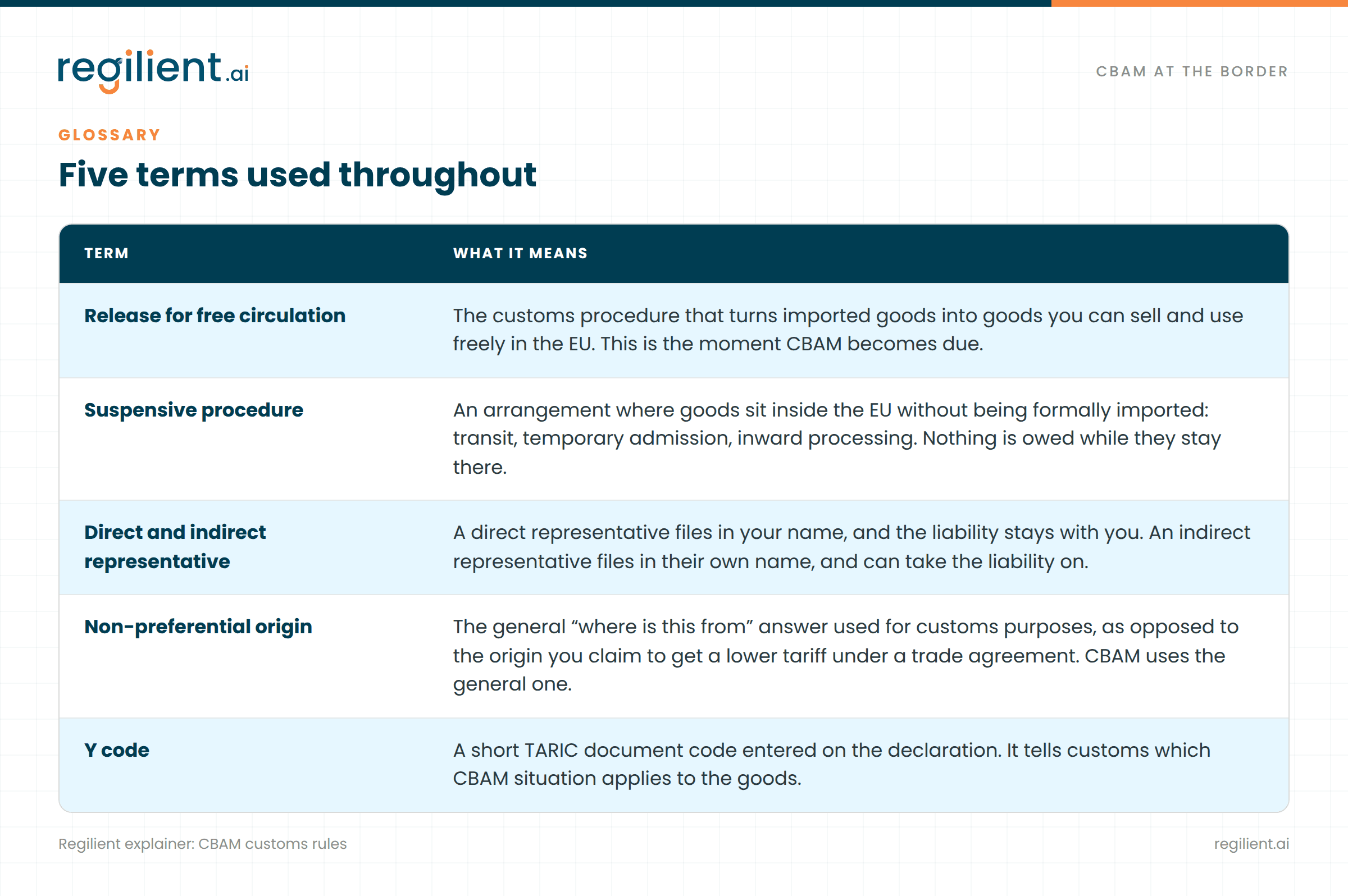
The four questions the customs rules answer
Question one: Who has to declare? CBAM follows the CBAM account number on the declaration. Not the commercial relationship, and not who arranged the freight.
Question two: What starts it? Only release for free circulation. Transit, temporary admission and inward processing do not, until the goods leave those regimes.
Question three: Where is it from? Origin decides whether CBAM applies at all. The country of production decides who can give you the emissions data.
Question four: What do you write? A short list of Y codes. Picking the wrong one is treated as a compliance finding, not a typing error.
Part one: Who has to declare
The rule looks simple. The CBAM declarant is either the importer or the indirect customs representative: whichever of the two enters the CBAM account number on the customs declaration.
Whether you get a choice about that comes down to one fact: is the importer established in an EU Member State?
Yes, established in the EU: the importer declares. The importer is the CBAM declarant and must hold authorised CBAM declarant status. The only way out is for an indirect customs representative to agree to take the role for those particular goods.
No, established outside the EU: an indirect representative must declare. There is no default and no choice. The indirect customs representative becomes the authorised CBAM declarant and carries the obligations that go with it.
In practice: Agree representation in writing before the first shipment, not at the border. A representative who has not agreed to act as CBAM declarant does not become one just because the goods have turned up.
Direct or indirect: the difference that costs money
This is the most common misunderstanding in CBAM, so it is worth saying flatly. Appointing a direct customs representative moves nothing. The importer is still the CBAM declarant, and the representative takes on no CBAM obligations at all.
Only an indirect customs representative can become the authorised CBAM declarant, and only if they agree to.
Arrangement | Who is the CBAM declarant | Can the role be refused? |
|---|---|---|
EU importer, no representative | The importer | Not applicable |
EU importer, direct representative | The importer; the representative takes on nothing under CBAM | Not applicable |
EU importer, indirect representative | Either, depending on who enters the account number | Yes, the representative may refuse |
Non-EU importer | The indirect customs representative, necessarily | No |
Where refusal is possible and the representative refuses, they must notify the importer and tell them that the CBAM obligations are theirs to meet. A company holding an Entry in the Declarant's Records authorisation can act as CBAM declarant, and can refuse in exactly the same way.
In practice: If your broker calls itself your "customs agent", ask two separate questions. Do you act directly or indirectly? And have you agreed to be our authorised CBAM declarant? The answers are independent of each other.
A worked example: same goods, different person on the hook
Scenario A: the EU buyer imports. A German buyer purchases steel fittings from a Turkish manufacturer and imports them in its own name. The buyer is established in the EU, so it is the CBAM declarant and needs authorised CBAM declarant status.
Scenario B: the non-EU seller imports. The same Turkish manufacturer imports in its own name and delivers to the German buyer afterwards. It is not established in the EU, so it cannot be the declarant. An indirect customs representative has to take the role.
The goods, the route and the emissions are identical in both cases. Only the identity of the importer has changed, and that is enough to move the obligation.
Three rules that catch people out
1. One representative per declaration. For the CBAM goods on a single customs declaration there can be only one indirect customs representative acting as authorised CBAM declarant. If a representative will take the CBAM role for some of the goods but not others, those goods have to go on two separate declarations.
2. Delegating the work does not delegate the liability. An authorised CBAM declarant can have someone else physically submit the declaration on its behalf. Legal responsibility stays exactly where it was.
3. A branch is not automatically a person. If a non-EU parent has an EU branch that does not meet the definition of a "person" in Article 3(18) of the CBAM Regulation, then neither the parent nor the branch can be an authorised CBAM declarant, and an indirect customs representative is required. Where the branch does meet that definition, the Member State it is established in determines which national competent authority you deal with.
In practice: If your group imports through an EU branch of a non-EU parent, check the branch's legal status early. It decides both whether you can be an authorised declarant at all, and which national authority you report to.
Part two: What starts the obligation
There is one trigger, and only one: release for free circulation. That is the whole test.
Goods can sit inside the EU customs territory for months under a suspensive procedure and owe nothing at all. The moment they are released, the obligation lands in full.
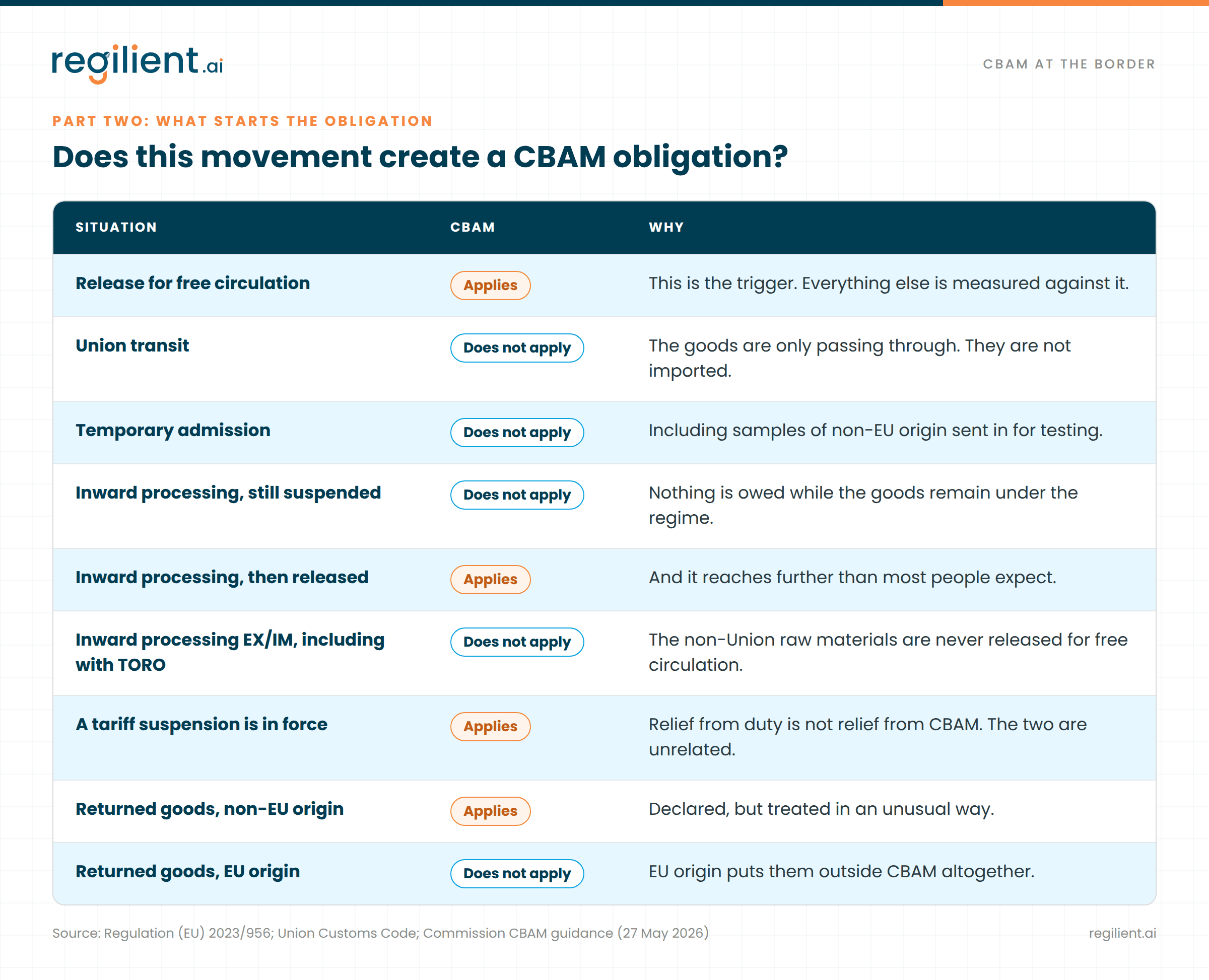
The temporary admission example in the guidance is drawn from Article 95 of Council Regulation (EC) No 1186/2009. The tariff suspension example is Council Regulation (EU) 2023/2890, amending Regulation (EU) 2021/2278.
Inward processing: the rule worth reading twice
While CBAM goods sit under inward processing, nothing is due. If they are later released for free circulation, CBAM applies. So far, so expected.
Here is the part that surprises people. If the CBAM goods have been processed into something else, and that product is released, the authorised CBAM declarant still has to declare the quantities and embedded emissions of the CBAM goods that went in, even when the finished product is not itself listed in Annex I.
Put plainly: turning a CBAM good into a non-CBAM product does not wash the obligation out of it.
Two ways out of inward processing
- Exit A: Re-exported. Goods held under suspension leave the EU. They are never released for free circulation, so CBAM never becomes due.
- Exit B: Released for free circulation. CBAM applies. Declare the quantities and embedded emissions of the CBAM goods that went in, even if the finished product is not an Annex I good.
The customs paperwork discharging the regime, including the bill of discharge, can be used to link the CBAM goods that went in to the products that came out and were released. Keep it.
In practice: Tell your inward processing team that CBAM does not disappear when goods are processed. Build the link from bill of discharge back to the original CBAM goods into your records now. You will need it for the declaration, and again if you are ever checked.
Returned goods
Returned goods are goods coming back into the EU after having been exported. Where they are of non-EU origin and come back under Article 203 of the Union Customs Code, they are subject to CBAM, but with an unusual treatment. They go into the annual CBAM declaration with total embedded emissions reported as zero.
The catch is that they still count towards the 50-tonne threshold, even though the emissions declared are nil. Returned goods as defined in Article 205 of the Code are reported normally, like any other import.
Returned goods | In the declaration? | Emissions | Counts to 50 t? |
|---|---|---|---|
Non-EU origin, Art. 203 UCC | Yes | Reported as zero | Yes |
Non-EU origin, Art. 205 UCC | Yes | Reported normally | Yes |
EU origin | No | Not applicable | No |
The zero-emissions treatment for Article 203 goods comes from Article 6(5) of Regulation (EU) 2023/956. Forgetting that they still count towards the threshold is an easy way to understate your exposure.
In practice: Include returned goods in your 50-tonne monitoring even though their declared emissions are zero. They are easy to leave out of a volume report, and they can be the thing that pushes you over.
There is no accidental back door
A reasonable question: what if goods end up in free circulation because another procedure was breached, and all the duties and taxes have already been paid as a result of that breach? Is CBAM simply missed?
The answer is firm. Release for free circulation requires that the CBAM requirements have been met, so the check has to come first. Where it has not happened, Article 198(1)(b) of the Union Customs Code lets customs authorities take any necessary measures to dispose of goods that cannot be released because they are subject to prohibitions or restrictions, including confiscation and sale, or destruction. Article 198(2) then treats abandoned, seized or confiscated non-Union goods as placed under the customs warehousing procedure.
Separately, even arrangements that sit properly outside CBAM can still be looked at. The guidance says explicitly that the inward processing EX/IM position does not stop the Commission monitoring such operations and assessing whether they amount to a circumvention practice under Article 27 of the CBAM Regulation.
Part three: Where the goods came from
Origin does two separate jobs in CBAM, and they are not the same job. Keeping them apart clears up a great deal of confusion.
Country of origin decides whether CBAM applies at all. It is determined by the EU's non-preferential rules of origin under the Union Customs Code, as required by Article 2(5) of the CBAM Regulation.
Country of production decides who can give you the emissions. It is the country where the last physical processing took place, ignoring packaging. Only that installation's operator can determine the specific embedded emissions, and it also drives the default factor for electricity and indirect emissions.
In most cases the two are the same country. When they are not, using one where the other is required gives you the wrong answer: either about whether CBAM applies, or about which default value to use.
In practice: Keep two fields in your item master, not one. Origin drives the CBAM question. Production drives the data request to your supplier. Merging them is behind a great many wrong default values.
Origins that put you outside CBAM
Under Article 2(4) of the CBAM Regulation, CBAM does not apply to goods originating in the third countries and territories listed in point 1 of Annex III. Norway, Iceland and Switzerland are among them, because they take part in or are linked to the EU Emissions Trading System, so a carbon price is not charged twice.
One practical wrinkle. Because those countries are outside the scope of integrated measures in TARIC, no document code is required for them at importation, and none will be created. There is nothing to look for.
Origin | CBAM | Document code |
|---|---|---|
EU | Does not apply | Y237, proven as for any other non-preferential origin |
Annex III countries and territories | Does not apply | None required, and none will be created |
Büsingen, Heligoland, Livigno | Does not apply | Y134 |
EEA EFTA, from 1 January 2027 | Does not apply, if already released there | Y423 |
Norway and Iceland intend to bring the CBAM Regulation into the EEA Agreement from 1 January 2027. From then on they will apply CBAM at their own external borders, and third-country goods already released for free circulation there will not face CBAM again when they enter the EU.
Switzerland and preferential proofs
CBAM turns on non-preferential origin, and a preferential proof is in principle not acceptable as evidence of it. There is one narrow bridge. A proof issued under the PEM preferential rules can be taken into account for CBAM goods from Switzerland, but only where all three of the following hold:
- Rules at least as strict. The preferential rules of origin are the same as, or stricter than, the non-preferential rules.
- No cumulation applied. No cumulation was used in establishing the origin.
- Stated in the proof. The information about non-cumulation appears in the proof itself.
There is a mirror-image case worth knowing about. Where EU CBAM goods are used as materials in further production in Switzerland, the processing may be too limited to give the goods Swiss non-preferential origin under EU rules, while still giving them Swiss preferential origin through PEM cumulation. For CBAM purposes those goods keep their EU non-preferential origin, and stay exempt.
In practice: If you buy from Switzerland on PEM proofs, ask your supplier to confirm in the proof itself that no cumulation was applied. Without that statement, the proof will not help you for CBAM.
Northern Ireland
Northern Ireland sits in an unusual position. The guidance deals with it in four steps.
- CBAM does not apply to Northern Ireland. It is not listed in Annex 2 of the Protocol on Ireland and Northern Ireland in the EU–UK Withdrawal Agreement.
- Northern Ireland is not part of the EU customs territory, although the Union Customs Code applies there under Articles 4 and 13(1) of the Protocol.
- Goods of GB origin moved from Northern Ireland into the EU are subject to CBAM, provided they are imported into the customs territory of the Union.
- Companies established in Northern Ireland must use an indirect customs representative when releasing CBAM goods from third countries into free circulation in the EU.
Part four: What you write on the form
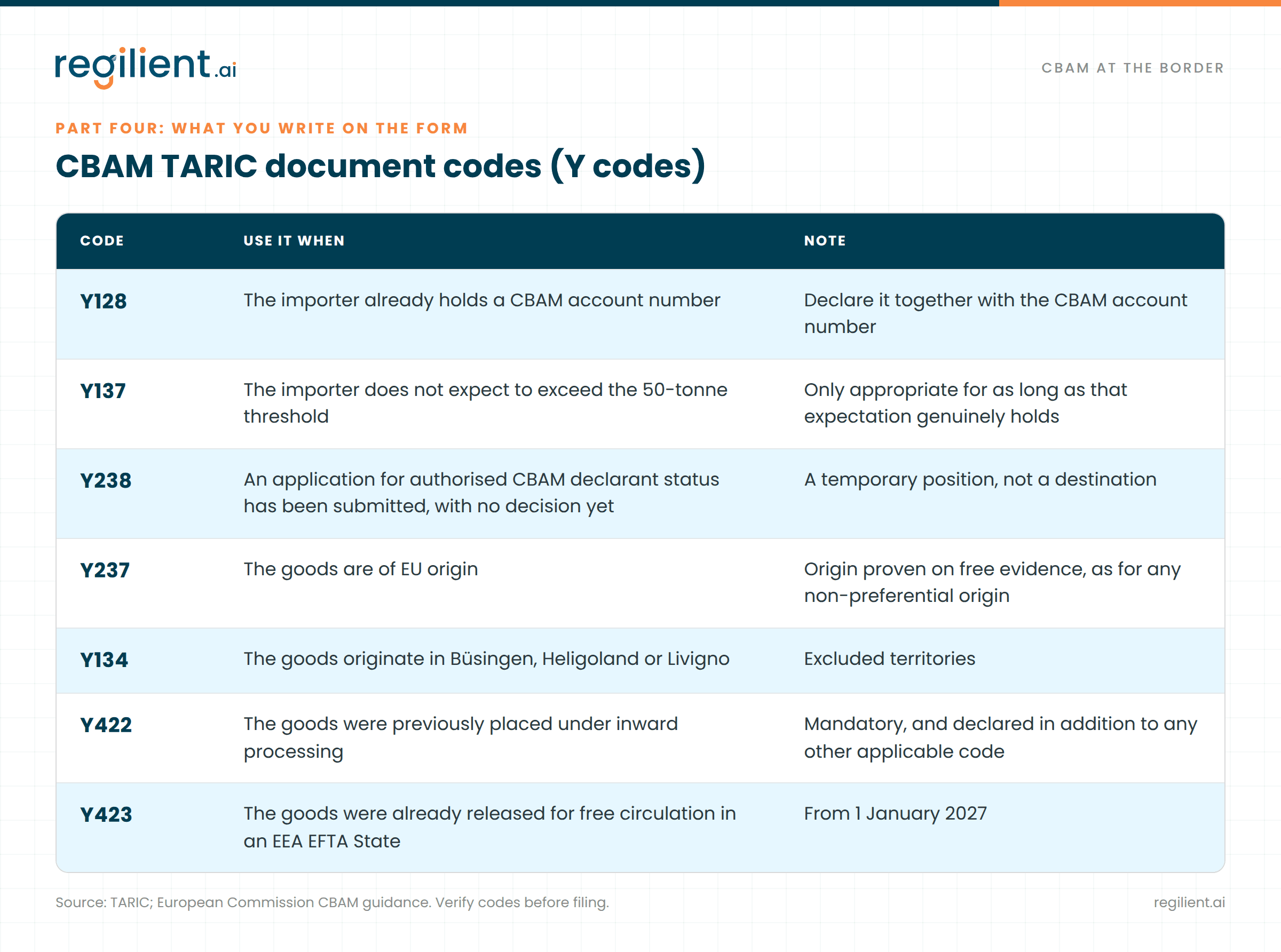
TARIC document codes are how the customs declaration tells the system which CBAM situation the goods are in. There are not many of them, they are short, and choosing the wrong one counts as a compliance finding rather than a clerical slip.
The two habits that matter most
Switch from Y137 to Y128 when you can see it coming, not when it happens. Y137 is for importers who do not expect to exceed 50 tonnes. The moment it becomes foreseeable that the threshold will be crossed during the year, Y128 is the correct code, used from that moment, together with the CBAM account number. You do not wait for the tonnage to actually cross.
Y422 stacks. It does not replace. Where CBAM goods are released for free circulation, or introduced into an Exclusive Economic Zone, after having been under inward processing, Y422 must always be shown. If another Y code also applies (Y238 for a pending application, Y128 for an existing account number), it goes on in addition. Y422 is the code that tells customs the goods came out of inward processing.
In practice: Have someone review the Y codes on a sample of declarations each quarter. Code selection is the cheapest CBAM error to catch internally, and the most awkward to explain to a national competent authority.
Before you file: a short working checklist
The whole guide in five lines
- One trigger: release for free circulation.
- One liable person: whoever entered the CBAM account number.
- Two origins: country of origin decides if, country of production decides who supplies the data.
- One rule that surprises people: inward processing does not wash CBAM out of a good.
- One habit: get the Y code right, and switch codes on foresight rather than on arrival.
Eight questions to answer before the declaration goes in
- Is the importer established in the EU? If not, an indirect customs representative has to act as authorised CBAM declarant.
- If a representative is involved, is it a direct or an indirect one? A direct representative leaves the CBAM liability with the importer.
- Has the indirect representative actually agreed to act as CBAM declarant, and for all the CBAM goods on this declaration?
- What customs procedure are the goods entering? Only release for free circulation triggers the obligation.
- Did any of these goods come out of inward processing? If so, Y422 is mandatory, and the embedded emissions of the original CBAM goods must be declared even if the finished product is not a CBAM good.
- What is the non-preferential origin, and is it an Annex III origin that puts the goods outside CBAM?
- Is the country of production different from the country of origin? If so, your emissions data and default values follow production.
- Which Y code or codes apply? And if you are using Y137, is it still true that you do not expect to exceed 50 tonnes?
Outlook: what is coming for customs teams
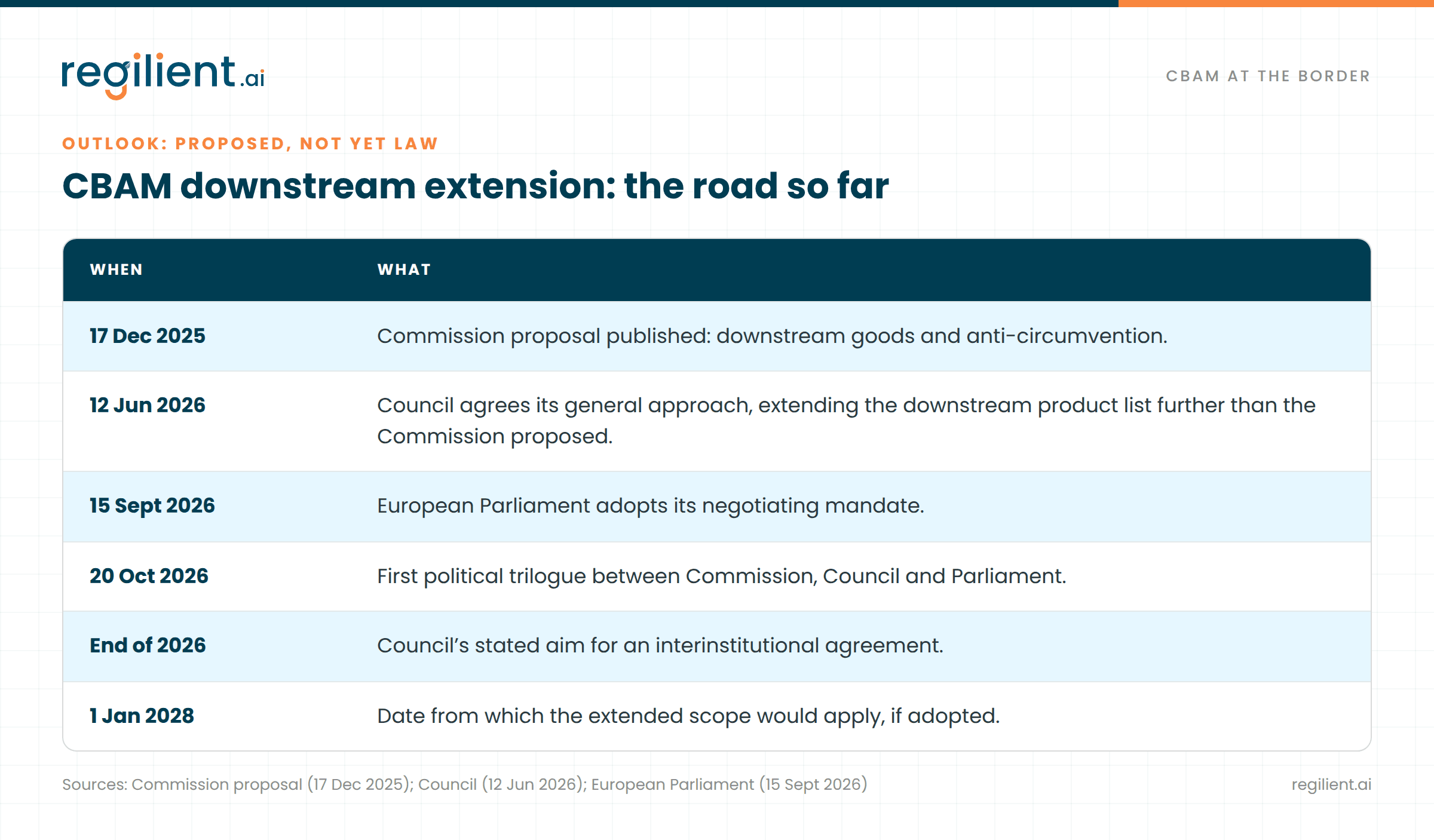
Proposed, not yet law. On 17 December 2025 the Commission tabled a proposal to extend CBAM to downstream goods and to strengthen anti-circumvention measures. Two elements matter for customs teams: a much longer list of goods that would need CBAM treatment on the declaration, and stronger record-keeping obligations for authorised CBAM declarants to back up their emissions calculations. The proposal also brings the artificial reshaping of supply chains to secure lower default values inside the definition of a circumvention practice.
None of this is law yet. If adopted, the wider scope would apply from 1 January 2028, which puts the practical work of classification review, supplier data and representation arrangements in 2027.
How Regilient supports CBAM customs work
Every rule in this guide depends on data that usually sits in different places: representation agreements with the broker, origin and production country in the item master, tonnage in an import report, and installation emissions with the supplier. CBAM errors at the border tend to come from those records disagreeing, not from a lack of effort.
Regilient helps teams keep that data joined up. Supplier outreach collects installation-level emissions and country-of-production data from the operators who can actually provide it. BoM and product mapping keeps CBAM goods, origin and production country as separate fields, so default values follow the right country. Regulatory alerts flag changes such as the downstream extension as they move through trilogue, so classification review starts in good time.
Regilient provides agentic sustainability software for product compliance, supplier engagement, and regulatory intelligence across REACH, RoHS, PFAS, CMRT, SCIP, CBAM, and global chemical regulations.
Prepared by Regilient for information only. Customs practice, document codes and origin rules change; verify against the Official Journal, TARIC and the current Commission guidance, and confirm your position with your customs broker or national competent authority before relying on any point here. This is not legal, regulatory, customs or compliance advice and should not be relied upon without professional or internal review.