
Table of Contents
- Authorised Declarant Status: Exploring the Role and Responsibilities.
- 01 Becoming an authorised declarant isn't a formality
- 02 Liability follows the EORI ( Economic Operators Registration and Identification number) number, not the organization chart
- 03 What the registry actually unlocks
- 04 The Commission's role is oversight, not gatekeeping at the transaction level
- 05 What we'd actually prioritise this quarter
Authorised Declarant Status: Exploring the Role and Responsibilities.
From 1 January 2026, no one moves CBAM goods into the EU without it. We walk through how the status is granted, who ends up holding the obligation when supply chains get complicated, and where the registry fits into a calendar that most importers haven't fully mapped out yet.
THE OBLIGATION CALENDAR - nothing on this list is optional | ||||
FROM 1 JAN 2026 Only authorised CBAM declarants may bring covered goods into free circulation. | ~15 WORKING DAYS Standard consultation window before an NCA can grant authorisation. | BY 30 SEP 2027 First annual CBAM declaration submitted, covering all of 2026. | SAME DATE First surrender of CBAM certificates against that declaration. | FROM 2027 Quarterly purchase requirement: 50% of year-to-date emissions, every quarter. |
Most of the conversations we have with clients about CBAM start in the wrong place. They want to talk about emissions factors, default values, the methodology annexes understandably, since that's where the arithmetic lives. But the arithmetic is irrelevant if the company doing the importing was never entitled to import in the first place.
Chapter 2 of the Commission's CBAM Questions and Answers, updated 27 May 2026, is the part of the guidance that governs entitlement: who can become an authorised CBAM declarant, how the application actually moves through a national competent authority, and what access to the CBAM Registry buys you once you have it. It's procedural rather than technical, which is exactly why it gets skimmed. We'd encourage the opposite. This is the chapter that determines whether goods clear customs at all.
01 Becoming an authorised declarant isn't a formality
Any EU-established importer of CBAM goods, and any indirect customs representative acting for an importer based outside the Union, must hold the status of authorised CBAM declarant before that importer can bring covered goods into free circulation. The application goes in electronically through the CBAM Registry, and it's assessed by the national competent authority in the Member State where the applicant is established not where the goods enter, not where the parent company sits, but where the applicant itself is established.
The criteria the NCA checks are narrower than they might expect:
• No record of serious or repeated infringement of customs legislation, taxation rules, market abuse rules, or the CBAM Regulation itself.
• Demonstrated financial and operational capacity to meet the obligations being taken on.
• Establishment in the Member State where the application was lodged.
• A valid EORI number already assigned.
A consultation procedure has to run before the authorisation can be granted, and the guidance sets an outer limit of fifteen working days for that step. It sounds generous until you map it against a shipment schedule. Companies that wait until goods are en route to start this process are, in effect, gambling with customs clearance.
WHERE THIS BITES The fifty-tonne threshold creates a trap for the unprepared. An importer who stays under it for non-electricity, non-hydrogen goods doesn't need authorisation at all. But the moment cumulative imports for the year are expected to cross fifty tonnes, the declarant must switch from TARIC code Y137 to Y128 and if authorisation wasn't already in hand, there's no grace period to fall back on. Electricity and hydrogen importers never get the exemption; authorisation is mandatory from the first unit. |
FIGURE 1 Where the 50-tonne line actually sits Cumulative imports of a non-electricity, non-hydrogen CBAM good across a single calendar year. Authorisation becomes mandatory the moment crossing the threshold is foreseeable not when it's actually crossed. 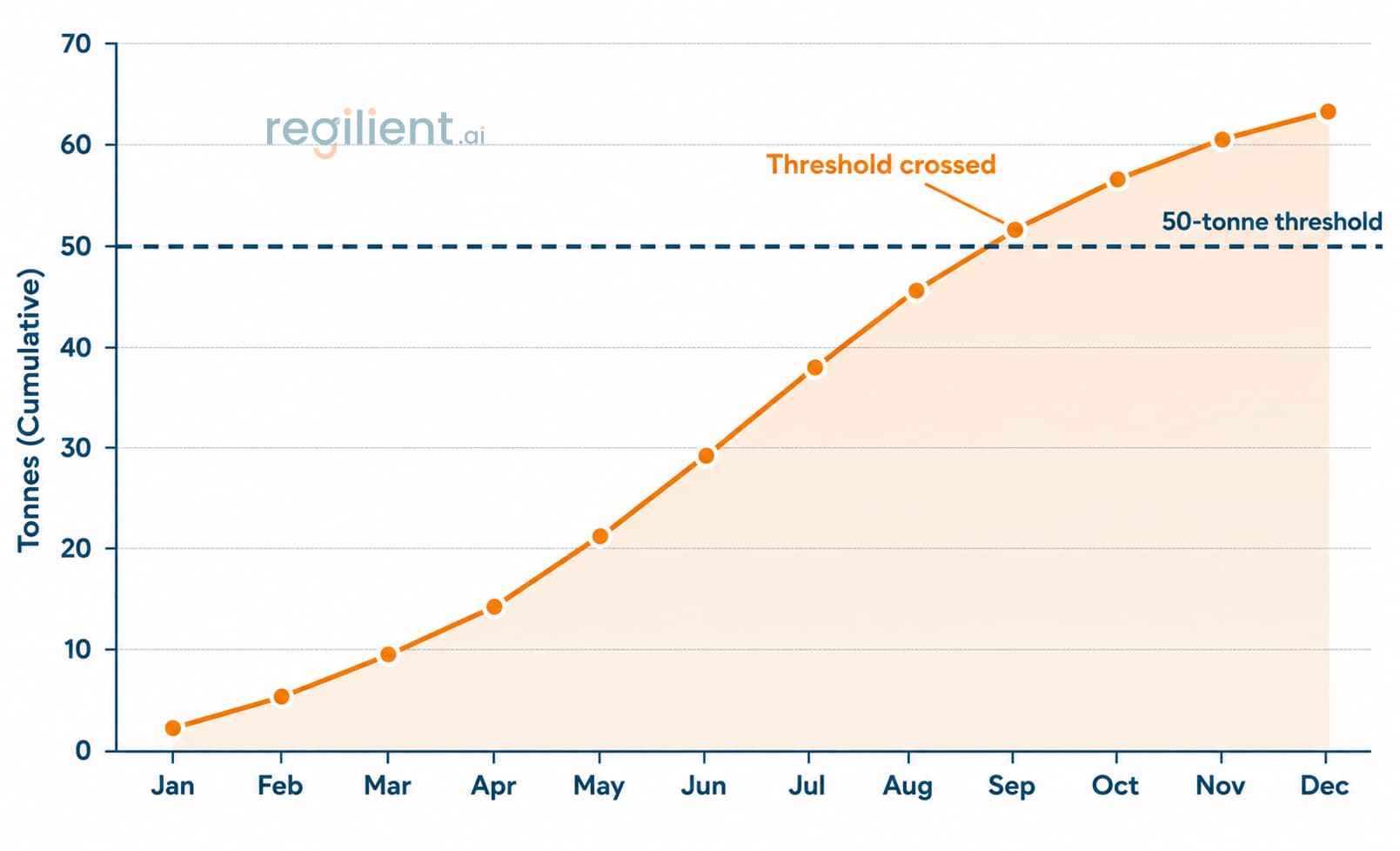 Illustrative volume curve. The TARIC code switch (Y137 → Y128) is a declarant judgment call, made before the line is crossed, not a retroactive correction after it. |
02 Liability follows the EORI (Economic Operators Registration and Identification number) number, not the organization chart
This is the point that trips up groups with layered customs arrangements, and it's worth sitting with. CBAM responsibility attaches to whoever includes the CBAM account number in the customs declaration, full stop. That can be the importer acting in its own name, or an indirect customs representative who has agreed to carry the obligation. A direct customs representative cannot take on this role; an EU importer who appoints one remains personally liable regardless.
The practical effect is that a single multinational with subsidiaries holding different EORI numbers across Member States cannot simply declare at a consolidated, group level by default. Each EORI number anchors its own CBAM declaration. There are three legitimate ways around this, and they carry different consequences:
FIGURE 2 Three structures, three different liability outcomes Who actually answers to the NCA under each model. Amber-bordered boxes carry legal liability; grey boxes do not. 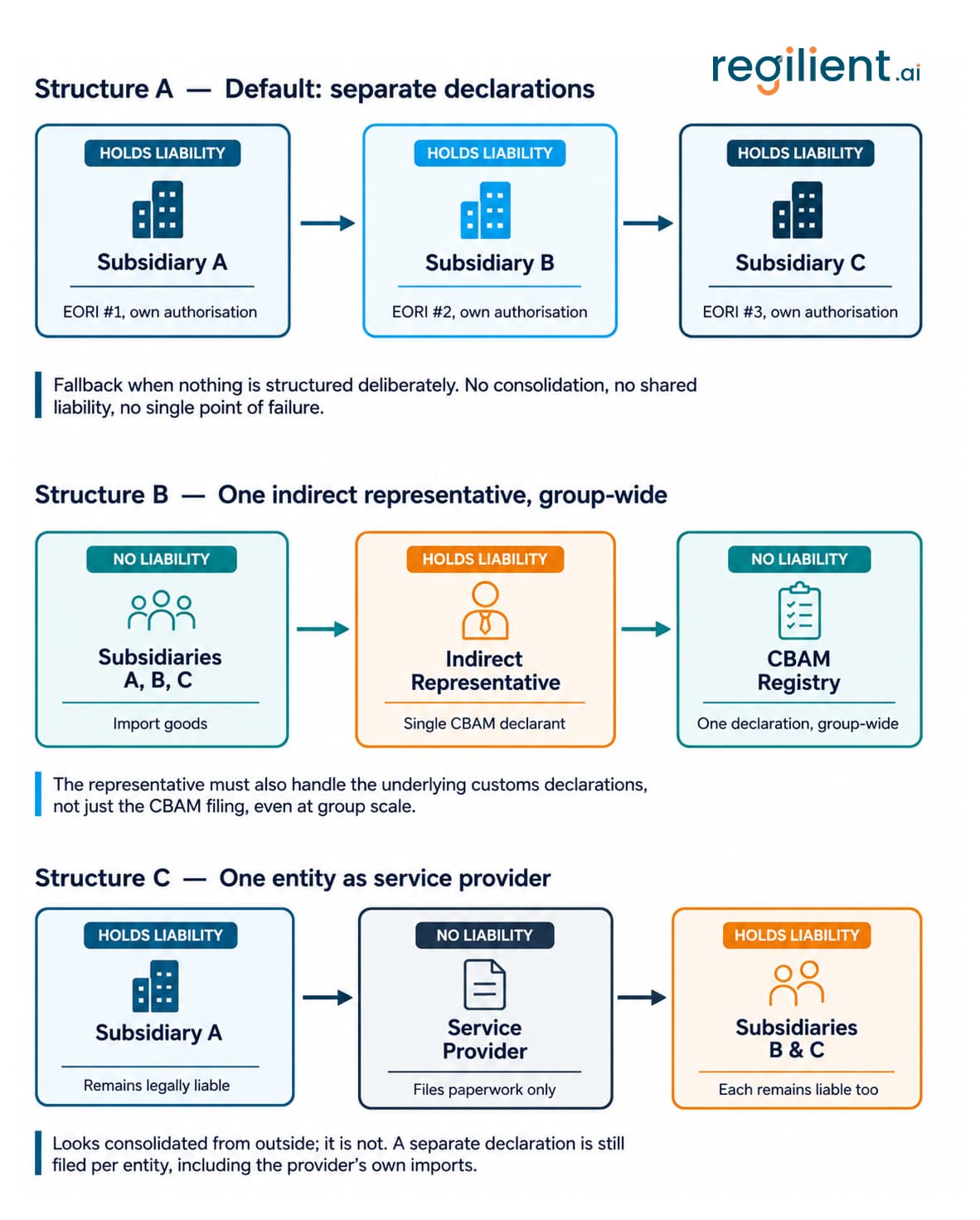 Structure B requires the indirect representative to also handle underlying customs declarations, not just the CBAM filing. Structure C still requires one declaration per entity, including the service provider's own imports. |
Note the distinction in the third structure: a group entity can submit declarations as a service provider for its sister companies, but it must file a separate CBAM declaration for each entity's imports, including its own. Acting as service provider doesn't collapse the paperwork into one filing, and it doesn't transfer legal liability away from the entity that actually imported the goods. The other entities stay on the hook.
03 What the registry actually unlocks
Authorisation and registry access are sequential, not simultaneous. Once an NCA grants authorisation, the Commission assigns a CBAM account number, and that number is the key that opens registry access routed through the EU-wide (UUM&DS) Uniform user management & digital signatures access management system, via either the CBAM domain or the customs domain depending on how the national authority has configured it.
FIGURE 3 From application to registry access The five-step sequence every authorised declarant moves through before they can transact in the registry at all. 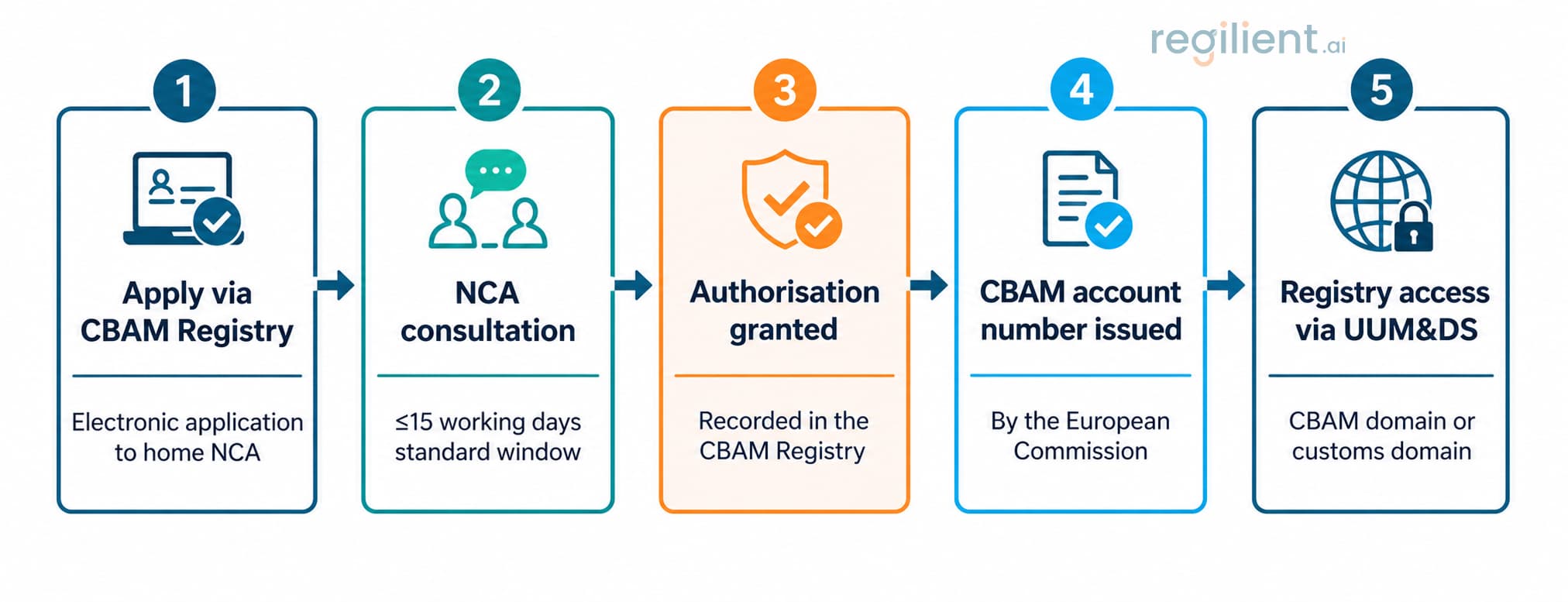 The highlighted step, authorisation granted is the gating event. Nothing on either side of it can be skipped or reordered. |
Inside the registry, an authorised declarant can do four things: submit the annual declaration, purchase CBAM certificates through the connected Common Central Platform, surrender certificates against a declared obligation, and request repurchase of any surplus left on the account afterward. Nothing on that list is available to anyone who hasn't cleared the authorisation step first including the purchase of certificates, which only becomes operationally possible once sales open in February 2027. Tracking these obligations across multiple EORI numbers and declaration cycles is exactly the kind of operational load that CBAM compliance software is built to manage.
FIGURE 4 What the registry unlocks, once you're in Four capabilities, equally gated behind authorised status, none ranked above the others. 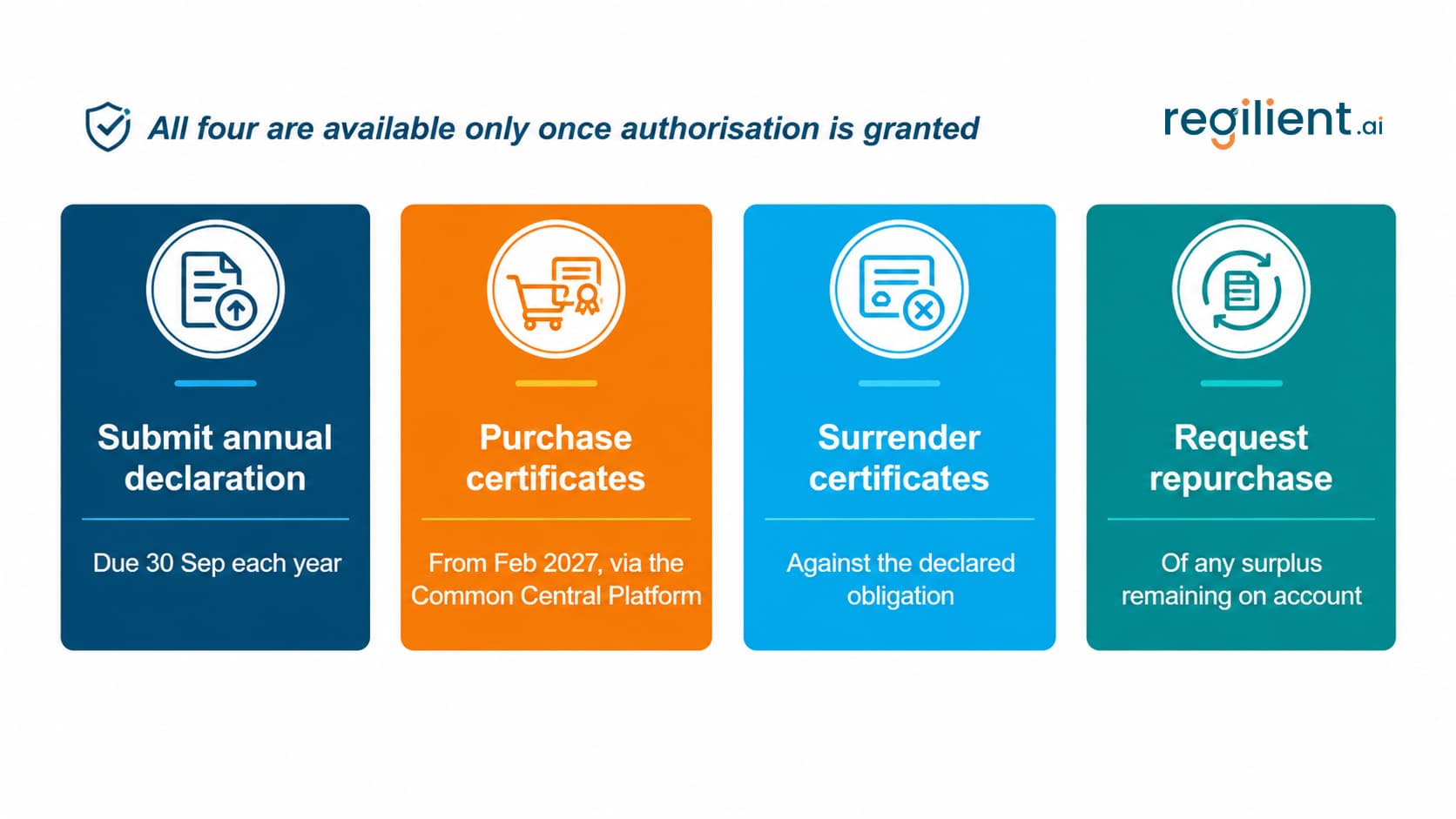 |
THIRD-COUNTRY OPERATORS HAVE A PARALLEL PATH Producers outside the EU aren't shut out of the registry entirely. They access it through a separate route the Commission's DG DIGIT EU-Access platform subject to validation by the Commission and consultation with Member States before access is revoked. This matters because operator registration is what makes it straightforward to pass actual verified emissions data to an EU declarant rather than leaving the declarant to default values. |
04 The Commission's role is oversight, not gatekeeping at the transaction level
It's worth being precise about where Commission authority actually sits, because clients sometimes assume Brussels is approving individual declarations. It isn't. The Commission manages the registry infrastructure, reviews submitted declarations for irregularities, flags concerns to the relevant NCA, and monitors trade patterns for signs of circumvention. The substantive decision to grant or refuse authorised declarant status, and the power to impose penalties for a flawed declaration, sits with the national competent authority in the Member State of establishment.
That division matters operationally. If a declaration is queried, the conversation that follows happens with the NCA, not with a central EU body. Groups operating across several Member States should expect to be managing several distinct regulatory relationships, not one.
One EORI, one declaration An indirect representative acting for multiple importers still files a single annual declaration covering every import they handled that year never more than one per year. | Refusal must be communicated Where an indirect representative is entitled to decline the declarant role, they must notify the importer and flag the importer's own obligation to comply. |
Split declarations are allowed A representative can agree to act as declarant for some goods and not others, but that requires two separate customs declarations, not one. | EORI ≠ competent authority The EORI number has no bearing on which NCA is responsible. That's determined purely by the declarant's Member State of establishment. |
05 What we'd actually prioritise this quarter
If a client asked us today where to put the next ninety days of effort against this chapter specifically, here's the honest order:
1. Map every EORI number in the group against actual import volumes. Don't assume the entity that's always handled customs is the right one to hold CBAM liability, the calculus is different now.
2. Decide the representative structure deliberately, not by default. Separate declarations, a single group-wide indirect representative, or a service-provider model each carry real trade-offs in administrative load versus concentrated liability.
3. File authorisation applications well ahead of any threshold crossing, with the fifteen-working-day consultation window treated as a floor, not a typical case.
4. Confirm registry access pathways early with whichever NCA is in play, since UUM&DS configuration differs by Member State and isn't always intuitive on a first attempt.
None of this requires the embedded-emissions methodology to be settled first. Authorisation and representative structure are sequencing decisions that can and should be locked down before the harder calculation work even begins.
Working through your own CBAM exposure? |
Regilient Advisory · This briefing reflects the European Commission's CBAM Questions and Answers as last updated 27 May 2026, and is provided for general guidance. It does not constitute legal advice.