
Table of Contents
- Summary
- Why California climate laws impact corporate groups around the world
- Scope assessment: the three-part entity test
- Defining "doing business in California"
- Corporate scenario: application to an EU industrial group
- SB 253 compliance: first filing requirements and phase-in timeline
- 1. The initial filing (10 November 2026)
- 2. Narrow first-year relief mechanism
- Multi-year implementation roadmap
- Status of SB 261 litigation
- Data integration: connecting California, CSRD and CBAM
- Regulatory interoperability matrix
- Recommended action plan for compliance teams
- About Regilient AI
In brief: California SB 253 requires US-formed entities doing business in California with more than $1 billion in worldwide revenue to report Scope 1 and 2 emissions to CARB by 10 November 2026. SB 261 (above $500 million) is blocked pending appeal. European parents are not reporting entities, but their US subsidiaries are. Regilient connects that data to CSRD and CBAM.
If your corporate group is headquartered in Europe, California's climate disclosure laws might initially seem like an offshore administrative matter, but they are not. Unfortunately, climate regulation no longer respects borders.
On 12 October 2026, California's implementing regulation officially took effect, confirming that the first annual greenhouse gas (GHG) emissions reports under SB 253 are due on 10 November 2026, less than two weeks away.
European parent companies are not direct reporting entities under the statute; however, their US-formed subsidiaries have to comply with the regulation. Crucially, the operational, supply chain, and emissions activity data required by California regulators typically resides within group-level systems established for EU regulatory compliance.
Below is a detailed guide explaining who is covered, what must be submitted, how current litigation affects reporting, and how European corporate groups can harmonise California filings with European Union frameworks like CSRD.
Summary
- SB 253 (Climate Corporate Data Accountability Act): Requires entities doing business in California with worldwide annual revenues exceeding $1 billion to disclose annual Scope 1 and Scope 2 emissions, with Scope 3 following in subsequent years.
- SB 261 (Climate-Related Financial Risk Act): Requires biennial climate risk reports for entities with annual revenues exceeding $500 million.
- Administration and enforcement: Both statutes are governed by the California Air Resources Board (CARB).
- Applicability: Applies strictly on a legal entity-by-entity basis to any US-formed entity that meets revenue and California activity thresholds, regardless of parent ownership.
- First reporting deadline: 10 November 2026 for SB 253 (Scope 1 and 2 emissions data).
- Litigation status: SB 261 enforcement is temporarily blocked by a federal appeals court, with no ruling yet. SB 253 remains fully active and unaffected by the injunction.
Why California climate laws impact corporate groups around the world
California recently enacted the strictest corporate climate disclosure laws in the US, requiring significant transparency from large businesses. Under SB 253, companies must report their greenhouse gas emissions annually, while SB 261 requires a climate-related financial risk report every two years. Overseen by the California Air Resources Board (CARB), the regulations were officially finalised on 12 October 2026, following updates that now allow parent companies to file on behalf of their subsidiaries. Companies must act quickly, as the first major emissions reporting deadline is 10 November 2026, with further rules for Scope 3 emissions expected in 2027.
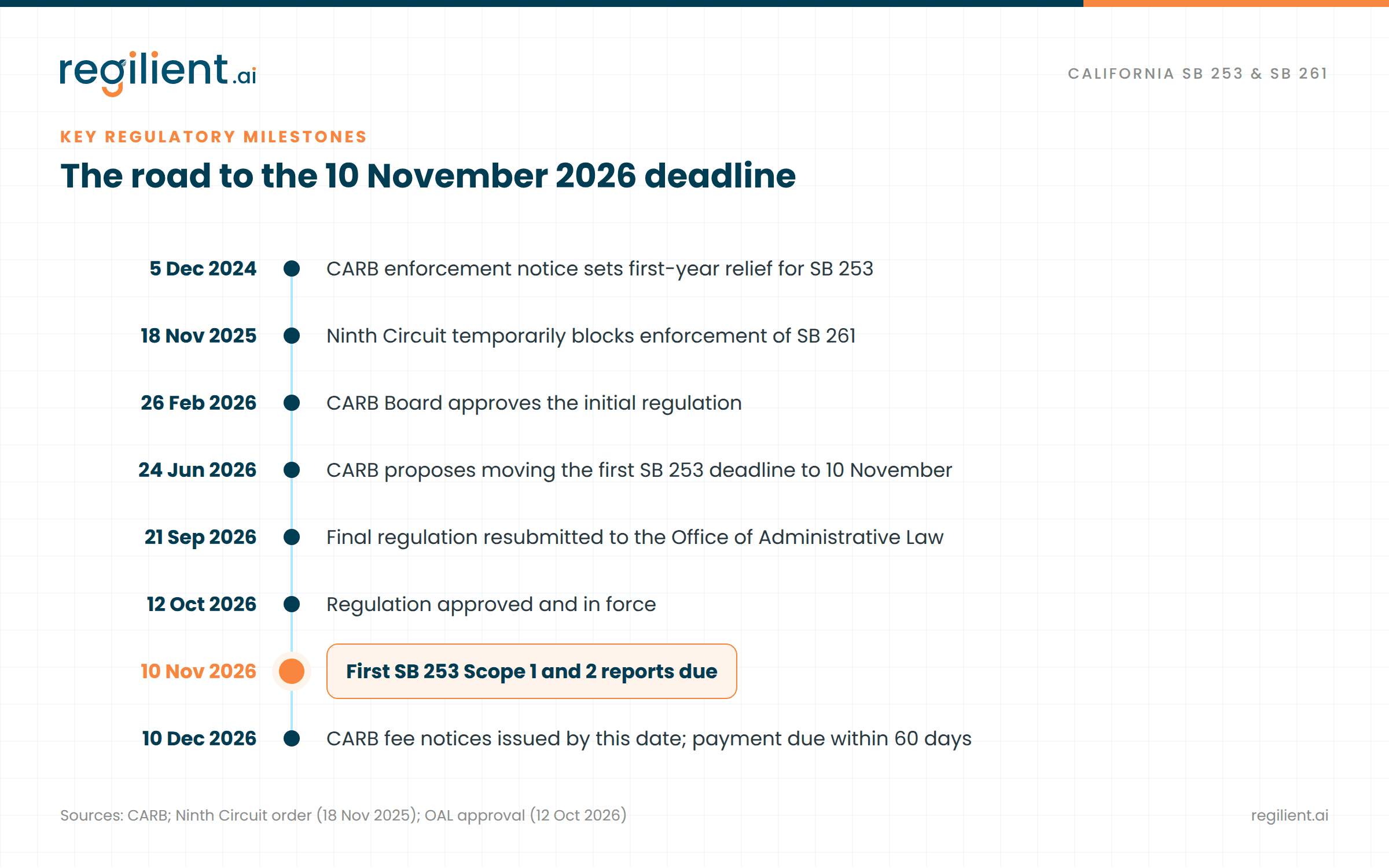
Figure: key regulatory milestones, December 2024 to December 2026
Crucially, these new requirements apply to far more than just local businesses. Any US-formed entity that does business in California and meets specific revenue thresholds must comply, regardless of where its ultimate headquarters are located. This broad reach means that international organisations (including European, British, and Asian industrial groups) are fully subject to these rules if their US subsidiaries operate within the state.
While European parents, UK holding companies, or Asian ultimate beneficial owners are not reporting entities themselves, their US subsidiaries (e.g., Delaware or Ohio corporations) fall directly within scope if they clear the financial and nexus thresholds. Industrial sectors particularly affected include European-owned steel, aluminium, cement, chemical, automotive, and manufacturing subsidiaries operating in the United States.
Scope assessment: the three-part entity test
To determine whether an entity must report under SB 253 or SB 261, the entity must meet all three of the following tests. Each legal entity is evaluated independently; revenues or activities are not aggregated from parent companies or non-US affiliates.
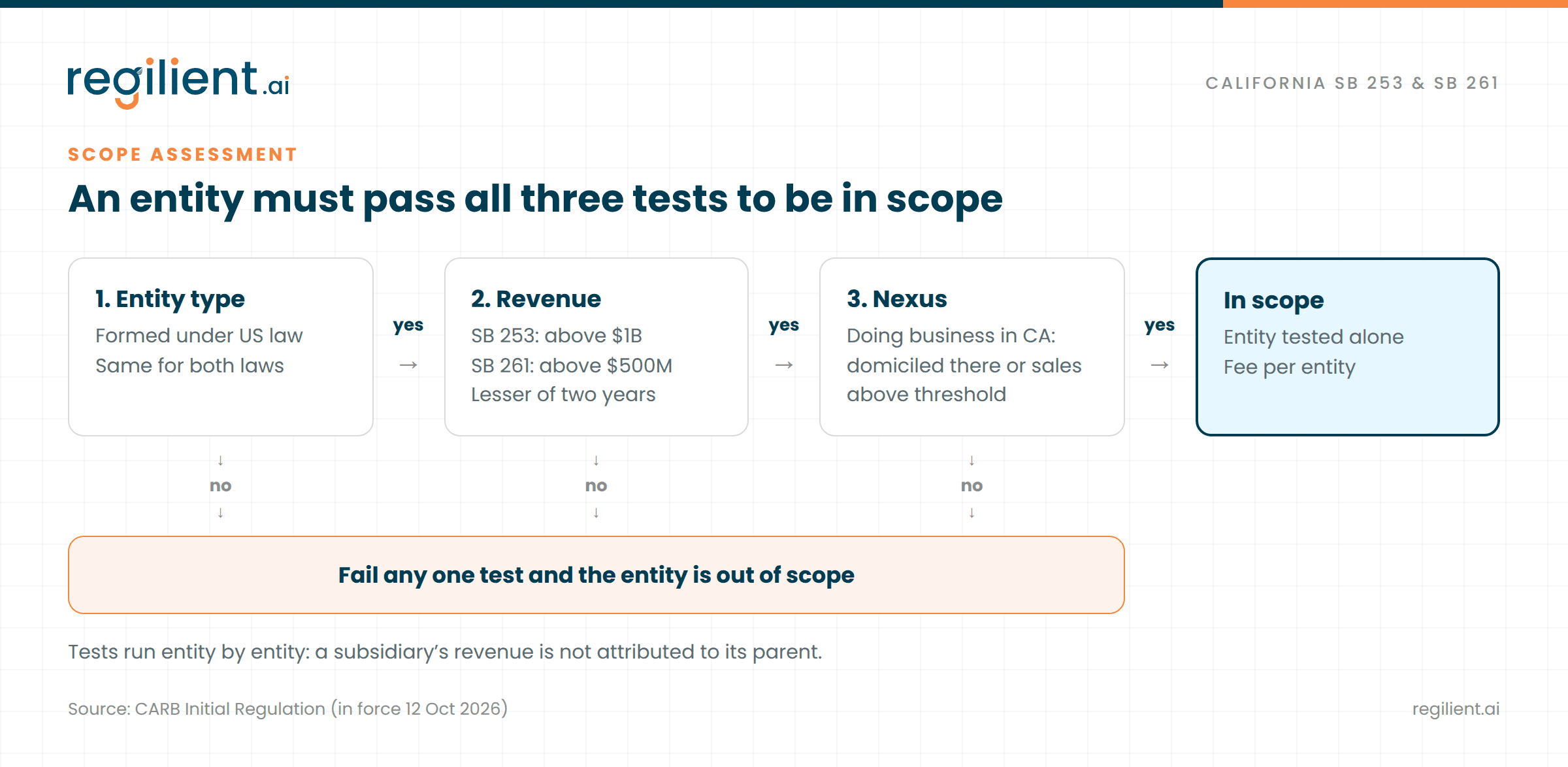
Figure: three scope tests, applied per legal entity
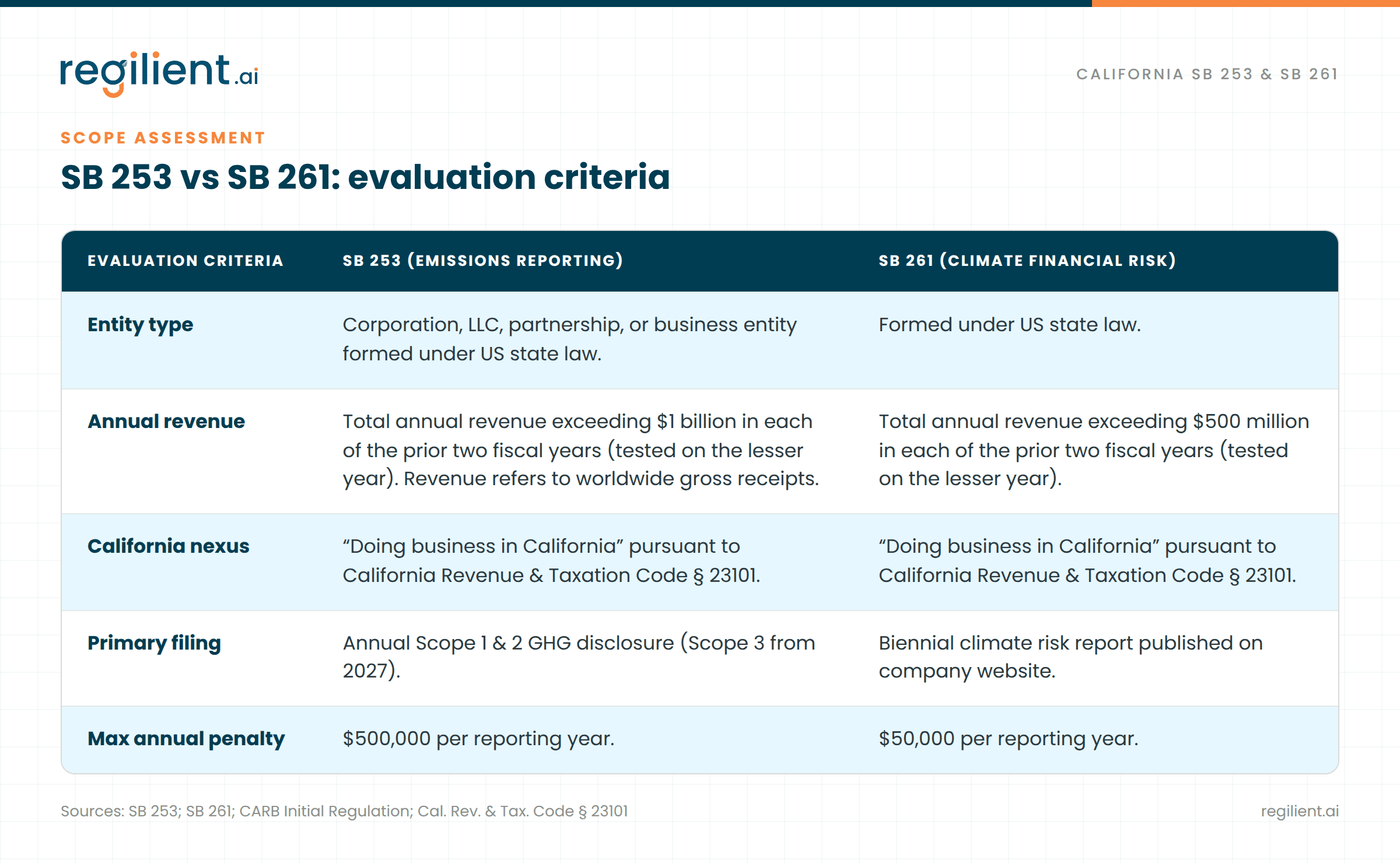
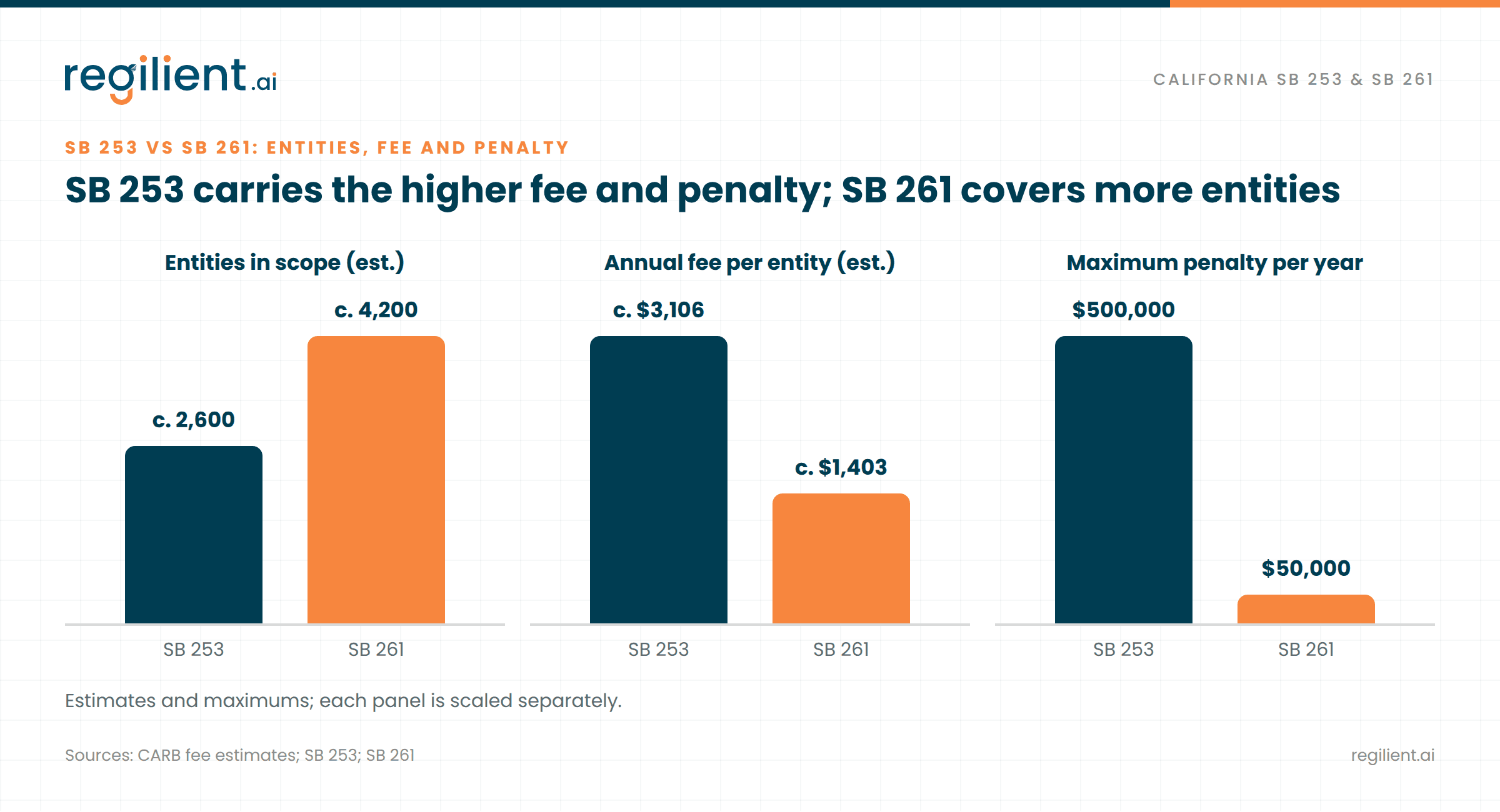
Figure: SB 253 vs SB 261, entities, fee and penalty
Defining "doing business in California"
CARB defines the California nexus requirement using specific tax code provisions:
- Being organised or commercially domiciled within California; or
- California sales exceeding the lesser of the annually indexed Franchise Tax Board threshold ($757,070 for 2025) or 25% of the entity's total global sales.
Note: CARB has excluded former property and payroll tests. Entities whose sole connection to California consists of teleworking personnel or wholesale electricity transactions are explicitly exempt.
Corporate scenario: application to an EU industrial group
A German aluminium group owns a Delaware subsidiary that runs a rolling mill in Kentucky. The subsidiary sells more than $1.3 billion of sheet a year in each of the last two fiscal years, $40 million of it to California customers.
- It is US-formed, so the entity test is met.
- Revenue is above $1 billion, so both revenue tests are met.
- $40 million of California sales is far above the threshold, so the nexus test is met.
- Result: the subsidiary is in scope for both SB 253 and SB 261. The German parent is not a reporting entity.
SB 253 compliance: first filing requirements and phase-in timeline
1. The initial filing (10 November 2026)
- Scope: Covers Scope 1 (direct operational emissions) and Scope 2 (indirect energy/electricity emissions) for the preceding fiscal year, formatted according to the Greenhouse Gas (GHG) Protocol.
- Fiscal year rules: Entities with fiscal years ending on or before 1 February report on the year ending in 2026. All other entities report on the fiscal year ending in 2025 (or their most recent complete year if data is available).
- Submission channel: Submissions are processed through CARB's electronic portal or via direct email submission to climatedisclosure@arb.ca.gov.
- Fees: CARB will issue administrative fee invoices on or before 10 December 2026, with payment due within 60 days. Estimated baseline fees are ~$3,106 per entity for SB 253 and ~$1,403 for SB 261.
- Parent-level grouping: Under amendments introduced by SB 219, a US parent entity may submit a single combined report covering multiple US subsidiaries, though administrative fees remain assessed per individual covered entity.
2. Narrow first-year relief mechanism
Entities that were not collecting Scope 1 and Scope 2 emissions data on or before 5 December 2024 may submit an official statement on corporate letterhead explaining the absence of data.
Note: This letterhead exemption applies strictly to the 2026 reporting period. It does not extend to 2027, when Scope 1 and Scope 2 limited assurance mandates take effect along with Scope 3 reporting requirements.
Multi-year implementation roadmap
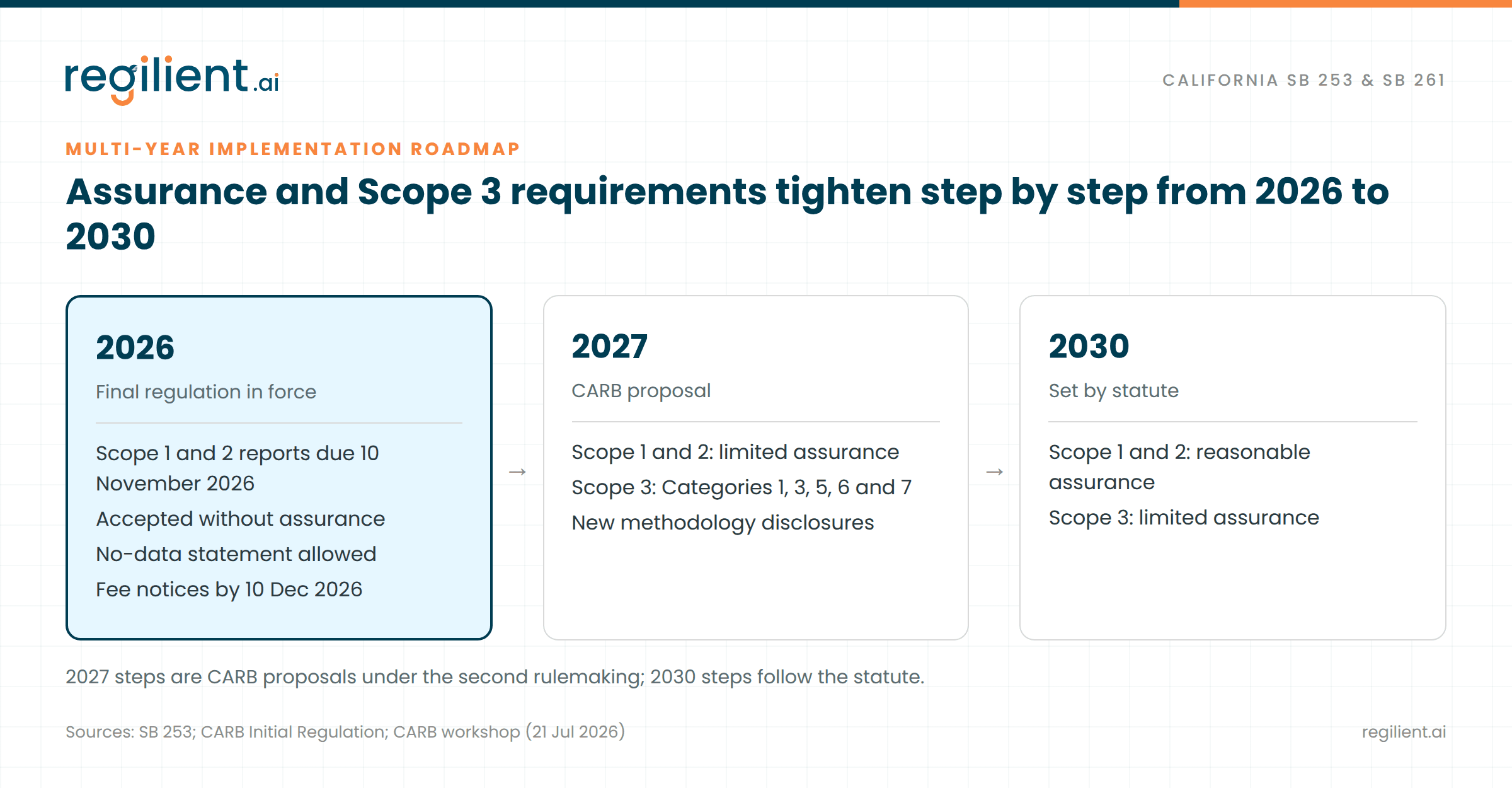
Figure: 2026, 2027 and 2030 requirements (2027 items proposed)
2027 phase-in (proposed rules):
- Scope 3 categories: Mandates reporting across five key categories: Purchased Goods and Services (Cat. 1), Fuel- and Energy-Related Activities (Cat. 3), Waste Generated in Operations (Cat. 5), Business Travel (Cat. 6), and Employee Commuting (Cat. 7).
- Limited assurance: Independent limited assurance required for Scope 1 and Scope 2 inventories.
- Methodological transparency: Disclosure of the percentage of Scope 3 data derived from primary supplier inputs, measurement uncertainty, exclusions, and inventory recalculations where cumulative shifts exceed 5%.
2030 statutory requirements:
- Transition to reasonable assurance for Scope 1 and Scope 2 emissions.
- Introduction of limited assurance requirements for Scope 3 emissions.
Status of SB 261 litigation
SB 261 requires covered entities to publish a climate-related financial risk report on their website based on established frameworks such as TCFD or IFRS S2 (ISSB).
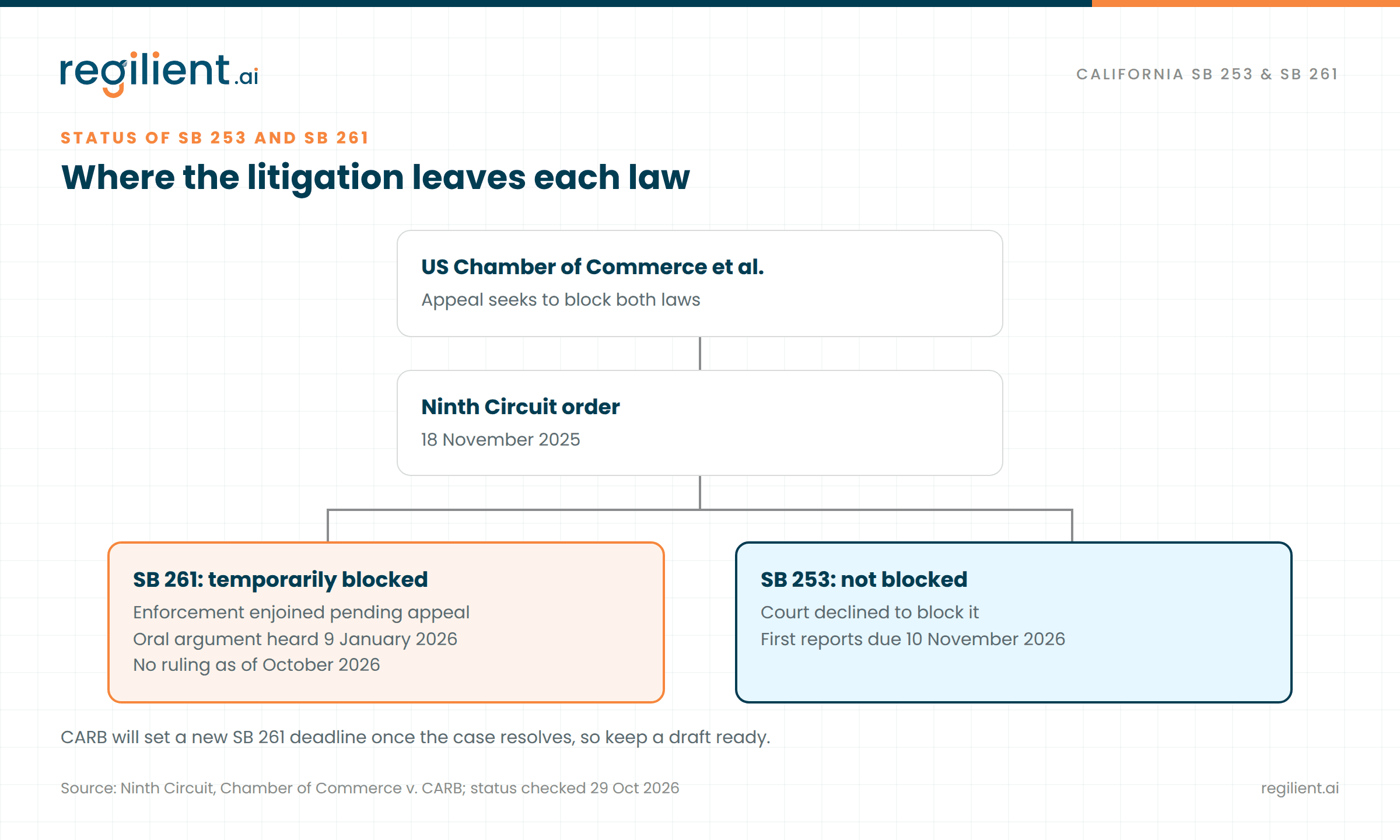
Figure: status of SB 253 and SB 261
Oral arguments took place on 9 January 2026. Because CARB plans to establish a revised reporting deadline immediately upon resolution of the litigation, covered enterprises should maintain a completed draft SB 261 report ready for publication.
Data integration: connecting California, CSRD and CBAM
For European parent organisations, compliance efficiency depends on recognising that California's SB 253 demands the exact same underlying activity data used across existing EU regulatory workflows.
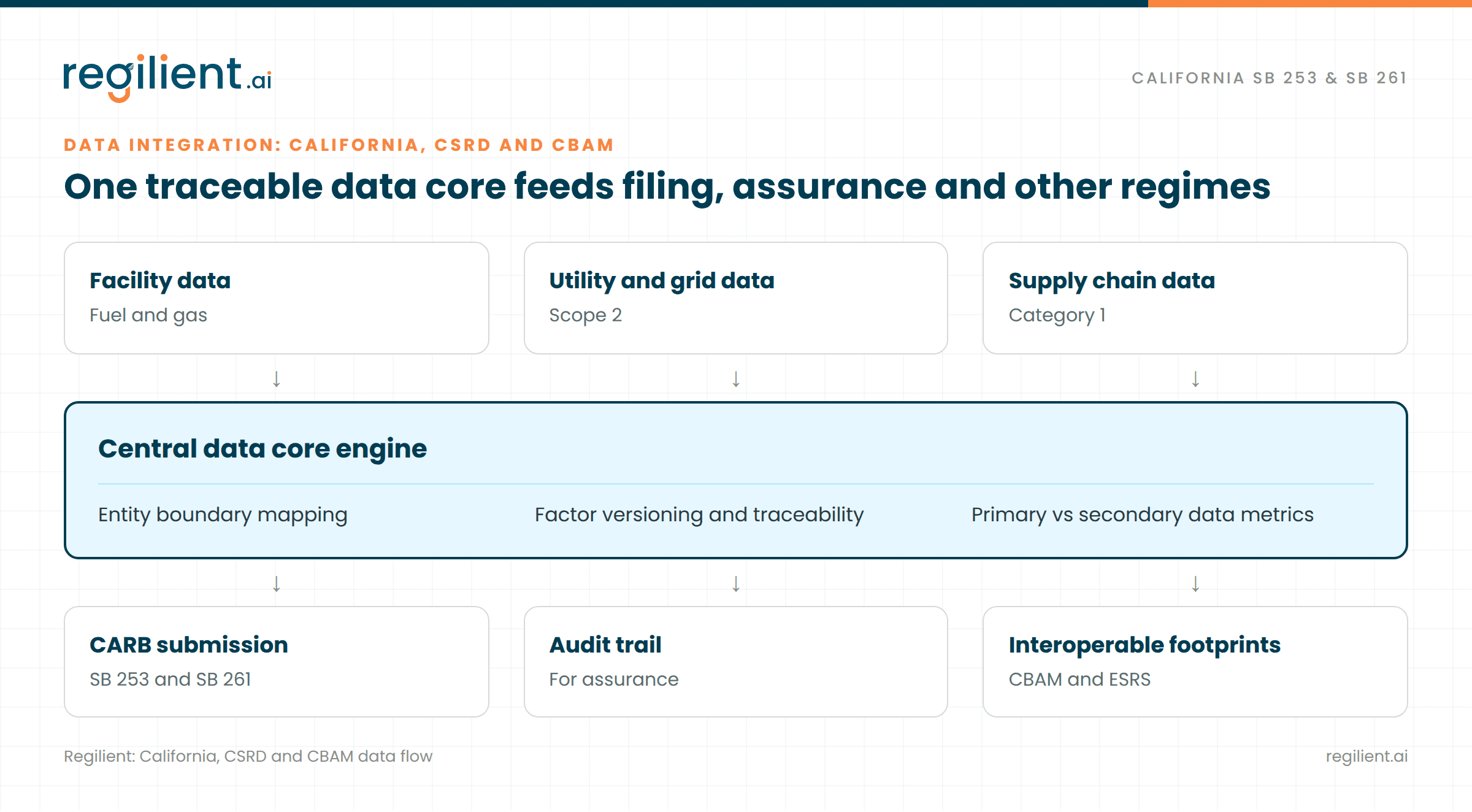
Figure: data flow for all the regulations
Regulatory interoperability matrix
Data requirement | SB 253 (California) | CSRD (ESRS E1) | EU CBAM |
|---|---|---|---|
Scope 1 & 2 | Mandatory (GHG Protocol) | Mandatory | Direct process emissions |
Scope 3 Category 1 | Proposed for 2027 | Mandatory under materiality | Embedded supply chain carbon |
Primary supplier data | Disclosure of primary data % required | Required for high-impact categories | Mandatory actual installation data |
Framework harmonisation | Accepts foreign reports meeting SB 253 standards | Standardised EU reporting structure | Specific embedded emissions formulas |
Recommended action plan for compliance teams
To prepare ahead of the 10 November 2026 deadline, corporate cross-functional teams (Legal, Sustainability, and Finance) should execute the following six steps:
- Audit all US legal entities: Review corporate structure diagrams to identify every US-formed subsidiary. Calculate gross revenues for the prior two fiscal years and evaluate California sales volume against the $757,070 nexus threshold.
- Establish the filing boundary: Determine whether to submit individual entity-level filings or utilise SB 219 provisions to submit a consolidated US parent-level report.
- Compile GHG inventory data: Extract operational energy, fuel, and electricity consumption data for the target fiscal year. Reconcile calculations against GHG Protocol standards.
- Evaluate exemption status: If emissions tracking was not active prior to 5 December 2024, prepare the formal letterhead relief statement for the 2026 filing cycle while initiating active GHG accounting for 2027.
- Prepare for assurance and Scope 3: Set up audit trails linking primary utility bills, fuel invoices, and sub-meter logs to emission factors to satisfy 2027 limited assurance criteria.
- Maintain a draft SB 261 report: Keep a TCFD/IFRS S2-aligned climate risk report finalised so it can be published promptly if the Ninth Circuit lifts the current injunction.
About Regilient AI
Regilient AI provides enterprise compliance solutions helping global corporations harmonise multi-jurisdictional reporting obligations across global supply chains, including California climate statutes, EU CSRD, and CBAM frameworks.
Regilient provides agentic sustainability software for product compliance, supplier engagement, and regulatory intelligence across REACH, RoHS, PFAS, CMRT, SCIP, CBAM, and global chemical regulations.
This article is for information only and is not legal, regulatory or compliance advice. Confirm your position with legal counsel or CARB before relying on any point here.