
Table of Contents
- What's New Compared to the Battery Directive?
- CE Marking and Conformity Requirements
- Battery Passport: Digital Traceability Starts 2027
- Recycled Content and Recovery Targets
- Supply Chain Due Diligence (Article 48)
- Key EU Battery Regulation (EU) 2023/1542 Deadlines & Timeline
- Why EU Battery Regulation Matters
- How Regilient Helps
The European Union's new Battery Regulation (EU) 2023/1542, which officially replaced the outdated Battery Directive 2006/66/EC, sets a unified legal framework for the sustainability, safety, and circularity of batteries across the EU. The regulation entered into force on August 17, 2023, and introduces binding requirements on carbon footprint, recycled content, supply chain due diligence, and the battery passport.
What's New Compared to the Battery Directive?
This regulation is no longer a directive, it is directly applicable across all EU Member States without needing national transposition. It covers all battery types—portable, industrial, automotive, LMT (Light Means of Transport), and EV (Electric Vehicle) batteries—and introduces specific rules for each based on their classification and use.
Key changes include:
- CE marking is now mandatory for most batteries.
- Due diligence obligations for critical raw materials.
- Carbon footprint disclosures and thresholds.
- Digital battery passports for traceability and transparency.
- Recycled content and material recovery mandates with set targets.
- Design requirements for replaceability, removability, and durability.
CE Marking and Conformity Requirements
All batteries placed on the EU market must undergo a conformity assessment procedure and bear the CE marking to indicate compliance. The assessment route depends on battery type:
- Portable and small industrial batteries (<2 kWh): Can self-declare via internal production control.
- EV batteries, LMT batteries, and large industrial batteries: Require notified body involvement.
The CE mark must be visible, legible, and indelible, along with the declaration of conformity, which must be kept for 10 years .
Battery Passport: Digital Traceability Starts 2027
From February 18, 2027, battery passports will be mandatory for:
- EV batteries
- LMT batteries
- Industrial batteries >2 kWh
The passport must be:
- Electronic and machine-readable
- Linked via QR code
- Include information such as manufacturer ID, material composition, carbon footprint data, and recycled content .
The passport will also link to the European Battery Passport Platform, ensuring traceability and compliance monitoring across the product lifecycle.
Recycled Content and Recovery Targets
The regulation sets minimum recycled content requirements for cobalt, lead, lithium, and nickel in batteries:
- By 2030:
- 12% cobalt
- 85% lead
- 4% lithium
- 4% nickel
- By 2035:
- 20% cobalt
- 85% lead
- 10% lithium
- 12% nickel
Additionally, by December 31, 2027, recovery targets in recycling facilities must meet:
- 90% for cobalt
- 95% for lead
- 70% for lithium
- 90% for copper and nickel .
Supply Chain Due Diligence (Article 48)
Originally scheduled for 18 August 2025, the application date for supply chain due diligence obligations was formally postponed to 18 August 2027 through Regulation (EU) 2025/1561, adopted in July 2025 under the EU's Omnibus IV simplification package. The postponement was granted to allow Member States additional time to designate and accredit notified bodies and to align with the anticipated timing of Commission guidance on related frameworks, including the Corporate Sustainability Due Diligence Directive. The Commission's deadline to publish official due diligence guidance is set for 26 July 2026.
They must:
- Establish a due diligence policy
- Implement a risk management system
- Use third-party verification and reporting
- Publicly report on risks and mitigation steps
These steps align with the OECD Due Diligence Guidance and are mandatory for companies with annual turnover >€40 million .
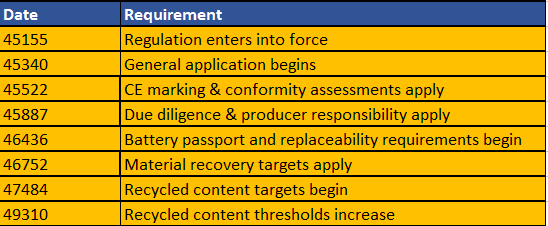
Key EU Battery Regulation (EU) 2023/1542 Deadlines & Timeline
Why EU Battery Regulation Matters
- Global Impact: Non-EU manufacturers must comply if selling into the EU.
- Product Design Pressure: Replaceability, safety, and recycled content now influence market access.
- Compliance Complexity: Managing supply chain data, declarations, and battery passports requires dedicated infrastructure.
- Enforcement Risk: Non-compliance may lead to withdrawal from the EU market or administrative fines.
How Regilient Helps
With Regilient, your battery compliance operations are automated and audit-ready:
- Built-in EU Battery Regulation workflow
- Battery passport-ready architecture
- Automated due diligence tracking
- CE mark documentation control
- Recyclability and carbon data management
The EU Battery Regulation's obligations are already live and the Battery Passport deadline is closer than most manufacturers' current data infrastructure can support. Book a Regilient demo to see how Regilient automates battery compliance from CE marking through to passport-ready supply chain data.