By Hitesh RamPublished: 2 min read

If you're exporting dual-use items and you don’t know your ECCN, you’re not shipping. You’re gambling.

What Is an ECCN?

ECCN stands for Export Control Classification Number. It’s a 5-character alphanumeric code used under the U.S. Export Administration Regulations (EAR) to identify items subject to export control due to:

  • National security
  • Nuclear nonproliferation
  • Anti-terrorism
  • Encryption
  • Regional stability
  • Missile tech, crime, or chemical/biological controls

If you manufacture or export electronics, software, encryption, sensors, lasers, or defense-related tech—you probably need an ECCN.

ECCN Structure Breakdown

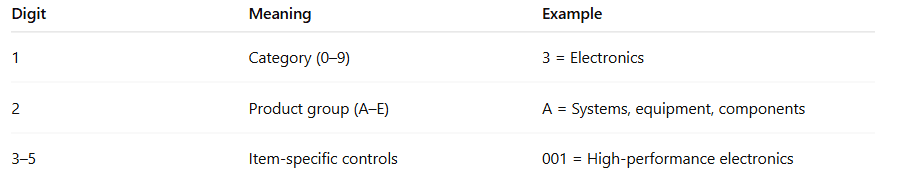
Example: 3A001
ECCN Structure Breakdown.PNG

There are ten categories (0–9) and five product groups (A–E), such as:

  • A – Equipment, assemblies
  • B – Test equipment
  • C – Materials
  • D – Software
  • E – Technology

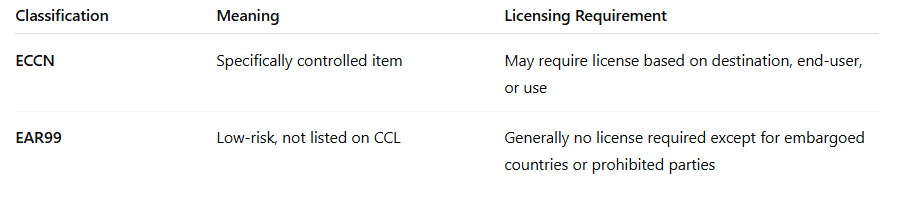
ECCN vs EAR99

ECCN vs EAR99.PNG

Don't assume you're EAR99 just because your product seems “non-sensitive.” Software and encryption tech often get flagged under ECCNs.

When Do You Need an ECCN?

You must classify your product under the Commerce Control List (CCL) if:

  • You're exporting from the U.S.
  • You're transferring tech to a foreign national (deemed export)
  • You’re selling dual-use tech (civilian + military use)
  • You're working with overseas subsidiaries or R\&D teams

And if your item has an ECCN, you may need:

  • An export license, OR
  • To qualify under License Exception (ENC, TSR, LVS, etc.)

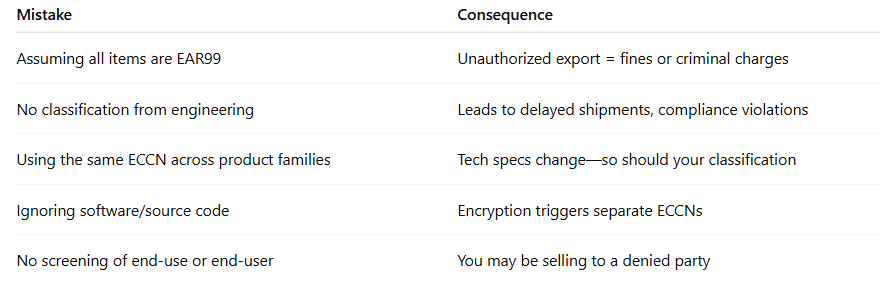
Common Export Control Mistakes
Common Export Control Mistakes.PNG

How to Classify for ECCN

Step 1 — Analyze Your Product

  • What does it do?
  • Is it controlled due to performance, function, or encryption?
  • Is it a dual-use or defense-related item?

Step 2 — Check the Commerce Control List (CCL)

  • Search by category (0–9)
  • Match product group (A–E)
  • Look for performance thresholds

Step 3 — Request a CCATS (if needed)

If you're unsure, file a Commodity Classification Request (CCATS) with BIS.

Step 4 — Document & Automate

  • Store ECCN at the product level
  • Link ECCN to COO, HTS, license requirements, and screening tools

What ECCN Classification Impacts

  • Export license needs
  • License exception eligibility
  • End-use screening
  • Deemed exports (e.g., engineers in foreign offices)
  • Encryption reporting to BIS
  • FTA eligibility (yes, really)

How Regilient Helps You Get ECCN Right

With Regilient:

  • Get ECCNs mapped at the component level
  • Automate dual-use checks during product onboarding
  • Link ECCNs with HTS codes, COO, and denied party screening
  • Track CCATS and license exception status

Getting your ECCN wrong is not a paperwork error, it is a licensing violation waiting to happen.

Book a Regilient demo to see how Regilient maps ECCNs at the component level and keeps classification linked to your broader trade compliance programme.

Speak to Our Compliance Experts

Questions about compliance, partnerships, or support? We're here to help.

Share

ECCN Explained: How to Legally Export Controlled Items Without Losing Sleep (or Your License)

What is an ECCN and why does it matter for exporters?
An Export Control Classification Number (ECCN) is a five-character alphanumeric code used under the US Export Administration Regulations to identify items subject to export control. Items are controlled for reasons including national security, nuclear nonproliferation, anti-terrorism, encryption, regional stability, and missile, chemical, or biological technology concerns. If you manufacture or export electronics, software, encryption, sensors, lasers, or defence-related technology, you almost certainly need to determine your product's ECCN before shipping, since the classification determines whether a licence is required at all.
What is the difference between an ECCN and EAR99?
An ECCN identifies a product as specifically controlled under one of the Commerce Control List's ten categories. EAR99 is the default classification for items that are subject to the EAR but not specifically listed elsewhere on the Commerce Control List, generally lower-sensitivity goods. Products should never be assumed EAR99 simply because they seem non-sensitive. Software and encryption technology in particular are frequently flagged under a specific ECCN even when the product itself appears commercially ordinary.
How is an ECCN structured, and what do the numbers and letters mean?
An ECCN follows a fixed pattern, for example 3A001. The first digit identifies one of ten broad categories (0 through 9), and the letter identifies one of five product groups: A: Equipment and assemblies B: Test equipment C: Materials D: Software E: Technology The remaining digits narrow the classification to a specific type of controlled item and its associated control reasons.
When do I need to classify my product under the Commerce Control List?
Classification is required if you are exporting from the US, transferring technology to a foreign national (a "deemed export"), selling dual-use technology with both civilian and military applications, or working with overseas subsidiaries or R&D teams. If your product carries an ECCN, you will then need either an export licence or qualification under a specific licence exception, such as ENC, TSR, or LVS.
What is a CCATS and when should I request one?
A Commodity Classification Automated Tracking System (CCATS) request is a formal submission to the Bureau of Industry and Security asking BIS to confirm the correct ECCN for your product. If, after analysing your product's function and checking it against the Commerce Control List, you remain unsure of the correct classification, filing a CCATS request gets you an authoritative answer directly from the regulator rather than relying on an internal judgement call.
How does Regilient help manufacturers manage ECCN classification?
Regilient's agentic sustainability platform supports export control compliance through: ECCN mapping at the individual component level rather than only at the finished-product level Automated dual-use checks built into the product onboarding workflow ECCN data linked directly to HTS codes, country of origin, and denied party screening CCATS status and licence exception tracking in one place This keeps classification, screening, and documentation connected instead of managed as separate spreadsheets across different teams.