
Table of Contents
- What Is Country of Origin (COO)?
- Why COO Is a Big Deal for Manufacturers
- How COO Is Determined (Legally)
- Common COO Mistakes & Their Risks
- What COO Affects
- What You Must Maintain for COO
- Country of Origin (COO): Frequently Asked Questions
- What does COO mean in trade compliance?
- How is country of origin determined?
- Why does country of origin compliance matter?
- Is country of origin the same as country of assembly?
- How Regilient Automates COO Accuracy
Last reviewed: 6 November 2026.
If you're treating COO as just a “Made in” tag, you're missing the point. It’s a legal claim, and the foundation of your trade compliance.
What Is Country of Origin (COO)?
Country of Origin (COO) refers to the country where a product is manufactured, assembled, or substantially transformed. It determines:
- Import/export eligibility
- Tariff rates
- FTA benefits (like USMCA)
- Product labeling
- Buy American / BABA compliance
- Enforcement risk
COO is not about where the product ships from. It's about where it was actually made, or transformed into its final commercial form.
Why COO Is a Big Deal for Manufacturers
With stricter customs enforcement, ESG due diligence laws, and FTA audits, COO is no longer just customs trivia. It’s legal exposure.
If you get it wrong:
- You lose trade benefits
- Your shipment gets held or fined
- You risk false origin claims and penalties
And if you can’t prove it? You’ve got a liability on your books.
How COO Is Determined (Legally)
1- Wholly Obtained or Produced
E.g., minerals mined, crops harvested, or products fully made in one country.
2- Substantial Transformation
Used when multiple countries are involved. The COO is the country where the product underwent a significant manufacturing process, resulting in a new name, character, or use.
> Example: Raw circuit boards sourced from China, transformed into full PCBs with firmware in Mexico = Mexico origin (if compliant with transformation rules).
3- Value-Based Rules (FTA-specific)
Some FTAs (like USMCA) use Regional Value Content (RVC) rules. If the percentage of regional content meets the threshold, the good qualifies under the agreement.
Substantial transformation determinations are one of the most frequently disputed points in a customs audit. See how Regilient's Trade Compliance Software documents and defends COO determinations across multi-tier supply chains.
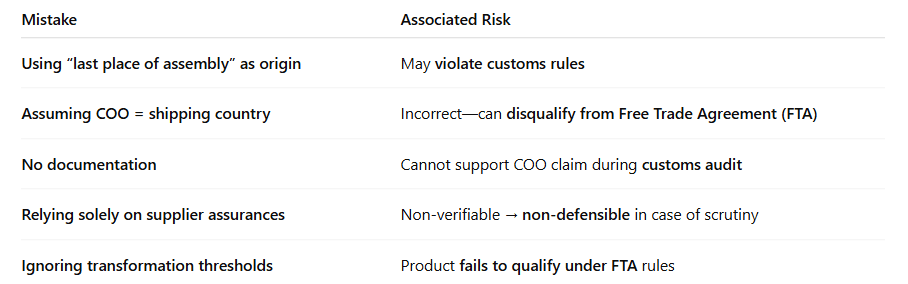
Common COO Mistakes & Their Risks
What COO Affects
- Customs declarations (HTS code + COO drives tariffs)
- FTA eligibility (USMCA, CAFTA, EU FTAs, etc.)
- Origin marking laws (e.g., “Made in USA” claims)
- Buy American / Buy America / BABA compliance
- ESG/sustainability disclosures (e.g., forced labor laws)
- SCIP, REACH, and CE reporting (EU traceability)
What You Must Maintain for COO
- Supplier origin declarations
- Bills of materials (BOM)
- Transformation process documentation
- RVC or tariff shift calculations (if applicable)
- Customs rulings or advance origin determinations
- Product-level COO database
Country of Origin (COO): Frequently Asked Questions
What does COO mean in trade compliance?
COO stands for Country of Origin, the country where a product is wholly obtained or has undergone its last substantial transformation. It is a legal determination, not simply the country listed as "Made in" on a label.
How is country of origin determined?
For products made in a single country, COO is usually straightforward. For products assembled or manufactured across multiple countries, COO typically depends on where the last substantial transformation occurred, a legal test that varies by jurisdiction and trade programme.
Why does country of origin compliance matter?
COO determinations affect duty rates, free trade agreement eligibility, country-specific import restrictions, government procurement rules such as Buy American Act requirements, and labelling obligations, so an incorrect COO claim can trigger fines, denied entry, or retroactive duty assessments.
Is country of origin the same as country of assembly?
Not necessarily. A product can be assembled in one country while its legal country of origin is a different country, if the components or processing that caused substantial transformation occurred elsewhere.
How Regilient Automates COO Accuracy
With Explore Regilient's Trade Compliance Software, you get:
- Centralized COO inquiry & collection from suppliers
- Product-level COO traceability linked to HTS, ECCN, and origin claims
- Audit-ready documentation for FTA, BABA, and customs
- Rule-based workflows for substantial transformation and RVC
- Country of origin risk maps (for ESG screening, forced labor laws, etc.)
Need to build a defensible COO into your compliance workflow? Explore Regilient's Trade Compliance Software