
Table of Contents
- Why this matters now
- What the regulation does: understanding the calculation
- How the deduction works, step by step
- Which carbon markets count, and what does not
- Case studies: what this looks like in numbers
- Case A: a steel mill in an emissions trading country
- Case B: a steel mill under a baseline-and-credit scheme
- Case C: a fertiliser exporter in a country with no carbon price yet
- Practical next steps
- How Regilient helps
In brief: Implementing Regulation (EU) 2026/2498, published on 16 November 2026, sets how a carbon price paid outside the EU reduces the CBAM certificates an importer must surrender. The deduction is the price effectively paid per tonne of product, divided by the year's CBAM reference price, times tonnes imported. It applies from 1 January 2026. Regilient helps importers collect that evidence from suppliers.
A new EU rulebook finally explains how a carbon price paid in India, Türkiye, South Africa or anywhere else turns into fewer CBAM certificates in Europe. For exporters in developing economies, it changes the question from "can we avoid this cost?" to "who should collect it?"
Based on Commission Implementing Regulation (EU) 2026/2498, published in the Official Journal on 16 November 2026.
Why this matters now
Since 1 January 2026, anyone importing steel, aluminium, cement, fertilisers, hydrogen or electricity into the EU has been building up a carbon bill. The bill is settled in CBAM certificates, priced in line with the EU Emissions Trading System. The first two quarterly prices for 2026 were set at €75.36 and €75.28 per tonne of CO₂e, and importers will buy certificates for 2026 imports from February 2027 and surrender them by 30 September 2027.
From the start, the CBAM Regulation promised one important safeguard that is, if a producer has already paid a carbon price at home, the EU will not charge for the same tonne of CO₂ twice. What was missing was the detail. Which carbon markets count? How do you turn a carbon tax paid in rupees or rand into a number of EU certificates? What evidence will customs authorities accept?
Regulation (EU) 2026/2498, adopted on 5 November 2026, answers those questions. It applies back to 1 January 2026, so it already covers every tonne imported this year.
The idea in one line
Certificates saved = ((carbon price effectively paid per tonne of product, in €) ÷ (CBAM reference price for the year)) × tonnes imported
This is Article 7(1) of the Regulation, written in plain words. Everything else in the rulebook is about getting the first number right.
What the regulation does: understanding the calculation
The Regulation does four practical things. It sets a single method for working out the carbon price "effectively paid" on the emissions embedded in each product. It explains how to convert that price into euro and then into a reduction in certificates. It lists the evidence a producer has to keep. And it says who is allowed to certify that evidence.
Two words in that first sentence carry most of the weight: effectively paid. The EU is not interested in a country's headline carbon price. It wants to know what the factory actually paid after free allowances, discounts, exemptions and refunds. A carbon tax of €30 per tonne that exempts 80% of a plant's emissions is, for CBAM purposes, a carbon price of €6.
There are two routes to a deduction:
- Actual carbon price. The producer prepares a carbon price report (in English, on the Commission's template), an independent person certifies it, and the importer claims the certified figure. This route is only open when the embedded emissions themselves are based on verified actual data.
- Default carbon price. The Commission can publish a default carbon price for each country with carbon pricing. Importers using default emission values can only use this route; importers using actual values can choose it if it is simpler.
How the deduction works, step by step
Annex I of the Regulation sets out the method as a chain of steps. The diagram below follows that chain from the producer's carbon bill at home to the number of certificates the EU importer no longer needs to buy.
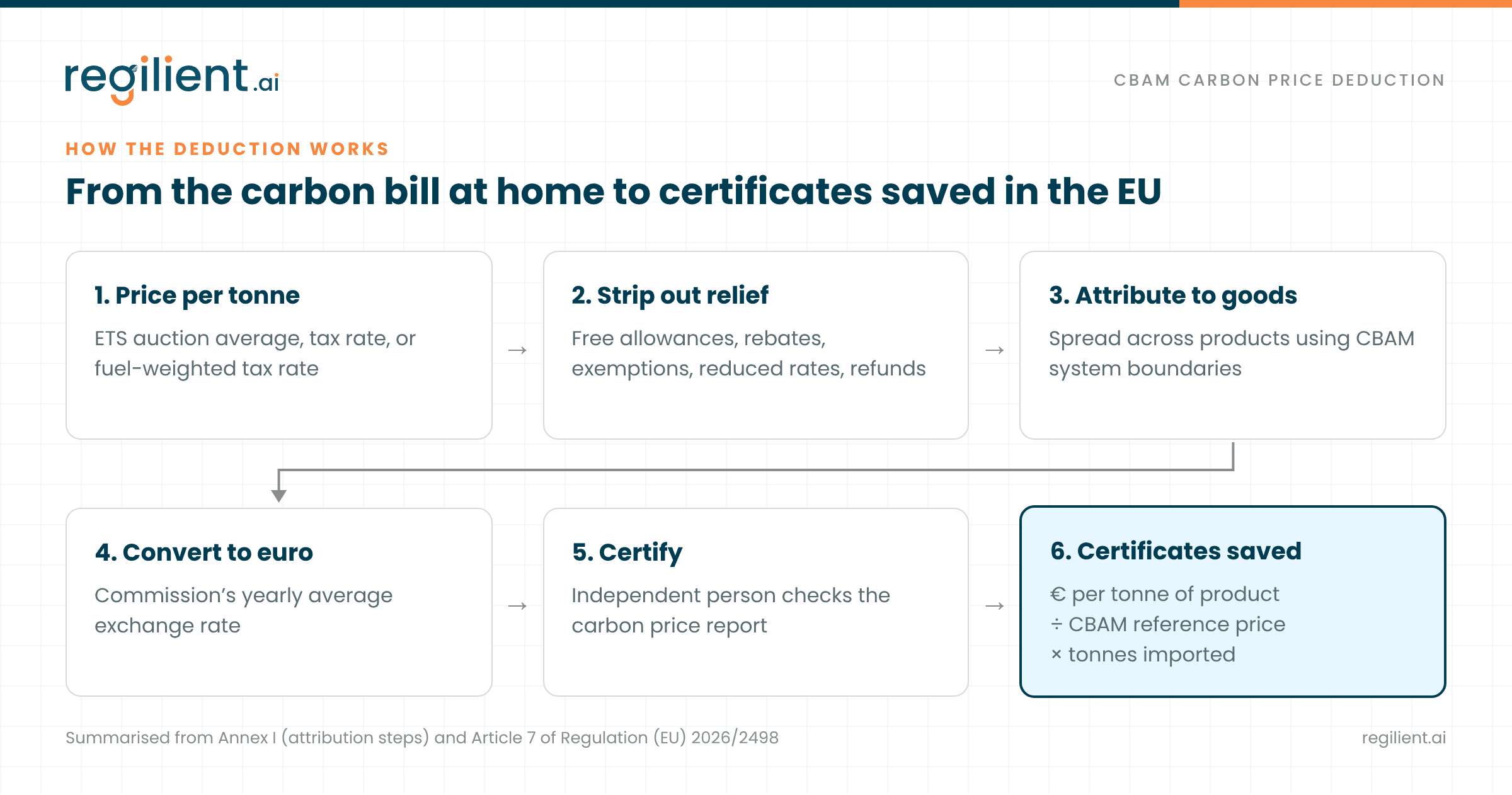
Summarised from Annex I (attribution steps) and Article 7 of Regulation (EU) 2026/2498.
A few details are worth knowing, because they decide whether a claim survives scrutiny:
- How the price is measured depends on the scheme. Under an emissions trading system, the default is the weighted average auction price for the period, or the secondary-market average if there are no auctions. A producer may instead use the average purchase cost of the allowances in its registry account. Under a point-source tax, it is the tax rate actually applied. Under a fuel-based tax, the rate per litre or tonne of fuel is converted into a price per tonne of CO₂ using the emission factor the tax law itself relies on.
- Exchange rates are fixed, not chosen. The Commission publishes a yearly average rate per currency, based on European Central Bank or Eurostat data.
- The reference price is the year's average CBAM price. It is calculated from the certificate prices published for the year of import, rounded to the nearest cent.
- Missing rebate evidence is fatal. If a plant is entitled to a rebate but cannot show how much, it gets no deduction at all. If the rebate has been officially set but not yet received, the official (or maximum) amount is deducted.
Which carbon markets count, and what does not
Annex II lists the mechanisms the Commission already accepts as genuine carbon pricing. The list is deliberately wide: it covers trading systems, baseline-and-credit schemes, and carbon taxes levied either at the chimney or on fuel. It is also explicitly non-exhaustive. A scheme that is not on the list can still be assessed by the independent person, and the Commission has committed to reviewing the list every year, including on request from third-country governments.
Type of mechanism | Jurisdictions in Annex II | Main "relief" the EU will deduct |
|---|---|---|
Emissions trading (cap-and-trade) | China (national ETS), Indonesia, Japan (GX-ETS), Kazakhstan, Montenegro, New Zealand, South Korea, Türkiye, UK, Québec, California, Washington, Oregon | Free allowances |
Baseline-and-credit trading | India (Carbon Credit Trading Scheme), Australia (Safeguard Mechanism), Alberta (TIER) and other Canadian output-based systems, including the federal backstop | Emissions below the baseline; in Canada also free allowances and liability caps |
Point-source carbon tax | Chile, Serbia, Singapore, South Africa, Ukraine | Exempted emissions |
Fuel-based carbon tax or fee | Albania, Argentina, Colombia, Israel, Japan (climate change tax), Mexico, Taiwan (carbon fee), UK (Carbon Price Support) | Exempted emissions, reduced rates |
Grouping simplified from Annex II of the Regulation. The relief column shows the main type listed; other forms of compensation must still be considered.
The Regulation is just as clear about what will not reduce the bill:
- A carbon price that only applies to exports. The price must apply to all goods from the installation, whatever their destination. A levy designed purely to capture CBAM revenue does not qualify.
- Voluntary or non-binding schemes. The mechanism must place compliance obligations on all operators in the covered sectors (small-installation thresholds are acceptable).
- Carbon credits that were never bought. Credits received for free count at zero unless their market price can be evidenced, and the price claimed for any credit cannot exceed the scheme's main price (the average allowance price or the tax rate).
- Too many international credits. Credits from abroad must be issued under Article 6.2 or 6.4 of the Paris Agreement, and can cover at most 10% of the emissions under the scheme.
- Price paid on emissions outside the CBAM boundary. Only the price attributable to the embedded emissions of the declared goods counts.
Case studies: what this looks like in numbers
The three examples below are illustrative. The companies are hypothetical and the figures are rounded to make the mechanics easy to follow. They use a CBAM reference price of €75 per tonne, close to the published 2026 quarterly prices.
A simplification to keep in mind. The examples show the "gross" CBAM exposure. In practice, the number of certificates due is also reduced to reflect the free allocation still given to EU producers, which is phased out gradually until 2034. In the early years this makes the net bill much smaller, and a carbon price deduction cannot push the bill below zero. The relative lessons hold; the absolute euro amounts will be lower at first and rise each year.
Case A: a steel mill in an emissions trading country
Mill A exports 10,000 tonnes of hot-rolled coil to an EU buyer. Its verified embedded emissions are 2.0 tCO₂e per tonne, so the shipment carries 20,000 tonnes of CO₂e. At €75, the gross CBAM exposure is €1.5 million.
At home, Mill A sits in a national ETS where the average auction price works out at €20 per tonne once converted at the Commission's yearly rate. But like most new trading systems, the scheme gives heavy free allocation: 70% of Mill A's emissions are covered by free allowances. So the price it effectively pays is 30% of €20, or €6 per tonne of CO₂, which is €12 per tonne of steel.
The deduction is (€12 ÷ €75) × 10,000 = 1,600 certificates, worth about €120,000. That offsets 8% of the gross bill.
Now imagine the same scheme with full auctioning. Mill A pays €40 per tonne of steel, the deduction rises to about 5,333 certificates, and the offset jumps to roughly €400,000, or 27%.
Lesson: being on the EU's list is not enough. Free allocation at home is deducted pound for pound, so its value to the exporter on EU-bound goods is close to zero.
Case B: a steel mill under a baseline-and-credit scheme
Mill B is in a scheme modelled on India's Carbon Credit Trading Scheme. Instead of buying allowances for every tonne, plants receive an intensity target. Mill B emits 2.4 tCO₂e per tonne of steel against a target of 2.2, so it must buy credits for the 0.2 tonne gap. Credits cost the equivalent of €10.
Its 10,000-tonne shipment carries 24,000 tonnes of CO₂e, a gross exposure of €1.8 million. But the carbon price effectively paid is only 0.2 × €10 = €2 per tonne of steel, because emissions under the baseline are treated as unpriced. The deduction is about 267 certificates, worth roughly €20,000, or about 1% of the bill.
There is an irony here. If Mill B beat its target and sold surplus credits, it would get no carbon price deduction at all. Its reward would come in a different form: lower verified embedded emissions, and therefore fewer certificates in the first place.
Lesson: intensity-based schemes give little direct CBAM relief while targets are loose. The relief grows as targets tighten, and the bigger prize is real efficiency gains that cut embedded emissions.
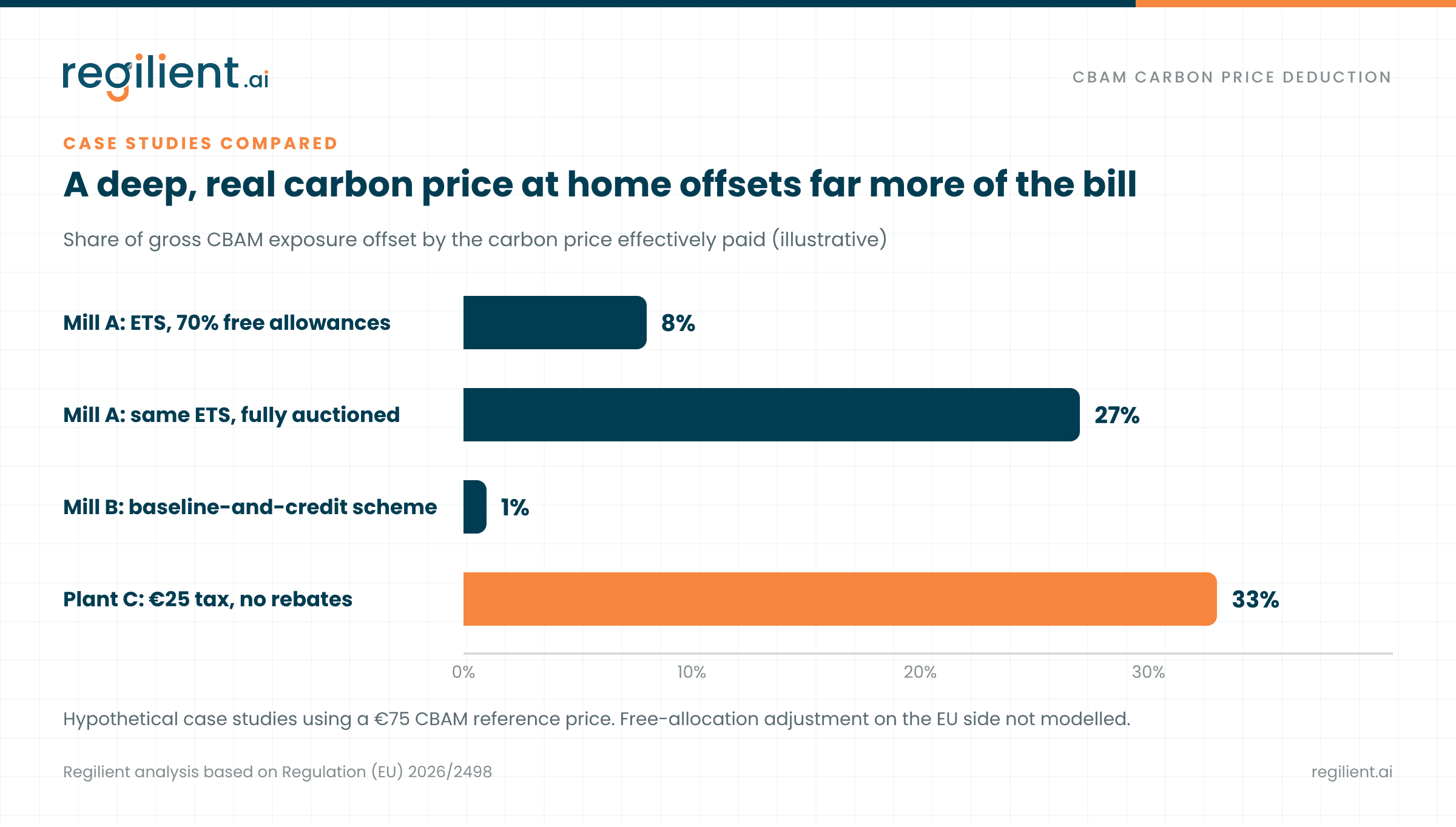
Hypothetical case studies in this note, using a €75 CBAM reference price. Free-allocation adjustment on the EU side not modelled.
Case C: a fertiliser exporter in a country with no carbon price yet
Plant C produces urea in "Country X", which has no carbon pricing today. It sells 50,000 tonnes a year into the EU, with embedded emissions of 1.8 tCO₂e per tonne. That is 90,000 tonnes of CO₂e and a gross CBAM exposure of €6.75 million, every cent of which flows to the EU.
Now suppose Country X introduces a point-source carbon tax of €25 per tonne on all industrial emissions, with no exemptions for large plants. Plant C pays €45 per tonne of urea at home. Its EU importer deducts (€45 ÷ €75) × 50,000 = 30,000 certificates. The CBAM bill falls to €4.5 million, and €2.25 million stays in Country X as tax revenue.
Here is the part that is easy to miss. Plant C's total carbon cost on its EU-bound urea is the same in both scenarios: €6.75 million. What changes is who collects it. Without a domestic price, it all goes to Brussels. With one, a third of it stays at home, where it can fund cleaner technology.
Finally, suppose the government, worried about competitiveness, refunds 60% of the tax to large exporters. The effective price drops to €10 per tonne of CO₂, the deduction shrinks to 12,000 certificates, and the EU collects €5.85 million. Plant C is no better off. The treasury simply hands €1.35 million to the EU budget.
Lesson: on EU-bound goods, a domestic carbon price does not add to the exporter's cost so much as redirect it. Refunding the tax does not help the exporter; it helps the EU's revenue.
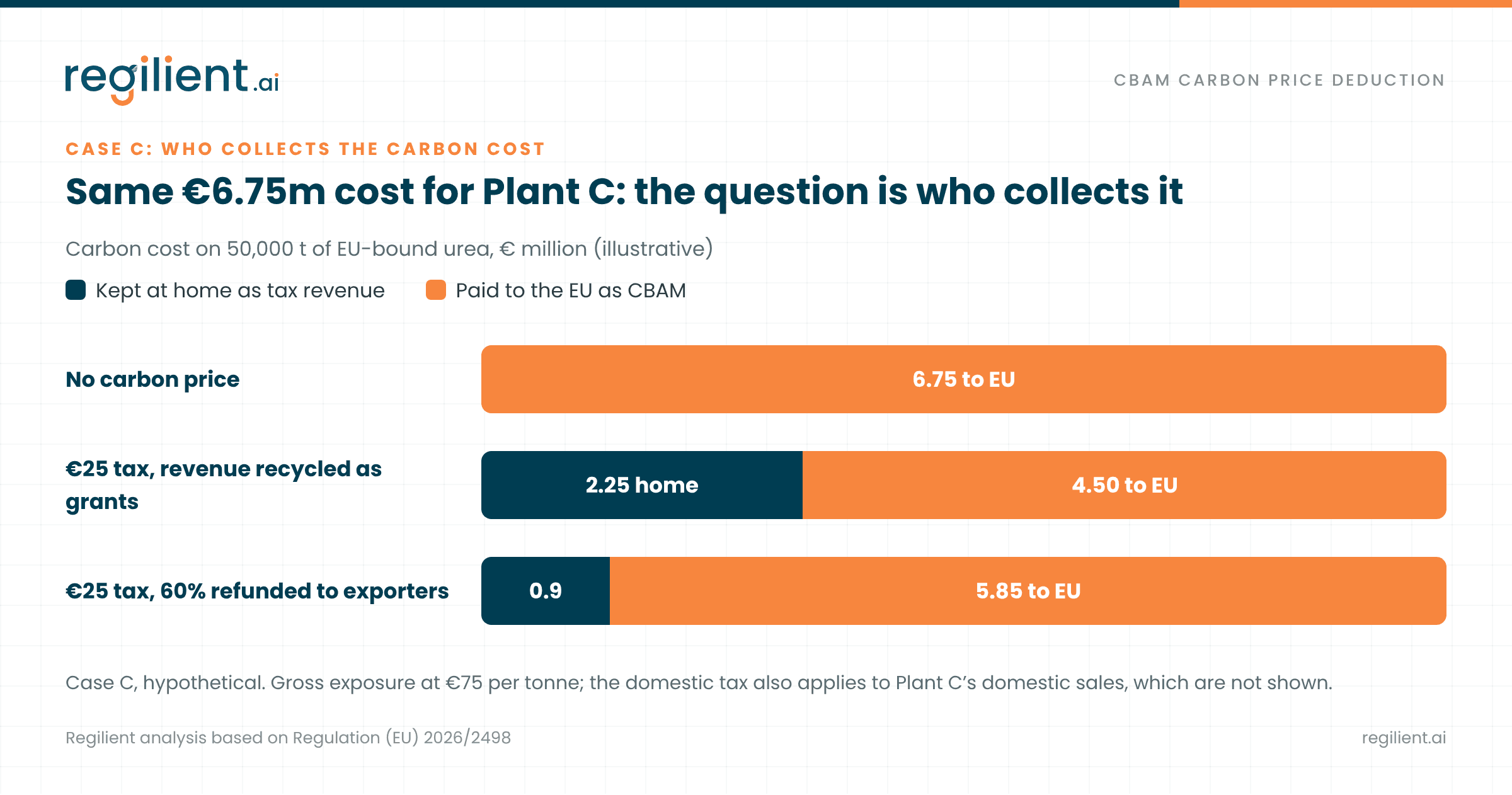
Case C, hypothetical. Gross exposure at €75 per tonne; the domestic tax also applies to Plant C's domestic sales, which are not shown.
Practical next steps
For producers outside the EU: map every carbon price, tax and levy that touches your installation, and every exemption or rebate you receive. Start preparing the carbon price report alongside your embedded emissions monitoring, since the two use the same reporting period and boundaries. Keep official records of tax paid, allowances surrendered and credits purchased. If you are entitled to a rebate you do not use, get written confirmation from the authority, otherwise it may be deducted anyway.
For EU importers: ask suppliers whether they pay a carbon price and which route (actual or default) is realistic for them. Remember that the actual route only works with verified actual emissions data. Check that the independent person is properly qualified. Build the likely deduction into 2026 and 2027 cost estimates, but treat it cautiously until the evidence is in hand.
For policymakers in exporting countries: look closely at Case C. A carbon price that is broad, binding, applies to all output and returns revenue through transparent decarbonisation grants keeps money at home. One riddled with exemptions mostly benefits the EU budget.
How Regilient helps
A carbon price deduction is only as good as the evidence behind it, and that evidence sits with suppliers: verified installation emissions, tax receipts, allowance surrenders and rebate records. Regilient's supplier outreach collects carbon price and embedded emissions data from producers in one workflow, so importers can see which suppliers support the actual route, which need the default route, and what the likely deduction is before certificates are bought in 2027.
This note is for general information only and does not constitute legal, regulatory or compliance advice. Case studies are hypothetical and simplified, and do not model the EU free-allocation adjustment to the number of certificates. Regulatory details, including the list of recognised mechanisms, default carbon prices and certificate prices, change frequently and should be checked against official sources.
Regilient provides agentic sustainability software for product compliance, supplier engagement, and regulatory intelligence across REACH, RoHS, PFAS, CMRT, SCIP, CBAM, and global chemical regulations.