
Table of Contents
- What is Catena-X PCF data?
- How IMDS and PCF data are connected
- What automotive suppliers need to collect
- Why IMDS data quality matters for PCF workflows
- IMDS is not a PCF system
- What changes for suppliers?
- How to manage IMDS and PCF data together
- 1. Build the product data structure
- 2. Collect material information
- 3. Validate supplier data
- 4. Maintain PCF information separately
- 5. Connect the datasets
- 6. Manage changes
- What should automotive suppliers automate?
- The practical takeaway
Automotive manufacturers are increasingly asking suppliers for more than material declarations. They also need product carbon footprint (PCF) data that can be exchanged through digital supply-chain networks such as Catena-X.
For suppliers, this creates an important data-management challenge: IMDS material data and PCF data are different, but they increasingly depend on overlapping product, component, material and supplier information.
The goal is not to replace IMDS with PCF reporting. It is to make the underlying product and material data reusable across both workflows.
What is Catena-X PCF data?
Catena-X provides a digital ecosystem for exchanging standardized information across the automotive value chain. Product Carbon Footprint data is one part of this broader data environment.
PCF data represents the greenhouse-gas emissions associated with a product or component according to the applicable calculation methodology and reporting requirements.
For automotive suppliers, this can mean providing customers with information about the carbon footprint of supplied parts or products while continuing to manage material compliance information through systems such as IMDS.
The two datasets answer different questions:
- IMDS: What materials and substances are contained in the part?
- PCF: What is the product's associated carbon footprint?
- Catena-X: How can relevant product information be exchanged through a connected digital ecosystem?
This distinction is important when designing the compliance-data workflow.
How IMDS and PCF data are connected
IMDS is primarily concerned with material and substance information. Automotive suppliers use it to communicate material declarations and support requirements associated with areas such as GADSL and ELV.
PCF reporting introduces another layer of product information.
A supplier may therefore need to connect:
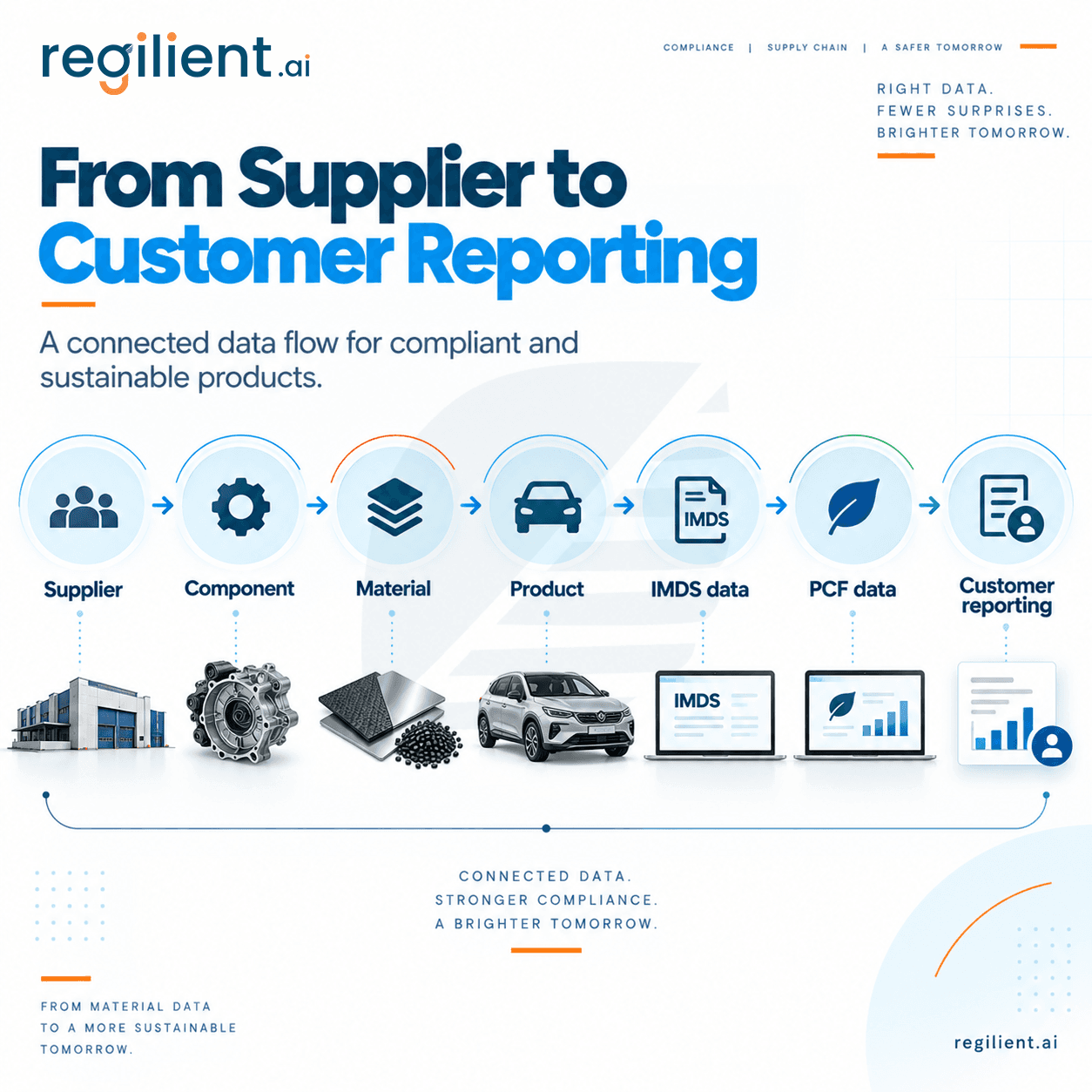
The underlying product structure matters to both workflows.
For example, a change to a component can affect the material declaration associated with that component. The same product change may also require the supplier to review whether the associated PCF data remains valid.
This is why treating every compliance request as a separate spreadsheet exercise creates unnecessary work.
Regilient's existing automotive compliance workflow already addresses the relationship between supplier information, IMDS, GADSL and automotive material compliance.
What automotive suppliers need to collect
PCF and IMDS workflows require different information, but there is significant overlap in the product hierarchy used to organize the data.
Depending on the customer and reporting requirement, supplier teams may need to manage:
- Product and part identification
- Component information
- Material composition
- Supplier information
- Manufacturing information
- Material quantities and weights
- IMDS material declarations
- PCF values and supporting information
- Version and change information
- Customer-specific reporting requirements
- Evidence supporting submitted data
The challenge is maintaining these records consistently.
A supplier should be able to identify which component, material and supplier information sits behind a particular product-level record.
Why IMDS data quality matters for PCF workflows
Poor material data does not only create an IMDS problem.
If product structures, component relationships or supplier information are incomplete, the same data-management weaknesses can make downstream sustainability reporting harder.
Common problems include:
- Missing supplier information
- Incorrect component relationships
- Outdated material declarations
- Incomplete material composition
- Duplicate product or material records
- Inconsistent product identifiers
- Manual reconciliation between compliance and sustainability teams
These are the same types of operational problems that can cause automotive material declarations to fail review.
Regilient's IMDS data-quality workflow focuses on identifying missing or incorrect material information before it becomes a downstream compliance problem.
IMDS is not a PCF system
One of the most important distinctions for automotive suppliers is that IMDS and PCF reporting should not be treated as interchangeable systems.
IMDS provides a structured environment for automotive material declarations.
PCF reporting addresses product carbon footprint information.
Catena-X provides an ecosystem for exchanging standardized data between participants in the automotive value chain.
A mature compliance-data architecture therefore needs to manage the relationships between these datasets rather than forcing one system to perform the role of another.
What changes for suppliers?
For suppliers, the operational requirement is increasingly moving from:
"Submit the required declaration."
to:
"Maintain reliable product data that can support multiple customer and regulatory workflows."
That means teams need better control over:
- Supplier data collection
- Material and component information
- Product structures
- Data validation
- Version control
- Change management
- Customer-specific reporting
- Evidence and audit history
The more customers request standardized digital information, the more important this underlying data layer becomes.
How to manage IMDS and PCF data together
A practical workflow should start with the product structure rather than with an individual reporting request.
1. Build the product data structure
Connect products to their components, materials and suppliers.
2. Collect material information
Maintain the relevant IMDS and material declaration information associated with components and materials.
3. Validate supplier data
Identify missing, inconsistent or outdated information before it is used in customer reporting.
4. Maintain PCF information separately
Store the PCF data and methodology-specific information required for carbon reporting without confusing it with material-composition data.
5. Connect the datasets
Where appropriate, connect the PCF record to the relevant product, component and supplier records.
6. Manage changes
When a product, component, material or supplier changes, identify which downstream records need review.
This creates a reusable data model instead of separate reporting silos.
What should automotive suppliers automate?
The highest-value automation is usually not the final submission itself.
It is the work required to prepare reliable data for submission.
That includes:
- Supplier data collection
- Automated follow-up
- Material-data validation
- Missing-data identification
- Product and BOM mapping
- IMDS data management
- PCF data association
- Change tracking
- Evidence management
- Reporting preparation
Regilient's automotive compliance platform supports IMDS and ELV compliance workflows, including IMDS/CAMDS data ingestion and validation, supplier workflows, material checks and compliance evidence.
The practical takeaway
Catena-X PCF reporting does not make IMDS obsolete.
Instead, automotive suppliers increasingly need to manage material compliance data and sustainability data as connected product information.
IMDS answers the material-composition question. PCF addresses product carbon footprint. Catena-X provides a digital environment for exchanging relevant information across the automotive value chain.
The suppliers best prepared for this shift are those that can maintain reliable product, material, component and supplier data once and reuse it across multiple compliance and sustainability workflows.