
Table of Contents
- What Is Brazil RoHS?
- Regulated Substances Under Brazil RoHS
- Brazil RoHS Compliance Timelines: What You Need to Prepare For
- Brazil RoHS Labeling & Documentation Requirements
- Brazil RoHS Market Surveillance and Enforcement
- Brazil RoHS Key Takeaways for Manufacturers & Importers
- Get Ahead with Regilient RoHS Compliance Automation
Brazil's electronics regulatory landscape has changed. On 10 July 2026, the Brazilian National Council for the Environment (CONAMA) published Resolution No. 516/2026 in the Federal Official Gazette, establishing Brazil's national framework for restricting hazardous substances in electrical and electronic equipment. The Resolution entered into force on the date of publication. This is no longer a draft — it is enforceable Brazilian law.
Progression timeline for context:
- 8 August 2025: CONAMA opened public consultation on the draft
- 24 September 2025: consultation closed
- March 2026: technical committee approved revised text following consultation
- 10 June 2026: CONAMA plenary approved the Resolution at its 150th Ordinary Meeting
- 10 July 2026: Resolution No. 516/2026 published and in force
What Is Brazil RoHS?
Resolution 516/2026 applies to electrical and electronic equipment operating at nominal voltages not exceeding 1,000 V AC or 1,500 V DC, including wires, cables, and spare parts intended for repair, reuse, functional upgrade, or capacity enhancement.
Product categories in scope include: household appliances, IT and telecommunications equipment, lighting equipment, consumer electronics, photovoltaic modules, electrical tools, toys, medical devices, and monitoring and control instruments.
Batteries and accumulators are explicitly excluded from scope. Existing ANATEL and INMETRO certificates remain legally valid but do not replace the new environmental compliance obligations under Resolution 516/2026. It aligns with the EU RoHS Directive but includes region-specific timelines, obligations, and exemptions.
This draft is under final review — but its core structure is unlikely to change.
Regulated Substances Under Brazil RoHS
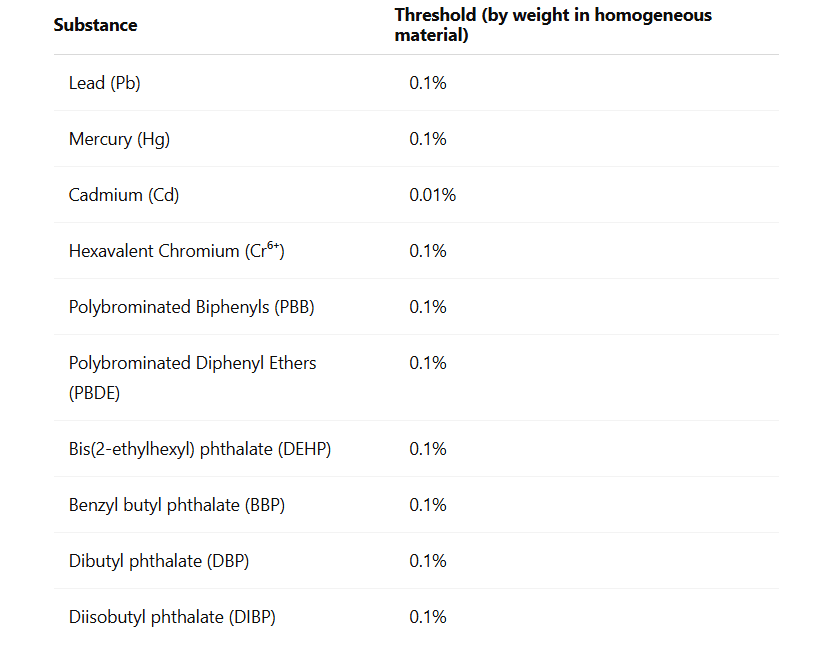
Brazil’s draft RoHS regulation restricts the following 10 hazardous substances, consistent with EU thresholds:
Brazil RoHS Compliance Timelines: What You Need to Prepare For
- Mercury: Already restricted under existing Brazilian lighting laws (since 2020)
- PBB and PBDE: Banned immediately upon final publication of the new RoHS resolution
- All Other Substances: Grace period of 4–7 years, depending on product category (to be defined in annexes)
Implementation schedules will be defined per product type in upcoming resolutions — monitor CONAMA and INMETRO channels closely.
Regional substance restrictions are easier to manage with RoHS compliance software that helps centralize supplier data, product information, and compliance tracking.
Brazil RoHS Labeling & Documentation Requirements
Resolution 516/2026 imposes obligations across five compliance dimensions:
1. Substance limits: Maximum concentration values by mass of homogeneous material for the ten restricted substances, aligned with EU RoHS thresholds (0.1% general; 0.01% for cadmium).
2. Product registration: Products must be registered in a national database.
3. Self-declaration of conformity: Manufacturers, importers, and distributors must issue a Brazil-specific self-declaration of conformity, distinct from ANATEL or INMETRO certification.
4. Traceability and labelling: Equipment must bear clear information in Portuguese enabling identification and traceability, including model, batch, serial number, trademark, contact address in Brazil, and identification of the manufacturer or importer. Equipment subject to reverse logistics obligations must display a symbol indicating separate disposal.
5. Technical documentation: Product descriptions, model identifiers, BOM, test reports or supplier declarations, and risk assessments must be maintained and made available on request.
Brazil RoHS Market Surveillance and Enforcement
Enforcement operates through a multi-layered market surveillance framework: IBAMA at the federal level, state environmental agencies at the sub-federal level, and additional oversight tied to the national registration database. Non-compliance may result in monetary fines, product withdrawal, import bans, public recalls, and in cases of environmental harm or falsified documentation criminal liability. Compliance timelines and enforcement priorities are being defined through subsequent CONAMA and INMETRO acts.
Brazil RoHS Key Takeaways for Manufacturers & Importers
- Don’t underestimate Brazil RoHS just because it’s in draft form — it will become enforceable.
- Align your substance controls with EU RoHS best practices today.
- Start compiling a centralized technical documentation library for your affected SKUs.
- Automate compliance tracking across suppliers to reduce risk.
Get Ahead with Regilient RoHS Compliance Automation
Regilient's RoHS compliance software helps manufacturers and importers eliminate compliance uncertainty across markets, including Brazil RoHS under Resolution 516/2026.
Automated supplier outreach & data collection Real-time tracking of hazardous substance levels Brazil-ready declaration & documentation workflows AI-powered alerts for updates & deadlines
Book a demo today and see how Regilient keeps you audit-ready across every market — Brazil included.