
Table of Contents
Brazil RoHS (CONAMA Resolution 516/2026) restricts 10 hazardous substances in electrical and electronic equipment (EEE) sold in Brazil. It's already in force, and unlike EU RoHS, it adds a mandatory national registry and product-by-product self-declarations. Here's when it applies, why it matters, what's required, and how to prepare.
Field | Detail |
Official name | CONAMA Resolution No. 516/2026 |
Published / in force | 10 July 2026, Federal Official Gazette |
Applies to | Manufacturers, importers, distributors, retailers of EEE (wires, cables, spare parts) |
Framework authority | Ministry of the Environment and Climate Change (MMA) |
Enforcement | IBAMA and state environmental agencies |
Key deadlines
All deadlines run from 10 July 2026, the date the Resolution took effect.
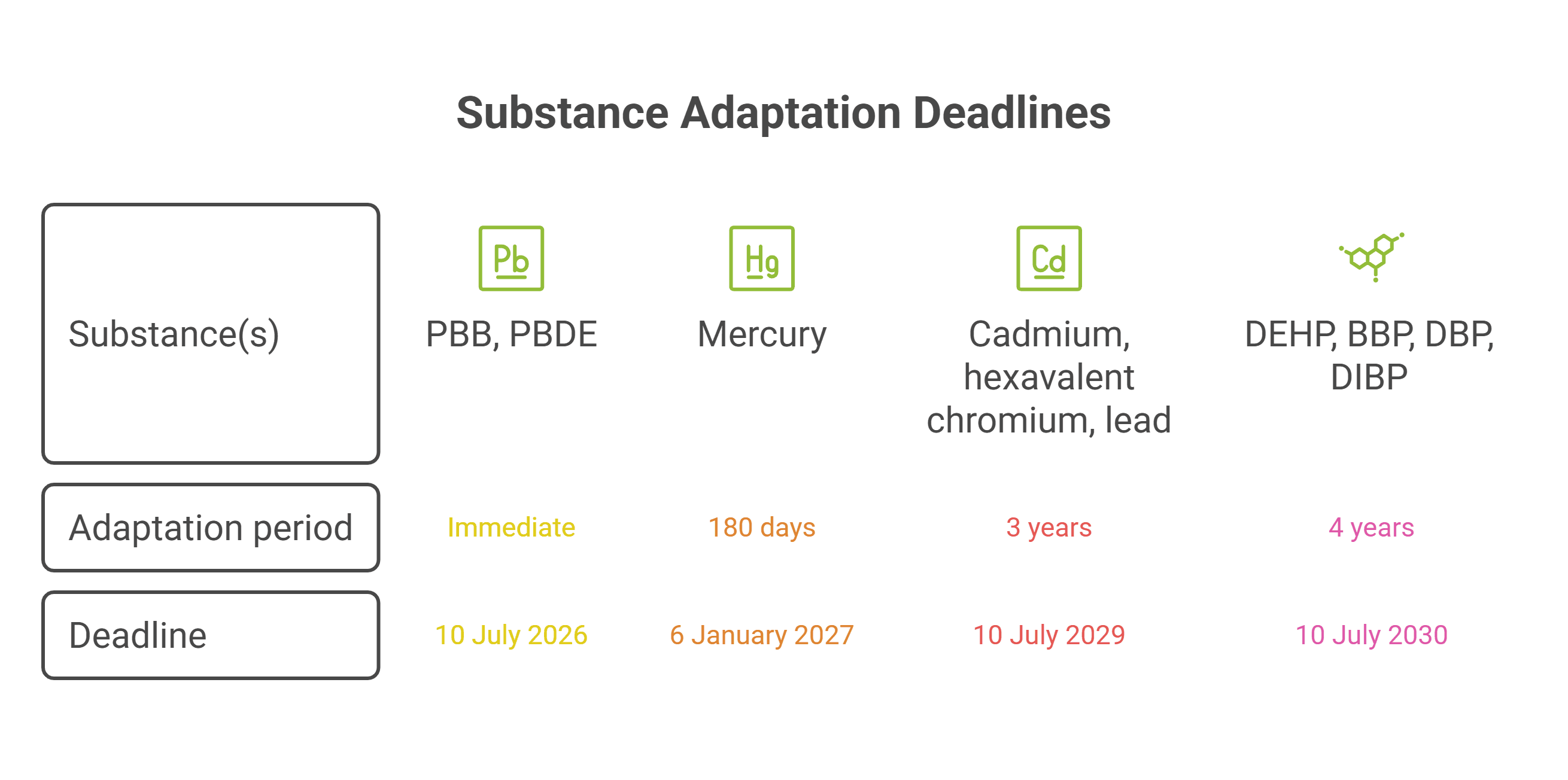
Other dates to know:
- Exemptions published: MMA's list, procedures, and documentation requirements due 6 January 2027
- Registry go-live: not fixed yet; once live, 1 year to register and self-declare
- Documentation & marking: enforceable once a self-declaration is issued
- Disposal symbol: enforceable 2 years after that
Spare parts repairing or reusing pre-deadline equipment are excluded, as is equipment under a valid exemption.
Why it matters
That “monitor it later” window has closed.
The substance list isn't the hard part: it matches EU RoHS 2. The hard part is process a registry and self-declaration per product, with no EU equivalent. Compliant products alone won't save a team lacking a self-declaration workflow, Portuguese files, and a registration plan.
Non-compliance risk goes beyond fines: administrative, civil, and criminal liability, plus mandatory recall and disposal
Distributors, retailers, and private-label brands carry extra risk: you must confirm a supplier's self-declaration before selling their product. Rebrand it under your own name, alter something that affects compliance, or skip that check, and you can be treated as the manufacturer, full obligations included.
What is required
Scope: finished EEE, wires, cables, and spare parts (repair, reuse, upgrade), the same categories as EU RoHS 2; batteries excluded.
Substance limits same as EU RoHS 2:
Substance | Limit (by weight) |
Lead, Mercury, Hexavalent chromium, PBB, PBDE, DEHP, BBP, DBP, DIBP | 0.1% |
Cadmium | 0.01% |
Mercury is also covered by Federal Decree 9,470/2018 (Minamata Convention); the stricter rule applies. MMA reviews the list every 5 years minimum.
Registration and self-declaration: Brazil's two big departures from EU RoHS. Register and self-declare individually per product, model, or family before manufacture/import. The declaration travels with the product (or a redirect tool) and goes online too.
Documentation and labelling: Portuguese technical files, retained 5 years after discontinuation (not launch). Every unit needs Portuguese-language model, batch, serial number, trademark, Brazilian contact address, and manufacturer/importer ID, plus a disposal symbol under reverse-logistics rules.
Exemptions: MMA grants one if substitution is impossible, an alternative's reliability is unproven, or life-cycle analysis shows more harm than benefit. Renewals: file 18+ months ahead. Denied/revoked: 12–18 month transition. Until MMA's list is out, EU Annex III/IV is a reference only, not a guarantee.
How to comply
- Map substances against your BoM: confirm existing EU RoHS data covers all 10 substances (including the phthalates), then count the SKUs, models, and families needing registration.
- Localize technical documentation into Portuguese, with retention running from discontinuation, not launch.
- pdate labelling and traceability to Brazil's required fields, and flag products needing the disposal symbol.
- Track exemptions against the MMA's published list once available; don't assume EU exemptions carry over.
- Prepare for inspection: IBAMA and state agencies can request samples, order testing, and seize non-compliant stock; the liable party covers the costs.
How Regilient can help
The chemistry is rarely the problem. Most EU RoHS-compliant products already meet Brazil's limits the load is registry readiness, self-declarations, and Portuguese paperwork, multiplied across every SKU. Regilient handles that layer:
- Substance tracking: automatic BoM-level checks against Brazil RoHS thresholds
- Supplier outreach: automated requests, reminders, validated declarations
- Self-declarations: generated from BoM data, registry-ready
- Portuguese documentation: centralised, versioned technical files per product
- Exemption alerts: flagged the moment the MMA acts on one
- Disposal marking: SKUs auto-matched to reverse-logistics obligations
Already tracking EU, UK, or China RoHS? The same platform covers Brazil too no parallel process needed.