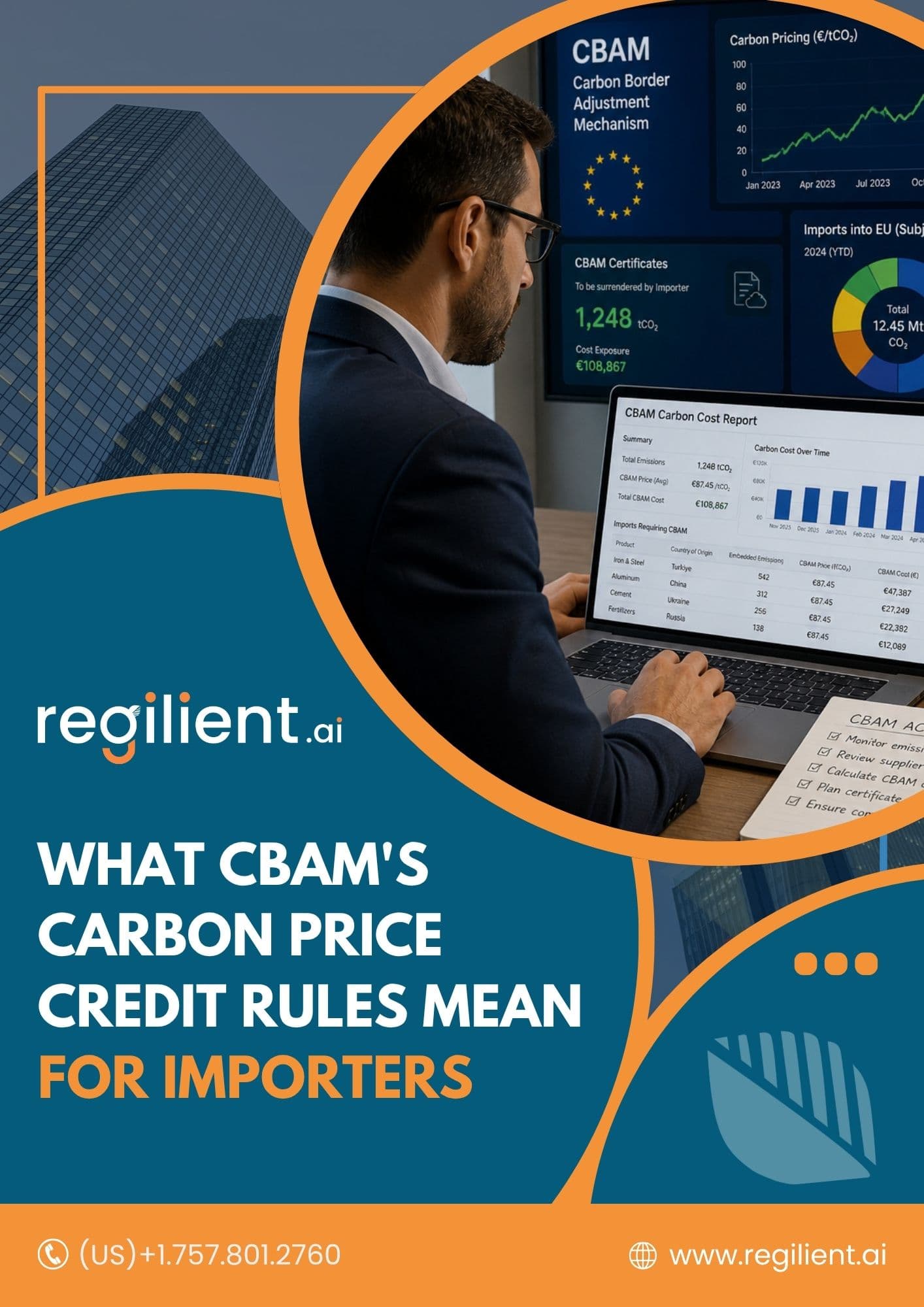
What CBAM's Carbon Price Credit Rules Mean for Importers
Fill Details & Download Free E-Book
What’s Inside The E-Book
Chapters Overview
Chapter 1: Introduction
Sets the stage for why the carbon price credit rules matter so much in practice. If you are importing steel, aluminium, cement, fertilisers, chemicals, hydrogen, or electricity into the EU, and your suppliers operate in jurisdictions with their own carbon pricing schemes, the deduction rules directly determine how much of your CBAM bill you can offset. This chapter explains the scope of the 2025 Commission consultation, the three Calls for Evidence launched in August 2025, and why the implementing acts have not yet been finalised — making early preparation the only viable strategy.
Chapter 2: Who Responded in Consultation and Why That Matters
Understanding who shaped this consultation tells you whose interests the final rules will need to balance. Companies and business associations accounted for 76% of all 158 submissions, making this overwhelmingly a producer-and-importer-led conversation. Critically, 46% of responses came from outside the EU — with the largest third-country contingents from China (7%), the United Kingdom (6%), and Türkiye (6%). That near-parity between EU and non-EU voices is the structural reason you will see sharp tensions throughout the debate. Small and micro-enterprises were also strongly represented (30% and 14% respectively), sending a clear signal that the final rules need to be workable for organisations without dedicated compliance teams.
Chapter 3: Where the Debate Concentrated
Nine key topic areas emerged, but three dominated the conversation, each attracting more than 40% of all submissions: the eligibility of carbon pricing instruments (74 responses, 47%), the definition of effective price paid (71 responses, 45%), and the treatment of rebates and compensations (65 responses, 41%). Iron and steel led sector engagement across almost every technical topic, reflecting both the sector's outsized CBAM exposure and the fact that several major steel exporters already operate under domestic ETS schemes. Electricity respondents concentrated heavily on proof of payment, where the anonymous nature of power market transactions creates distinct verification challenges that no other CBAM sector faces in the same way.
Chapter 4: The Core Question - Which Carbon Costs Actually Count?
This was the single most contested topic in the entire consultation. The broad consensus: only genuine, explicit, and verifiable carbon costs should count toward a CBAM deduction. That means compliance-based Emissions Trading Systems like the UK ETS and China's national ETS are widely supported as eligible. Voluntary carbon credits from unregulated markets drew significant scepticism due to concerns about additionality and the risk of double counting. Non-EU respondents pushed back, arguing for a broader definition that would capture fuel taxes, electricity taxes, and other climate-related levies. The chapter presents the four-tier eligibility framework emerging from stakeholder sentiment: Likely Eligible (compliance ETS, government carbon taxes, verified net carbon costs), Conditionally Eligible (Article 6 Paris credits, domestic compliance offsets from Singapore and South Africa), Contested or Unclear (voluntary carbon credits, RECs and IRECs, fuel and electricity taxes), and Likely Excluded (direct and indirect rebates, energy taxation, hidden subsidies, non-government levies).
Chapter 5: Rebates, Subsidies, and the "Effective Price Paid" Problem
The most-discussed topic in the entire consultation (71 responses). The core tension: EU-based respondents argued that any rebate a third-country government grants to its producers should reduce the recognised carbon cost accordingly — preventing CBAM from being gamed by subsidy-backed exporters. Third-country respondents pushed back hard, arguing that all actual carbon costs paid abroad should be fully deductible without adjustment. The chapter explains why this divide matters for your procurement strategy: if your supply chain involves producers receiving government rebates or compensations tied to their carbon pricing obligations, those rebates will likely reduce or eliminate your CBAM deduction. The chapter also flags the risk of "disguised support" — revenue recycled back to firms through indirect channels — and explains why transparent, published reference prices will become essential compliance infrastructure.
Chapter 6: Proving You Actually Paid - The Documentation Challenge
53 responses (34% of submissions) addressed proof-of-payment requirements, and the theme was consistent: the current framework risks becoming unmanageable, especially for companies operating in complex supply chains with diverse upstream suppliers. Stakeholders called for standardised, digital documentation: government-issued receipts accepted as sufficient evidence, one proof per supplier uploaded once and reused for subsequent declarations, and certified emissions values rather than extensive raw technical documentation. For the electricity sector specifically, several respondents argued that if a third country has a recognised and enforced carbon pricing mechanism, no physical proof of payment should be required at all — given how impossible it is to trace electricity flows through interconnected grids. The compliance signal: your documentation processes need to be built with flexibility now, before the implementing acts lock in.
Chapter 7: Accreditation - Who Gets to Verify?
40 responses addressed who is authorised to certify carbon price declarations, and this is one area where third-country voices clearly dominated — 22 of those 40 responses (55%) came from outside the EU, well above the overall consultation share of 46%. The concern was direct: if the Commission only recognises EU-accredited verifiers, it creates a structural trade barrier and significantly raises compliance costs for non-EU manufacturers, particularly SMEs. Stakeholders called for alignment with internationally recognised frameworks like ISO 14064 and the GHG Protocol, mutual recognition agreements between the EU and third countries, and acceptance of verifiers accredited by national certification authorities in their home countries, provided they meet clear international standards.
Chapter 8: The Technical Details That Matter - Currency and Emissions Scope
Two technically critical but often overlooked issues. On currency conversion: 24 responses pushed for standardised, publicly published exchange rates — but stakeholders disagreed on whether rates should be daily, weekly, monthly, or annual averages. On emissions scope consistency: this is arguably the most fundamental technical challenge in the entire CBAM deduction system. Third-country carbon pricing schemes rarely cover the same emissions scope, greenhouse gases, or production boundaries as CBAM. When scopes do not match, there is a real risk of either double counting (claiming a deduction for emissions CBAM does not cover) or under-crediting (not receiving recognition for carbon costs that genuinely correspond to CBAM-covered emissions). Stakeholders cited ISO 14064 and the GHG Protocol as reference points, but existing documentation and verification standards were judged insufficient to reliably prove consistency between systems.
Chapter 9: Coordinated Industry Responses
Three notable groups submitted identical position papers, giving a clear read on where organised industry pressure is heaviest. EU and GB Transmission System Operators called for linking the EU ETS and UK ETS and urged temporary exemption for UK electricity imports. The EUROFER iron and steel paper (Finland, Belgium, Poland) argued for a conservative, verifiable approach to deducting foreign carbon prices, with direct and indirect rebates fully accounted for and other cost forms like energy taxation excluded. The FEC/IVSH paper from Germany raised the risk of carbon leakage and cost asymmetry for downstream metal products, and called for CBAM scope extension to high-risk downstream products with more than 70% metal content.
Chapter 10: What This Means for Your Compliance Strategy Right Now
The implementing acts are not finalised yet. But the consultation has signalled where the Commission is likely to land: a conservative approach to eligibility, strict accounting for rebates and subsidies, standardised documentation requirements, and an internationally inclusive accreditation framework. This chapter translates those signals into five near-term priorities: Map your carbon costs now and identify which pricing instruments your suppliers operate under. Audit your rebate exposure before the net carbon cost definition is locked in. Build your documentation infrastructure before the proof-of-payment rules are set. Assess your verifier relationships if you rely on non-EU certifiers. And monitor DG TAXUD reference price publications closely, because currency conversion and emissions scope alignment will both depend heavily on what the Commission publishes as official reference data.
Chapter 11: How Regilient AI Solves Carbon Price Paid Overseas
Regilient's Carbon Price Declaration workflow is built around the exact concerns that dominated the 2025 consultation. The three-tab flow covers every piece of information needed to claim a CBAM deduction for carbon prices paid in third countries — regardless of which way the Commission's final rules tilt. The Scheme tab captures scheme name and type, country of payment, reporting period, currency, price per tCO₂, certificates retired, total amount paid, and payment date — directly addressing the eligibility framework, effective price paid, and currency conversion concerns (169 combined responses). The Production and Export tab links the declared carbon price to the specific volume of production exported to the EU versus total production covered, auto-calculating the importer's estimated offset claim in euros in real time — addressing emissions consistency and net carbon cost calculation concerns. The Documents tab accepts tax receipts, retirement certificates, and verifier statements via drag-and-drop upload in multiple formats, with each document reusable across subsequent declarations — implementing the one-proof-per-supplier ask that came up repeatedly across 53 responses.
Disclaimer: The information provided in Regilient's blogs, ebooks, and other materials is intended for informational purposes only and should not be construed as legal advice. While we strive to provide accurate and up-to-date information, the rapidly evolving nature of compliance regulations means that the content may not always reflect the most current legal standards or interpretations. Therefore, it is crucial to consult with qualified legal professionals or our experts to ensure compliance with specific regulations and requirements applicable to your business. Reliance on the information provided without seeking professional advice could result in legal risks and potential non-compliance. Regilient disclaims any liability for errors, omissions, or damages arising from the use of the information provided in our materials.