
Build vs. Buy Product Compliance & Sustainability Software
Fill Details & Download Free E-Book
What’s Inside The E-Book
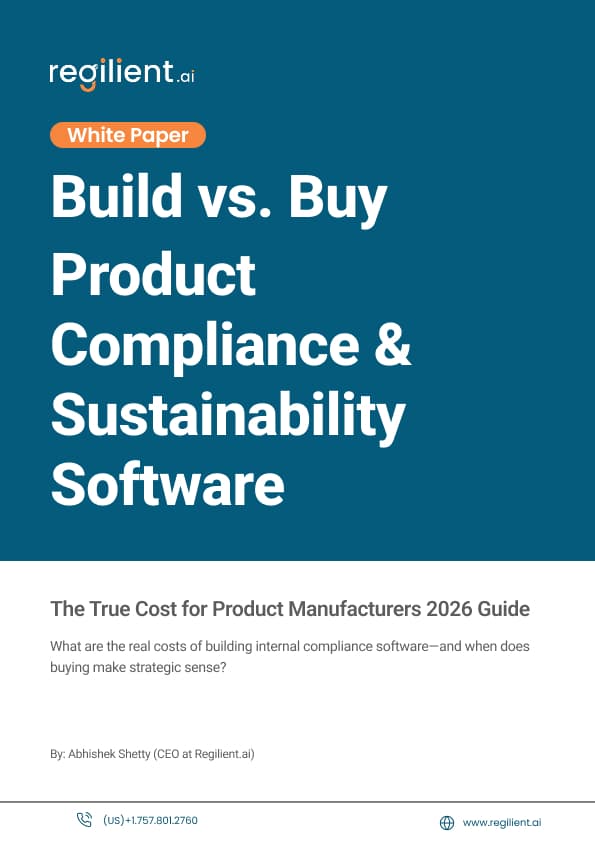
Build vs. Buy Product Compliance & Sustainability Software — The True Cost for Product Manufacturers 2026 Guide
Are you still debating whether to build your own compliance platform or buy a specialised solution? Every year manufacturers spend millions building internal tools — only to discover the real costs emerge long after launch. This white paper by Regilient CEO Abhishek Shetty cuts through the assumptions and delivers a clear, data-backed answer to one of the most consequential technology decisions product manufacturers face today.
Why Download This White Paper?
Whether you are a Compliance Manager, VP Engineering, CIO, Sustainability Director, or Procurement Leader, this guide gives you the financial, strategic, and operational evidence you need to make the right call — before committing budget, headcount, and years of effort to the wrong path. Here's what you can expect:
- True Cost Breakdown: Discover why 78% of lifetime software TCO accrues after launch — and what that really means for your internal build budget.
- Regulatory Complexity Exposed: Understand why compliance platforms are not static applications but dynamic, regulation-driven intelligence systems that demand continuous updates.
- Risk Quantification: Learn how non-compliance costs organisations an average of $14.82 million in fines, disruption, and recall costs — and how platform choice directly affects your exposure.
- AI & Scale Advantage: See why AI-powered compliance systems trained on millions of parts across hundreds of companies cannot be replicated by a single organisation's internal dataset.
- Build vs. Buy Decision Framework: Walk away with a clear set of criteria to evaluate whether internal development is ever justified — and a strategic recommendation grounded in industry data.
Table of Contents
Chapter 1: What Is a Product Compliance & Sustainability Platform?
A clear explanation of why modern compliance platforms span RoHS, REACH, PFAS, CMRT, SCIP, CSRD, CBAM, and more — and why these domains are interconnected, not isolated.
Chapter 2: Why Companies Consider Building Internally
An honest look at the three motivations behind internal builds — cost savings, control, and AI optimism — and why industry data consistently challenges each assumption.
Chapter 3: The Hidden Complexity of Regulatory Intelligence
An examination of why regulations are never static, how each update triggers interpretation, rule reconfiguration, and system logic changes — and what McKinsey and the Standish Group say about why large custom software initiatives fail.
Chapter 4: Total Cost of Ownership — The Financial Reality
A full lifecycle cost analysis covering direct costs (developers, compliance SMEs, DevOps, AI tuning) and indirect costs (regulatory lag, supplier inefficiencies, opportunity cost) — including why specialised platforms deliver 30–50% lower 5-year TCO.
Chapter 5: Continuity & Dependency Risk
A frank assessment of what happens when the key developers or sustainability leader who built your internal system leaves — and the common failure patterns that turn internal builds into sunk costs.
Chapter 6: AI & Agent-Based Systems — Scale Matters
Why compliance AI improves with cross-industry volume and edge-case exposure, and why 93% of compliance professionals agree that specialised AI tools outperform internal builds on error reduction and automation.
Chapter 7: Compliance Is Risk Management, Not Data Entry
The strategic case for treating compliance as a proactive risk function — with data on the $5.1M average disruption cost, the 45% rise in non-compliance penalties since 2011, and the 78% of manufacturers still failing CSRD value chain disclosure requirements.
Chapter 8: The Human Element & Supplier Engagement
Why even the most advanced software cannot replace structured supplier follow-up, escalation workflows, and relationship management — and how specialised providers bundle all three.
Chapter 9: Strategic Focus — Core vs. Non-Core Capability
A strategic lens on why regulatory intelligence platform development is rarely a manufacturer's core competency, and what is lost when engineering teams are diverted to software maintenance instead of product innovation.
Chapter 10: When Does Internal Development Make Sense?
The five conditions under which building internally may be justified — and why they are rarely present in global product manufacturing.
Chapter 11: Strategic Recommendation
A clear, actionable recommendation backed by industry benchmarks, including how to integrate a specialised platform with your ERP/PLM systems and focus your internal team where they deliver the most value.
Stop underestimating the true cost of building internally. Download the Build vs. Buy Product Compliance & Sustainability Software white paper now and make your platform decision with confidence.
Disclaimer: The information provided in Regilient's blogs, ebooks, and other materials is intended for informational purposes only and should not be construed as legal advice. While we strive to provide accurate and up-to-date information, the rapidly evolving nature of compliance regulations means that the content may not always reflect the most current legal standards or interpretations. Therefore, it is crucial to consult with qualified legal professionals or our experts to ensure compliance with specific regulations and requirements applicable to your business. Reliance on the information provided without seeking professional advice could result in legal risks and potential non-compliance. Regilient disclaims any liability for errors, omissions, or damages arising from the use of the information provided in our materials.
%20(1).jpg)
%20(1).jpg)