
Table of Contents
- PFAS 101: Not Just Another Acronym
- Where PFAS Hides in Electronics
- Why Regulators Are Cracking Down
- In the United States:
- In the European Union:
- In Canada:
- What’s the Risk for Electronics Manufacturers?
- Your PFAS Action Plan — Do It Now
- Where This Is Headed
- PFAS isn’t just an environmental risk anymore. It’s a business continuity risk.
Let’s be honest.
If you’re in electronics and still treating PFAS like a future problem, you’re not paying attention. These chemicals—used in everything from semiconductors to solder masks—are now at the center of a global regulatory storm.
Regulators aren’t just circling anymore. They’ve landed.
PFAS 101: Not Just Another Acronym
PFAS stands for Per- and Polyfluoroalkyl Substances—a massive class of synthetic chemicals with carbon-fluorine bonds that don’t break down. That’s what makes them useful. That’s also what makes them dangerous.
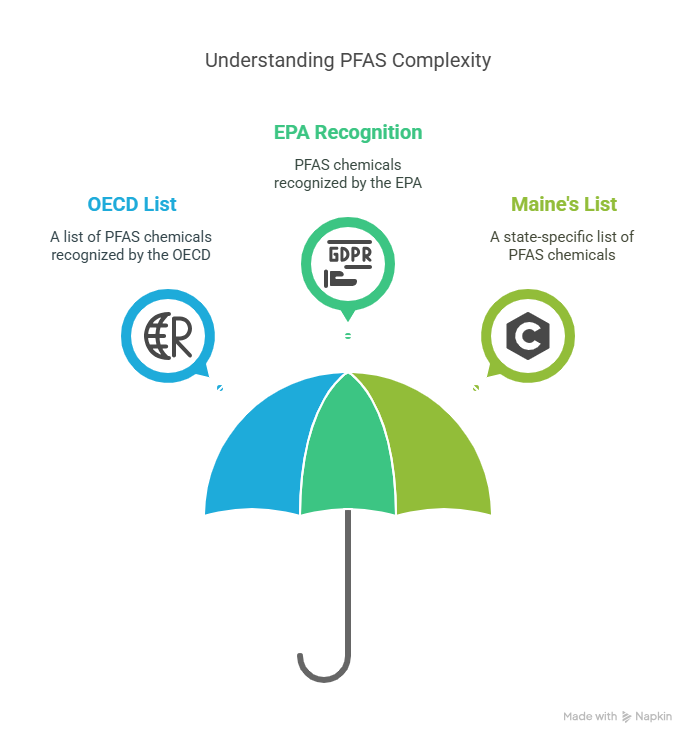
And no, this isn’t about one chemical. It’s a moving target:
- OECD lists around 4,700
- The EPA recognizes over 12,000
- Maine has its own list !_- visual selection.png
Where PFAS Hides in Electronics
PFAS doesn’t show up on product labels. But it’s woven into your electronics supply chain:
- PCB coatings for dielectric strength
- Semiconductor etching and heat resistance
- Hard drive lubricants
- Cable jackets and wire insulation
- LCD and OLED displays
- Aerospace systems where zero failure is tolerated
If it insulates, resists, repels—or simply lasts—it might contain PFAS.
Why Regulators Are Cracking Down
This isn’t just about emissions or ESG posturing.
PFAS has been detected in:
- Rainwater, globally
- Breast milk, everywhere
- Umbilical cords and new-born bloodstreams
And the science? It’s ugly:
- Testicular and kidney cancer
- Liver toxicity
- Immune suppression
- Reproductive harm
- Sky-high cholesterol
Every gram ever made is still out there. That’s why global regulators are stepping in.
PFAS Regulation in 2025: Electronics in the Crosshairs
In the United States:
- TSCA Section 8(a)(7): Mandatory PFAS use reporting by May 2025—even for articles. No electronics exemptions.
- State-level mandates: Maine, Minnesota, and California are imposing stricter PFAS disclosure rules.
- EPA water regulations: Focused on discharge levels, but if you’re dumping PFAS-laced effluent, expect enforcement.
In the European Union:
- REACH PFAS Proposal: A sweeping restriction across all uses, unless specifically exempted.
- POPs Regulation: PFOA and PFOS already banned.
- Drinking Water Directive: Adds indirect pressure on electronics manufacturers to track PFAS use.
In Canada:
- CEPA Section 71: New reporting rule for long-chain PFAS, including PTFE. Impacts imported electronics. Reporting deadline: March 24, 2025.
Even if you don’t sell in all these regions, your suppliers probably do. If they’re not compliant, neither are you.
What’s the Risk for Electronics Manufacturers?
Most electronics companies don’t even realize they’re exposed.
PFAS may be in your coatings, adhesives, or insulating materials—even if your BOM doesn’t mention them.
Still your responsibility.
Non-compliance leads to:
- Product bans in global markets
- Fines you didn’t forecast
- Contract loss due to ESG scoring
- Long-term brand erosion
Your PFAS Action Plan — Do It Now
- Screen Every BOM
Start with PCBs, semiconductors, displays, wire jackets, adhesives. Use PFAS screening tools to assess high-risk materials.
- *Get [Full Material Declarations (FMDs)](https://www.acquiscompliance.com/topic/material-disclosure/)**
Push suppliers for data. Use structured formats (IPC-1752A, IEC 62474). No data? No deal.
- Test for PFAS If in Doubt
Where suppliers fall short, test your materials using LC-MS/MS or other validated analytical methods.
- Track Global PFAS Regulations
Keep tabs on TSCA 8(a)(7), REACH Annex XVII, CEPA S.71, and local mandates in Maine and California. Stay ahead, not reactive.
- Integrate PFAS into Your EHS Program
This isn’t just chemical compliance. It’s product stewardship, corporate accountability, and brand reputation management.
Where This Is Headed
- The EU is moving toward a full PFAS ban in electronics
- Maine is requiring PFAS content reporting for all product categories
- Retailers and OEMs are demanding supplier transparency
- Investors are watching ESG disclosures more closely
PFAS isn’t just an environmental risk anymore. It’s a business continuity risk.
And those who prepare now? They’ll win contracts, not lose them.
At Regilient, we offer:
- Material screening automation
- Supplier declaration tools
- TSCA/REACH readiness
- Custom PFAS risk scoring
No fluff. No guessing. Just clear, fast answers.