
Table of Contents
- What Are Ozone Depleting Substances?
- The Montreal Protocol: The Regulatory Framework You're Actually Operating Under
- Who Does ODS Compliance Actually Affect in Manufacturing?
- US Regulatory Enforcement: EPA CAA Section 608 and Beyond
- SNAP: The Often-Overlooked Piece of ODS Compliance
- The Supply Chain Dimension: Where ODS Compliance Gets Genuinely Hard
- Common ODS Compliance Mistakes Manufacturers Make
- What ODS Compliance Documentation Should Actually Look Like
Most manufacturers assume ozone-depleting substances (ODS) are a solved problem, CFCs were phased out decades ago, and the ozone layer is recovering. Tell that to the compliance team at a US electronics firm that just discovered their refrigeration component supplier is still using R-22 (HCFC-22), a controlled substance under the Montreal Protocol with active import restrictions as of 2020. Assumptions don't survive audits.
ODS compliance is alive, actively enforced, and increasingly tangled with modern supply chain due diligence requirements. Here's what manufacturers need to know in 2025 and beyond.
What Are Ozone Depleting Substances?
Ozone depleting substances are chemicals that, when released into the atmosphere, chemically react with and break down stratospheric ozone, the layer that shields Earth from ultraviolet radiation. The mechanism is well understood: chlorine and bromine atoms liberated from ODS molecules catalytically destroy ozone molecules (O₃) in a chain reaction. A single chlorine atom can destroy up to 100,000 ozone molecules before being deactivated.
The key metric is Ozone Depleting Potential (ODP) a relative scale where CFC-11 (trichlorofluoromethane) is set at 1.0. A substance with an ODP of 0.5 destroys half as much ozone per kilogram as CFC-11. This number matters in regulatory determinations of phaseout schedules and exemption thresholds.
The main ODS families relevant to product manufacturers are:
- Chlorofluorocarbons (CFCs): CFC-11, CFC-12, CFC-113, CFC-114, CFC-115. ODP range: 0.6–1.0 (CFC-11 and CFC-12 = 1.0; CFC-115 = 0.6) . Largely phased out in developed countries by 1996 under the original Montreal Protocol, but still appear in legacy equipment and some developing-country supply chains.
- Hydrochlorofluorocarbons (HCFCs): HCFC-22 (R-22), HCFC-141b, HCFC-142b. ODP range: 0.01–0.11. The transitional replacement for CFCs — now themselves being phased out. Critical for manufacturers of refrigeration, air conditioning, and foam products.
- Halons: Halon-1211, Halon-1301, Halon-2402. ODP range: 3.0–10.0. Used in fire suppression systems. Exceptionally destructive — Halon-1301 has an ODP of 10, meaning it destroys ten times as much ozone per kilogram as CFC-11.
- Methyl bromide (CH₃Br): ODP 0.6. Used historically in fumigation and some agricultural applications. Subject to critical-use exemptions.
- Carbon tetrachloride (CCl₄): ODP 1.1. A solvent and chemical feedstock with significant ODS designation.
- Hydrobromofluorocarbons (HBFCs) and methyl chloroform (1,1,1-trichloroethane, TCA): ODP 0.1–1.0. Solvents and blowing agents with ongoing restrictions.
The Montreal Protocol: The Regulatory Framework You're Actually Operating Under
The Montreal Protocol on Substances that Deplete the Ozone Layer, adopted in 1987 and entered into force in 1989, is the governing international treaty. It is administered by the United Nations Environment Programme (UNEP) and has been ratified by 198 countries — making it the only UN treaty to achieve universal ratification.
The protocol doesn't work as a static list. It operates through a schedule of controlled substance groups (Annexes A through F) with differentiated phaseout timelines for developed (Article 2) and developing (Article 5) countries. This distinction matters enormously for manufacturers with global supply chains: a supplier in an Article 5 country legally operating with HCFCs may be supplying you with a component that is restricted at your end-market.
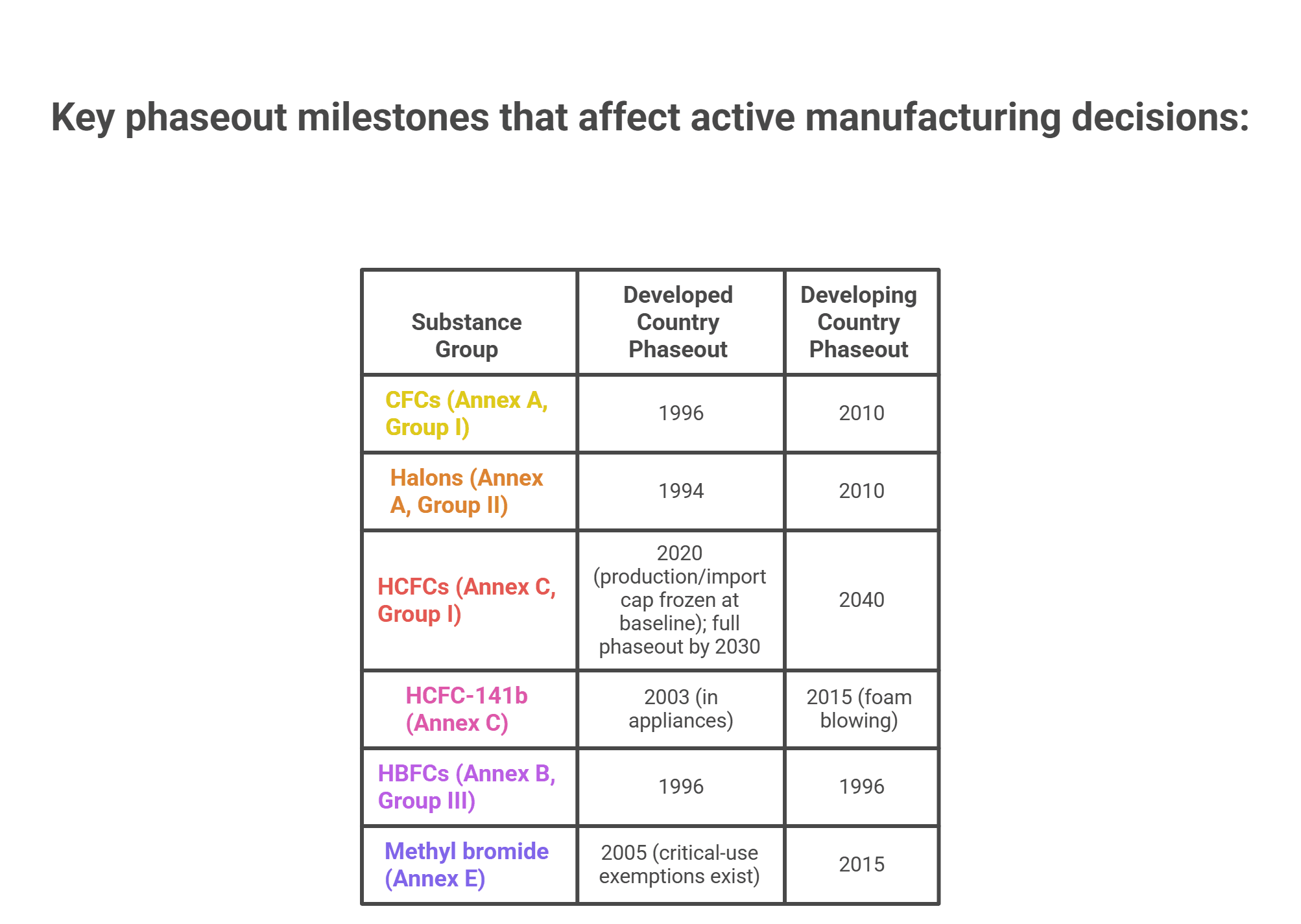
The Kigali Amendment (2016), which entered into force in 2019, extended the Montreal Protocol's reach to cover hydrofluorocarbons (HFCs). HFCs are not ozone-depleting but were introduced as ODS replacements, and they are potent greenhouse gases. The Kigali Amendment phases down HFC production and consumption with specific schedules — meaning manufacturers transitioning away from ODS may inadvertently step into HFC compliance obligations. This is the area most manufacturers haven't yet fully mapped.
Who Does ODS Compliance Actually Affect in Manufacturing?
If you manufacture, import, or export any of the following product categories, ODS compliance is directly relevant to your operations:
Refrigeration and air conditioning equipment: HCFC-22 (R-22) is the most common compliance headache here. US EPA prohibitions on new HCFC-22 production and import went into full effect on January 1, 2020. Manufacturers still selling R-22-charged equipment, or using R-22 in manufacturing processes, are in violation. Replacement refrigerants (R-32, R-454B, R-466A ) must be verified through EPA's SNAP (Significant New Alternatives Policy) program.
Foam insulation and construction materials: HCFC-141b was widely used as a foam blowing agent. Its use in rigid foam for refrigerators, building insulation, and polyurethane foam products is heavily restricted. Manufacturers sourcing pre-foamed components from developing-country suppliers should verify blowing agent specifications — HCFC-141b remains available and in use in some regions.
Fire suppression systems: Halon-based systems in industrial equipment, military products, and aviation components remain a live compliance issue. New equipment cannot be manufactured with virgin halons in most jurisdictions. Recycled halon from existing bank stocks may be used under specific conditions.
Aerosol products: CFCs as propellants are long phased-out, but some aerosol applications with HCFCs as solvents or carriers remain under review.
Electronic cleaning solvents: HCFC-141b and HCFC-225 have been used as electronics cleaning agents. Carbon tetrachloride and 1,1,1-trichloroethane (methyl chloroform) were common defluxing solvents — both now restricted under the Montreal Protocol and regulated under US EPA TSCA as well.
US Regulatory Enforcement: EPA CAA Section 608 and Beyond
In the United States, ODS compliance is primarily governed by the EPA under Section 608 of the Clean Air Act (CAA) for refrigerants, and the broader EPA ODS regulatory program for production, import, export, and use of controlled substances.
Key enforcement obligations for manufacturers:
Section 608 requirements apply to anyone who maintains, services, repairs, or disposes of equipment containing refrigerants. Technicians must be certified, refrigerants must not be vented, and equipment must be properly evacuated before disposal. Violation penalties can reach $44,539 per day per violation, per the current inflation-adjusted figure under 40 CFR Part 82.169 and the Federal Civil Penalties Inflation Adjustment Act.
Import and export controls: The EPA issues Allowances for ODS imports under the phaseout schedule. Manufacturers importing products containing controlled substances or components that use them in production must verify that their supply chain is operating within allotted allowances. This is where supply chain visibility becomes a hard legal requirement, not a best practice.
Reporting requirements: Producers, importers, exporters, and transformers of Class I and Class II ODS must file annual reports with the EPA detailing quantities produced, imported, exported, destroyed, or used as feedstocks.
EU F-Gas Regulation (EU 2024/573) and ODS Regulation (EU 2024/590): Two companion regulations entered into force on 11 March 2024 Regulation (EU) 2024/573 on fluorinated greenhouse gases (replacing Regulation (EU) No 517/2014) and Regulation (EU) 2024/590 on ozone-depleting substances (replacing Regulation (EC) No 1005/2009). Manufacturers exporting to the EU must verify refrigerant and blowing agent specs against the updated substance lists under both regulations.
Without automation, tracking which substances are in which components, supplied by which tier-2 or tier-3 supplier, against a phaseout schedule that differs by country is a spreadsheet problem that grows exponentially with product complexity. A refrigeration manufacturer with 200 SKUs across 40 component suppliers has, realistically, no manual mechanism to answer the question "do any of our products contain HCFC-141b?" with confidence.
That's the gap Regilient closes. The platform's supplier engagement module sends structured data requests to component suppliers not generic emails, but targeted requests for specific substance declarations mapped to your BOM. Suppliers who don't respond get automated follow-ups. The data that comes back gets validated against Regilient's substance screening engine, which flags ODS against current restricted substance lists and phaseout schedules. No chasing. No spreadsheets. No guessing.
SNAP: The Often-Overlooked Piece of ODS Compliance
The EPA's Significant New Alternatives Policy (SNAP) program is where many manufacturers get caught off guard. SNAP evaluates substitutes for ODS and publishes lists of acceptable and unacceptable alternatives not just for the environment, but sector by sector and end-use by end-use.
A refrigerant that is SNAP-acceptable for a walk-in cooler may be SNAP-prohibited for a residential air conditioner. A foam blowing agent acceptable for building insulation may be prohibited for appliance foam. This granularity means that switching away from an ODS substance requires verifying the specific SNAP status of the replacement in your specific application — not just confirming it's "non-ODS."
As of 2025, the EPA has issued several Rule 20 and Rule 21 SNAP listings that retroactively list certain HFCs as unacceptable in specific end-uses — meaning manufacturers who transitioned from ODS to HFCs believing they were compliant now face a secondary compliance obligation under the Kigali Amendment phasedown. The compliance chain doesn't end when you substitute an ODS substance. It restarts.
The Supply Chain Dimension: Where ODS Compliance Gets Genuinely Hard
Here's the manufacturer's real problem. You don't use HCFC-22 directly. But your HVAC component supplier in Vietnam does. Your product shipped to a California distributor contains a refrigeration module charged with a controlled substance. You didn't produce the ODS. You didn't import it. But the product is in your name, on your invoice, crossing a border with it inside.
This is not a hypothetical. It's the structural challenge that makes ODS compliance a supply chain problem, not just a procurement problem.
The EU's ODS Regulation (EU) 2024/590 (which repealed and replaced Regulation (EC) No 1005/2009 in March 2024) requires that imported products or equipment containing ODS are verified against the controlled substance schedule before customs clearance. "I didn't know what my supplier was using" is not a legal defence.
Manual supplier audits questionnaires, certificates, spot-check lab testing can catch known substances from known suppliers. What they can't do is scale. When you have hundreds of suppliers across multiple tiers, in Article 5 and non-Article 5 countries, with formulations that change without notification, manual processes create systematic blind spots.
Regilient approaches this differently. Rather than relying on annual questionnaires that suppliers may or may not answer accurately, the platform maintains a continuously updated regulatory database cross-referenced against supplier declarations at the BOM level. When a new SNAP ruling is issued or a phaseout milestone passes, Regilient flags which products in your portfolio are affected before your compliance team reads about it in an industry newsletter.
The difference between manual and automated ODS compliance isn't efficiency. It's whether you find the problem before or after the customs hold.
Common ODS Compliance Mistakes Manufacturers Make
1. Assuming phaseout = elimination. Many controlled substances remain legally usable under service exemptions, critical-use exemptions, or feedstock exemptions. A manufacturer who decommissions an ODS-containing process but sells servicing contracts for legacy equipment still has Section 608 obligations.
2. Not tracking the Article 5 / non-Article 5 boundary. A supplier in an Article 5 developing country operating legally under their domestic schedule can ship you a component that violates your end-market's restrictions. Legal at origin, non-compliant at destination.
3. Conflating ODS compliance with HFC compliance. The Kigali Amendment is a separate obligation from classical ODS phaseouts. A product free of Montreal Protocol Annex A-F substances may still be non-compliant under Kigali HFC phasedown schedules in the EU, US, and increasingly other jurisdictions.
4. Treating refrigerant charge as a product attribute, not a compliance variable. The refrigerant in a shipped product is a controlled substance. It needs to be tracked, declared, and verified — not assumed.
5. No audit trail. If a regulator asks how you verified ODS compliance in your products, "we asked our suppliers" doesn't hold up without documentation. Declarations must be version-controlled, timestamped, and traceable to specific BOM revisions.
What ODS Compliance Documentation Should Actually Look Like
A defensible ODS compliance programme for manufacturers includes:
- BOM-level substance mapping identifying which components could contain ODS, not just finished products
- Supplier declarations specific to ODS-controlled substances not generic "RoHS compliance" letters that say nothing about Montreal Protocol Annexes
- SNAP verification records for any substitute substances in regulated end-uses
- Phaseout schedule monitoring tracked against your specific end-markets (US, EU, and jurisdiction-specific rules)
- Import/export documentation for products containing controlled substances
- Annual reporting records if you are a producer, importer, or exporter of Class I or Class II ODS
Regilient generates this documentation stack automatically declarations collected from suppliers are matched to BOM revisions, stored with version history, and exportable in audit-ready format. When a compliance review comes — internal or regulatory — the answer to "how do you know your products don't contain restricted ODS?" is a report, not a conversation.
ODS compliance is not a legacy issue. The Montreal Protocol is actively enforced, the Kigali Amendment is adding new obligations, SNAP is issuing new rules, and global supply chains are carrying controlled substances across borders in components that most compliance teams have never specifically examined. The manufacturers who treat this as solved are the ones who get surprised.
If you're not certain which of your products or components contain controlled ODS or how your supplier base maps against current phaseout schedules across your end-markets that's the problem Regilient was built to answer.